I’m currently with SSE but hope I can get an answer here as they have been taken over by OVO. I have two separate electricity meters, one for standard rate, and one for storage heater and hot water, the latter being controlled by a clock which gives two separate charging periods.
We don’t use the heater except for background (low rate is about 45% total usage) and I think Economy 7 would be cheaper. Is this possible to move to a single E7 meter (smart if poss) and would there be a charge? The whole system dates from the 1960s and so far as I know the only change has been two new meters a few years ago. Picture of distribution board attached.
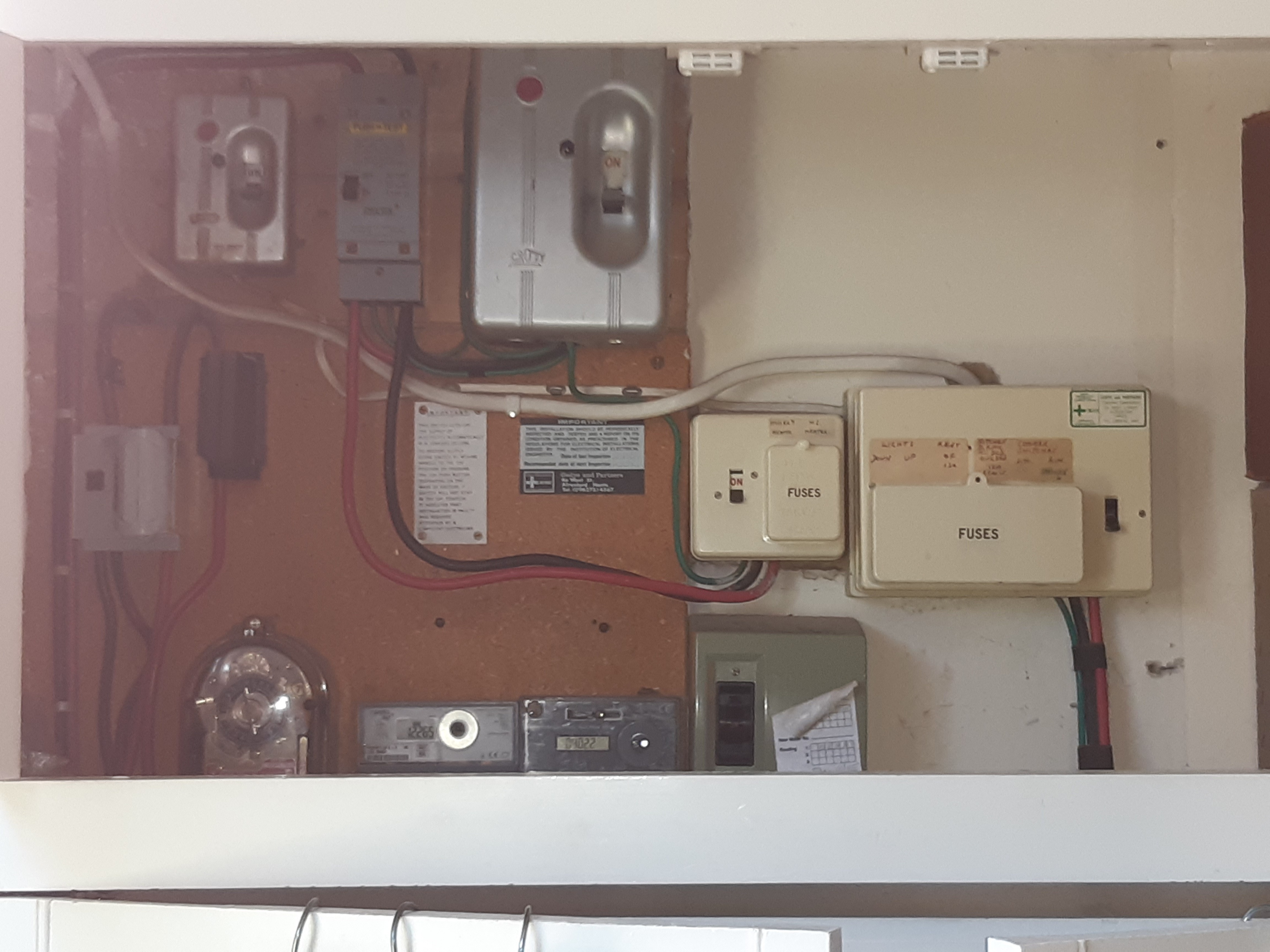
Hey @johnlbrooks - that’s an “interesting” historical electricity fuse-board!
Your initial question is reasonably straightforward, although there are some alternatives to consider.
But the photo raises some other factors which are worthwhile considering… particularly around the area of safety.
We’ve got a great guide to help you figure out who’s responsible for each part of your set up and who to contact when you need to make changes:
Safety of the existing installation
a; The larger silver isolator switch at top centre looks like the mains incomer. We wouldn’t fit that now. Your local Distributed Network Operator (DNO) needs to be asked if they could change this to the usual 100A Service Fuse.
If you don’t know who is your DNO, fill out your Forum Profile and I’ll work it out for you.
b; The green earthing wires are too small. They need replacing with 10mm² green/yellow wire and your earth connection (copper stake?) checked for compliancy. This requires a local electrician. I’m unsure if OVO would be prepared to change you to a Smart Meter unless you had adequate earthing.
c; Your only safety (earth-leakage) trip appears to be on the input to the fusebox feeding the storage radiators. There’s no RCD that I can see on your lighting/power circuits. As the house wiring is old, there’s an higher chance of faulty wiring which could cause damage, but fail to blow the fuse. Not good!
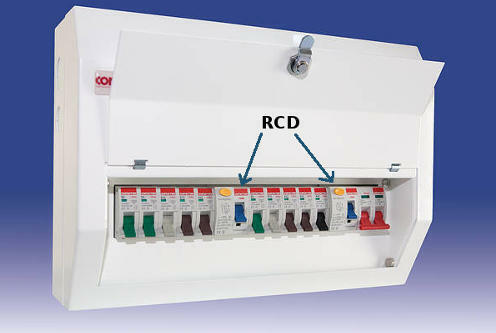
Personally I’d be asking a local electrician to quote for a new “split load” Consumer Unit. These come ready-built with two RCD (safety) trips and a range of MCB trips which replace the present set of fuses.
The Consumer Unit here has ten MCB trips of a mix of different Amp ratings. There is a wide range to choose from. This one I found on the website of the electrical wholesalers, TLC Direct.
For customers wanting to go from Single Rate to Economy 7
We don't currently have the capability to change smart meters from Single Rate to Economy 7, or vice versa. If this capability ever becomes available we’ll update the Forum accordingly so that everyone’s aware.
Hey @johnlbrooks - that’s an “interesting” historical electricity fuse-board!
Your initial question is reasonably straightforward, although there are some alternatives to consider.
But the photo raises some other factors which are worthwhile considering… particularly around the area of safety.
We’ve got a great guide to help you figure out who’s responsible for each part of your set up and who to contact when you need to make changes:
Safety of the existing installation
a; The larger silver isolator switch at top centre looks like the mains incomer. We wouldn’t fit that now. Your local Distributed Network Operator (DNO) needs to be asked if they could change this to the usual 100A Service Fuse.
If you don’t know who is your DNO, fill out your Forum Profile and I’ll work it out for you.
b; The green earthing wires are too small. They need replacing with 10mm² green/yellow wire and your earth connection (copper stake?) checked for compliancy. This requires a local electrician. I’m unsure if OVO would be prepared to change you to a Smart Meter unless you had adequate earthing.
c; Your only safety (earth-leakage) trip appears to be on the input to the fusebox feeding the storage radiators. There’s no RCD that I can see on your lighting/power circuits. As the house wiring is old, there’s an higher chance of faulty wiring which could cause damage, but fail to blow the fuse. Not good!
Personally I’d be asking a local electrician to quote for a new “split load” Consumer Unit. These come ready-built with two RCD (safety) trips and a range of MCB trips which replace the present set of fuses.
The Consumer Unit here has ten MCB trips of a mix of different Amp ratings. There is a wide range to choose from. This one I found on the website of the electrical wholesalers, TLC Direct.
For customers wanting to go from Single Rate to Economy 7
We don't currently have the capability to change smart meters from Single Rate to Economy 7, or vice versa. If this capability ever becomes available we’ll update the Forum accordingly so that everyone’s aware.
Many thanks for your answer and I note your safety suggestions. Unfortunately, I have realised that I left out a couple of facts from my original question.
I’ve marked up my photo with the wiring layout that was previously hidden. The biggest omission is that (I have been told) we have 3-phase power that enters the board at the numbers 1, 2 & 3 in the picture. Those are hefty copper coated wires. The grey and black boxes they enter are 100 amp fuses. To my uneducated eye it looks like phase 3 supplies the off peak system. The heating is fan driven hot air through underfloor ducts from a single large storage block in the centre of the house. The grey box under the smaller fuse box is, I think, a RCD for the lighting/power.
Does any of this alter your views. Many thanks for your patience
Thanks for the clarifications @johnlbrooks and I’m pleased to find someone else who draws on top of photos like I do!
You having 3-phase would account for the size of the isolator box for the house incomer at top-centre. I’m still unsure what is the function of the smaller silver isolator at top-left, but it doesn’t matter for this discussion, so let’s press on.
I’d left out a space in my earlier reply, which meant you couldn’t click on a link taking you to the Topic where @Nancy_OVO mentioned 5-terminal meters. I’ve now re-edited it above, but I want to repeat it again here because it just happens to be within a recent discussion about a house with 3-phase electricity!
For the sake of others reading this at a later date, in John’s photo above, his labels 2 & 3 are the two phases, each entering the top of a 100A Service Fuse. Label 1 is the neutral connection which eventually goes to the larger consumer unit (bottom-right) supplying the main house circuits.
Your ducted hot-air heating sounds wonderful. This is obviously not going to be replaced by few Dimplex Quantum storage radiators! So scrub that suggestion.
The “correct” way to do all this would be to have two separate 45A ALCS devices connecting your heat-storage block and your hot-water immersion heater respectively. Each could then be driven by the Kaluza Platform I mentioned earlier.
Those devices don’t yet exist. But the electronics could readily be derived from the existing V2G charger, currently being trialed in 400 homes in GB.
Sorry, I forgot to respond to the comment about the RCD for the main fusebox.
This may do what’s required of it… assuming it’s rated to trip at 30mA of current imbalance.
However, using a single device like this for the whole house isn’t a great way of providing a protection system which is “friendly”. As it’s presently wired, as soon as a faulty device gets plugged into a socket, the trip operates and plunges the entire household into darkness!
That’s why I was suggesting a split-load consumer unit as a basic minimum.
Thanks for the Profile information. I had (incorrectly) guessed that you were in Scotland based on the type of electricity supply and ducted hot-air heating!
I’ll have a think about the implications of you having gas, but no renewable sources (yet). The best strategy for future energy needs is to spread your usage across multiple devices/sources. I have a hot water cylinder with three different energy inputs for example.
Payback period is quite important at my age! The main reason for wanting E7 is so I can switch supplier freely. Having 2 meters means, as I expect you are aware, that I am stuck with SSE because no other supplier will accept a switch.
OK @johnlbrooks so I’ll try to avoid suggesting strategies with a 20-year payback time!
Do you happen to know the current or power-rating for that central heat-storage block?
I’m wondering if it’s essential to retain two phases, or if it’s possible to run everything from a single-phase meter.
Secondly, you may not now be as “stuck with SSE” as you suppose. As a result of the acquisition, all SSE’s problematic sites have now become OVO’s responsibility!
If one of your existing meters or the time-clock were to fail, they would have to be replaced anyway.
Even if OVO used existing technology and installed one their approved 5-terminal SMETS1 meters, they are scheduled to be upgraded to SMETS2 functionality and migrated across to the National Smart Meter Network as of 28th June.
Thanks @Transparent, The heater is a Creda Comfortaire. I’m slightly confused because according to the rating plate on the heater it is 5 kw off peak, 250 w on peak (which I guess is for the fan), but the service leaflet I inherited from the previous owner says that the minimum model Comfortaire heater is 6 kw! I suppose we go with the rating plate.
I’m not sure exactly what you mean as to not being “stuck”. I understand that OVO have taken over, but surely unless I get a single meter as opposed to two I am now stuck with OVO instead of SSE?
That’s interesting @johnlbrooks - so the Comfortaire has two separate electrical feeds; one for the heater element which is controlled by the off-peak time-clock, and another for the fan, which must remain “live”.
I’d be surprised if it took as much as 250w to run the fan and any associated electronics/sensors. I have a twin-fan MVHR (mechanical ventilation with heat recovery) unit, and that only draws 80w peak.
However, 5kW is pretty small for a whole-house hot-air system. I can understand why it’s fed from a timeclock to enable you to benefit from cheaper-rate electricity. But I have no idea why this would need to be on a separate phase!
To put this in context, most electric shower units would be rated around 10kW and we don’t insist those houses use 3-phase.
Creda is also now a division of Dimplex, who have licensed OVO’s control system for their Quantum Storage Radiators. I wonder if the controller could be made available as a retro-fit to your Comfortaire? You could try emailing them to enquire.
So my current assessment (pun intended!) is that you could ditch one of the phases and have an ordinary single-phase SMETS2 Smart Meter with an Economy-7 tariff.
Just be aware that it is common practice for customers with E7-tariffs to pay a higher-rate per kWh for their standard electricity. So E7 isn’t always viable.
And that’s why I think you might wish to avail yourself of a smart-tariff “layer” over the top of an ordinary tariff. You’d then be fed much cheaper electricity by the Kaluza Platform whenever it bought-in low-priced energy on the wholesale market. And as it’s got weather-forecast input, you’d only be fed enough electricity for the predicted demand over the next 24 hours.
I hope I’m making sense.
Just in case I’ve missed anything, I’m going to tag @PeterR1947 to use his engineering experience on the above recommendations, and correct me as required.