


Rank 1
April 27, 2021
Solved

Big discrepancy between the usage graphs and the actual meter readings

  • April 27, 2021
  • 61 replies
  • 2479 views

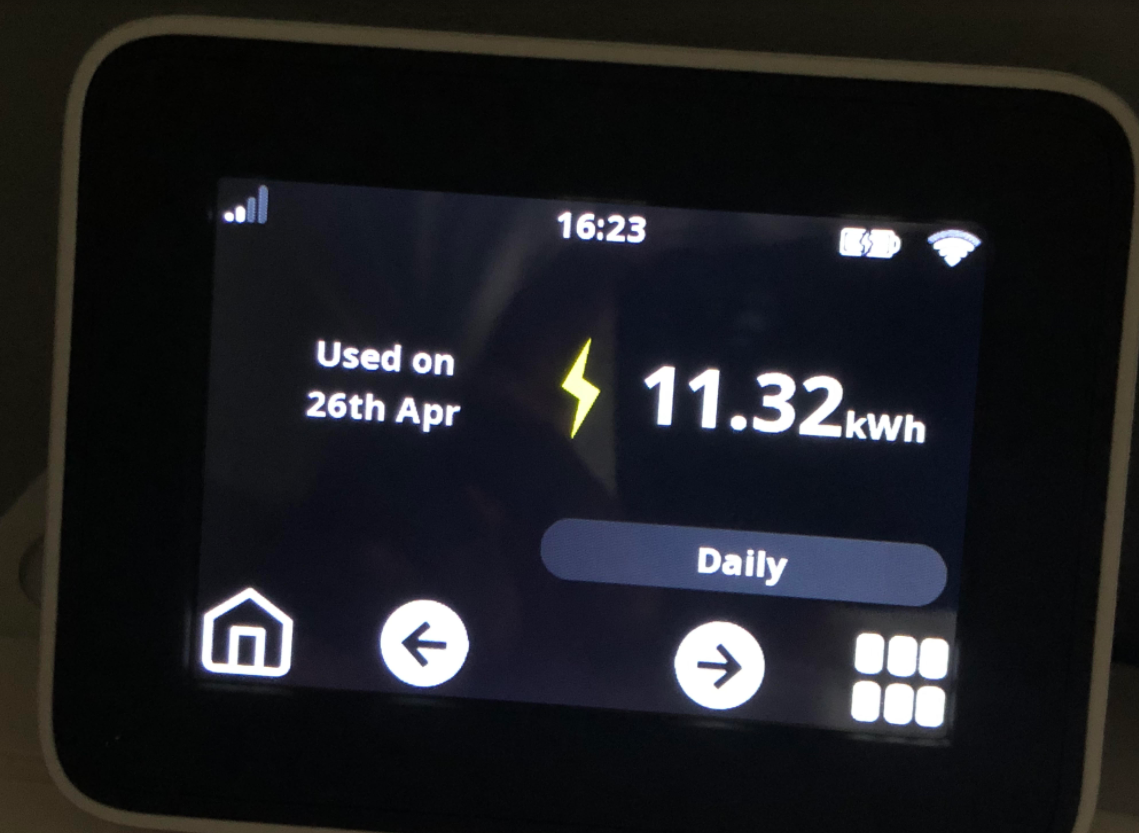
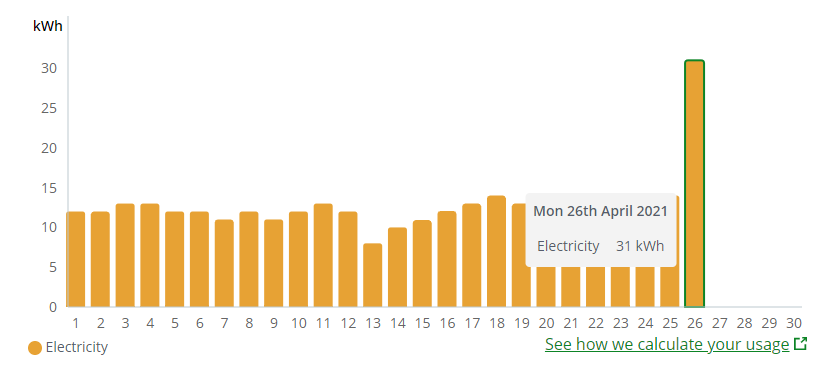
According to the online dashboard, the usage for yesterday is triple to what it was according to the smart meter.

The online dashboard suggests we have used 31kWh yesterday, but the IHD says 11kWh.

Any idea what is going on?

The online portal also suggests we should increase the direct by almost 3 times, but this is not reflected in the actual usage.
 

Best answer by Jess_OVO

Updated on 27/01/25 by Emmanuelle_OVO:


Glad to hear the Support Team were able to explain that the reading schedule of your meters meant the usage data you were seeing was estimated. Hopefully we should have your reading schedule updated soon but in the meantime, the more manual readings you supply the more accurate both your usage graphs and direct debit calculations will be.


There was also a promising response from the development team, to your suggestion the usage graphs could be clearer in terms of showing when the data is estimated -


We’re looking to improve the usage graph in the future, so this is very helpful feedback.:slight_smile:


Keep up the good work of catching bugs and providing feedback! !t really is so valuable to make sure we improve our online tools, making it easier for you to track and reduce your usage. 

61 replies

Jess_OVO
OVO Staff
Jess_OVOSolved
OVO Staff
April 29, 2021

Updated on 27/01/25 by Emmanuelle_OVO:


Glad to hear the Support Team were able to explain that the reading schedule of your meters meant the usage data you were seeing was estimated. Hopefully we should have your reading schedule updated soon but in the meantime, the more manual readings you supply the more accurate both your usage graphs and direct debit calculations will be.


There was also a promising response from the development team, to your suggestion the usage graphs could be clearer in terms of showing when the data is estimated -


We’re looking to improve the usage graph in the future, so this is very helpful feedback.:slight_smile:


Keep up the good work of catching bugs and providing feedback! !t really is so valuable to make sure we improve our online tools, making it easier for you to track and reduce your usage. 

Powered by Re-knowable Energy!
Jess_OVO
OVO Staff
OVO Staff
November 3, 2021


I’m pleased to have this confirmed, @Jess_OVO, but the only information I found online (quoted above) didn’t refer to any regulations strict or otherwise. Would you be able to point me to the regulations that constrain a supplier’s ability to turn off a smart meter supply, please?

(This would let me quote something much more reassuring when the need next arises.)

Thanks in anticipation


I’ve taken this one away to our Smart metering expert who’s advised:

The challenge here is it is not a singular explicit regulatory statement. It is a culmination of clauses and obligations, including monitoring measures where we are required to report on our behaviour and what we've done, within our Licence and the associated Codes.  As part of the Credit Management journey, there is no differentiation allowed for the metering installed. The same rules and processes must be followed for a Smart meter as for a Traditional non smart one, which require us to go down an explicit route. None of which allows a Supplier to remotely 'turn off' a Smart Meter for any reason without providing clear and explicit pre-warnings and that would be due to the customer not topping up and 'self-disconnecting'. This in the Supply Licence Clauses relating to Self Disconnection and Prepayment Meters - which include Smart Meters in Prepayment mode.


Does this help, @Simon1D?

Powered by Re-knowable Energy!
Rank 2
November 3, 2021

Thanks, @Jess_OVO I think it does, although I’ve no intention of reading the linked documents in any detail.

I’m left thinking that it was just a peculiar way for the smartme website to summarise things, giving the impression that suppliers might have had some choice in the matter.

BW

Simon
Blastoise186
Super User
Super User
November 3, 2021

Yeah, I’d agree with the expert as well.

In my personal opinion, any prepayment meter that disconnects supply due to running out of credit automatically falls in the locally triggered disconnection category, since the disconnect was triggered by the meter itself without any input from - or in response to - any external entity.

Admittedly the legacy PAYG+ tariff that Boost used to offer is/was a bit of an edge case due to the nature of how that worked, but the same rules still apply regardless.

Securing energy by zapping security bugs... For that is The Blastoise Way! Remember, I'm just like you - AI Powered Evil Geniuses aren't Staff!
gmmarcinAuthor
Rank 1
November 27, 2021

 (bearing in mind we’d expect your usage to increase over the next few winter months)

Care to expand on why you expect the increase to be so much? So far I am not seeing much, if any at all. Sure, few kWh more in winter for the LED lightining, maybe, but double? I don’t think so. Why do you think you know my usage better that I do?


Jess_OVO
OVO Staff
OVO Staff
November 29, 2021

Generally speaking most households do see an increase in the energy they use at this time of year, given the darker and colder days, @gmmarcin - obviously this is dependent on the way you heat your home as well as the energy efficiency of your lighting and other appliances.


It’s also worth bearing in mind that if you’ve recently joined us or made the upgrade to a smart meter, these usage projections do become more accurate over time. The longer you’re with us and the more usage data we receive from your smart meter, the better we’re able to anticipate your seasonal usage patterns, although these may of course change over time if there’s a particularly colder or longer winter - or you make any home improvements such as upgrading your home’s insulation or heating system.


Have you been using the Direct Debit calculator on your online account to see these projected usage costs?

Powered by Re-knowable Energy!
gmmarcinAuthor
Rank 1
November 29, 2021

So you assume the usage and we all know what assume means.

Rank 2
November 29, 2021

I think even I can read off @gmmarcin’s graph that they joined Ovo in February (the zero usage in January is the clue - or maybe that’s when the smart meter was installed).

To be technical for a moment, if I were fitting a model of usage to that graph, where there was a background constant part plus a seasonal part (more in winter than in summer), the best fit would have essentially no seasonal part. And I can do that in my head. No actual calculation required. It’s “obvious”.

If Ovo is doing anything at all with a customer’s usage data when it estimates DDs, then what it is doing makes no sense whatsoever.

I’m another user whose electricity consumption is essentially flat across the year. It’s also only 10% of my total energy consumption (or was before the old gas boiler was replaced - I’m hoping that gas consumption will fall by ~30% with the new boiler), so to talk in general terms about a user’s “energy” consumption, as @Jess_OVO did, is really to turn a blind eye to what can be a significant factor.

In my case, the figures were roughly:

annual electricity: 3000 kWh

annual gas (water heating): 3500 kWh

annual gas (space heating): 27500 kWh

and my consumption of gas was about 300 kWh per month throughout the summer months.

So, of my 34000 kWh “energy” consumption, the vast bulk of it was confined to the winter months.

Not paying attention to this kind of pattern really really should be a matter of some shame for Ovo.

Simon
gmmarcinAuthor
Rank 1
November 29, 2021

I think even I can read off @gmmarcin’s graph that they joined Ovo in February (the zero usage in January is the clue - or maybe that’s when the smart meter was installed).

To be technical for a moment, if I were fitting a model of usage to that graph, where there was a background constant part plus a seasonal part (more in winter than in summer), the best fit would have essentially no seasonal part. And I can do that in my head. No actual calculation required. It’s “obvious”.

If Ovo is doing anything at all with a customer’s usage data when it estimates DDs, then what it is doing makes no sense whatsoever.

Yes we joined OVO in February and have smart meter installed in March. We gave the annual kWh usage based on our last year with British Gas when joining OVO. So far, we are not far off what we used last year hence I don’t understand why OVO wants to double the DD

Rank 2
November 29, 2021

Yes we joined OVO in February and have smart meter installed in March. We gave the annual kWh usage based on our last year with British Gas when joining OVO. So far, we are not far off what we used last year hence I don’t understand why OVO wants to double the DD

I think it’s for Ovo to offer a credible explanation. I haven’t seen one yet and, until one is offered, all we can do is speculate about the reasons...

Simon