




Firedog
Super User
Super User
February 26, 2024
Solved

Why is my Future Annual Consumption estimate so persistently high?

  • February 26, 2024
  • 86 replies
  • 1895 views

I have just read this passage about FACs in another thread: “… my own experience shows that [the future annual consumption figure] is being based on, (or at least being adjusted based on) actual meter readings. I could see my FAC for gas changing (reducing by large amounts) within minutes of submitting a new meter reading.”

This is what is supposed to happen, if I understand the wording here: Usage projection is a figure produced by our billing system, that uses smart meter readings (if available) to project the usage for you over the next year.

We clearly have a two-tier system: an ineffectual one for smart meter customers, and another better one for everyone else. Those who submit manual readings 'see their FAC changing within minutes.' Those of us with smart meters are apparently subject to a system which can take months to adjust the FAC to actual usage, despite having meter readings recorded automatically every day.

My own (electricity only) FAC got stuck last year after a meter adjustment. I was told last year, as was the Ombudsman, that it would all come right after a meter exchange, which happened in September. There was no change to my FAC until mid-November, when it suddenly started falling from its figure of 2.35 times the actual annual usage. This is how it has progressed, from its stubbornly-maintained figure of 2902.9 where it had been since the previous April:
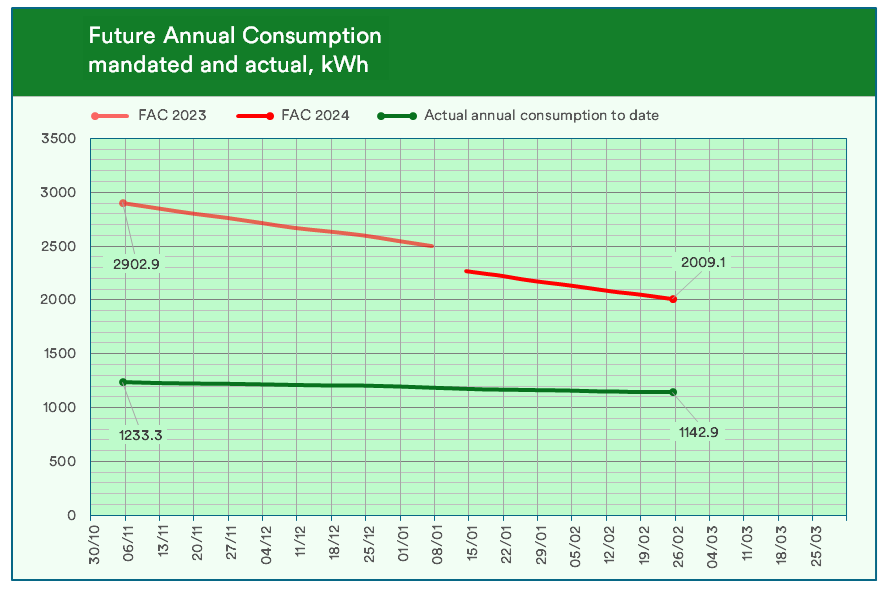


I can't explain the hiatus in early January, unless there was some manual intervention. The figures are updated every Sunday, and occasionally midweek: there have been 16 updates since 5 November. If manual intervention is possible, then there’s no need to rely solely on this clearly flawed system.

I suppose I should be grateful that my FAC is now only 76% higher than my actual consumption for the past year. Excel tells me that if both curves proceed at the same rate, they will eventually meet on 8 August next, just one year after OVO assured the Ombudsman and me that a meter exchange would soon solve the problem.

For those of us with multi-rate tariffs (e.g. Economy 7), there have to be FAC figures for peak and offpeak usage. It’s the ratio between these that determines how economical the tariff is, so it’s also important that this ratio is also accurate. It’s not, for me. Not only is any Direct Debit calculation worthless, but so are projected costs when trying to compare tariffs. 

There is something seriously wrong with the FAC determination if it can't adapt more quickly to actual, readily-available meter-confirmed data as Ofgem mandates and as Tim maintains it should.

Best answer by Firedog

Updated on 15/08/25 by Emmanuelle_OVO:

 I’ve now (courtesy of @ChristopherS_OVO - thanks!) had some actual figures for the calculation of my FAC, and they’re as clear as an early-morning midstream sample. I learnt a few things, though:

  • The EAC is indeed allegedly updated to reflect data shared by the supplier. If that sharing fails for some reason - and it clearly did in my case - the EAC reverts to a default value, subsequently adjusted for whatever data have been successfully shared since the fault. 
  • I can’t for the life of me work out where these default values come from. I’m told they are for a ‘typical E7 user’. So no attempt at all to take into account the factors that Uswitch and comparethemarket say are used to match the EAC to the user’s household [“central industry sources including the Retail Energy Code Company … estimate your consumption over the next 12 months based on a number of factors about your property and based on your property’s historical consumption.Your usage comparison is based on your energy usage compared to other households in your postcode region. Your usage will be affected by a number of factors including the size of your home and the number of people who live there.”]
  • Meter readings are thus used to adjust the EAC from its initial default value, but this can only happen of course if OVO successfully submit readings. This seems to be where the fault is in my case.
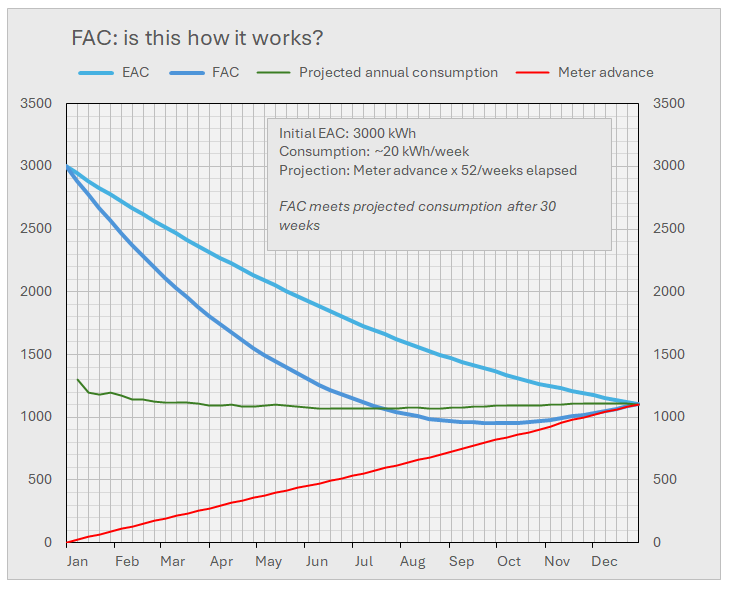
  • OVO then generates an FAC from the current reading and the current EAC, the proportions of each depending on the time elapsed since Week 0. By Week 52, the EAC proportion will be 0 and the meter advance 100%. 
  • It’s impossible for me to work out how the EAC is adjusted when a reading is submitted, but I suspect it’s a similar arrangement.* This being the case, the FAC should approach parity with the meter advance before the year is up. How long before is a mystery, but it’s not likely to be nine months before.
  • I can see no reason why OVO can’t generate a more accurate FAC if it’s clear that the EAC is wrong. OK, this would involve manual intervention, which they understandably try to avoid. However, I’m sure it would have taken much less effort on their part just to do this rather than involve at least five different employees in trying (and failing) to explain why it went wrong for me in the first place.
     

[I just realized after reading this through, though, that this was the sort of approach Fujitsu took when faults appeared in bits of their Post Office Horizon system. I won’t draw any more parallels ...] 


*   If it were a similar arrangement (the EAC value changing pro rata with the meter advance over a fixed period), then we’d end up with a second-order function which would give a parabolic curve if the actual consumption was lower than expected. Something like this (I know how you all love my pretty charts 🙂):


86 replies

Firedog
Super User
FiredogSuper UserAuthor
Super User
October 2, 2024

It is good to know it is sorted and useful to know it has taken a year. That is useful when giving feedback to posters given the typical shorter time quoted by ovo when I use to regularly post. 


@Jeffus It’s only taken a whole year for me because of a fault: OVO has been making a mistake when submitting my meter readings to Elexon which arose from changes made to the meter configuration. This only became clear a few weeks ago.

Normally (if there is such a concept!) the EAC will start at a default figure based on TDCVs, ostensibly modulated by household conditions. It’s then adjusted each time new readings are submitted, so it should fairly rapidly approach a realistic value. I’m afraid the complexities of the calculations are quite overwhelming for me, so I couldn’t quantify ‘rapidly’. Each new EAC is then incorporated into OVO’s FAC calculation simply by taking the two quantities - meter advance and EAC - and adding them together pro rata. After n weeks, the FAC will be

  • FAC = meter advance x n/52 +  EAC x (52-n)/52. 

So obviously at the end of a year, the EAC is no longer involved. Without knowing how the EAC varies with meter advance as notified, it’s impossible to say how quickly the FAC would approach the actual annualized meter advance. 

Noel | I have no official status; I'm just a volunteer who comes here to help other customers. My gear: Aclara SGM 1416-B Electricity-only E7 meter; Chameleon IHD3-PPMID-AAA | It may look as if I know what I’m talking about, but don’t let that fool you. |
Nukecad
Super User
Super User
October 2, 2024

Just out of interest.

After sending a new gas meter reading yesterday my FAC for gas increased within minutes by 8 kWh.

Today, and all by itself, it has gone down again by the same 8 kWh.

I'm not even going to try figuring that one out, 8 kWh is nothing compared to some of the MWh ups (and downs) that I have seen

I said, Hey - Watts going on.
Rank 2
June 14, 2025

We recently had a smart meter fitted as our bills were showing we using a gas at the level of a medium size business.  They have informed us that our meter had a fault and billing our now dealing with the over payments.  But we have also been told that our debt to the Company has been reported to the credit reference agent and we are on a list relating to struggling to pay.  

We are paying what we use monthly which is £100 a month but there systems are still stating we should be paying £600 a month! They don’t communicate with us, we phone we get told something different every time and is now been 13 weeks since they started their investigation.  The last we were told they were resetting our balance to 0 as we owe nothing.  But we feel like we are being treated like criminals and this balance reset is at present taken 3 weeks and still the same.


Complaints are hopeless as well, the complaint we made was just closed and we were never told. 


What can we do as it’s unfair that a credit is being ruined for their errors and we are not struggling we are paying what we use and rest is invalid.  The untold stress this is putting on us is crazy.


Blastoise186
Super User
Super User
June 14, 2025

Hi ​@Elwell1624 ,

@Nukecad is more experienced than I am at this particular situation so I’ll give him a heads up.

Securing energy by zapping security bugs... For that is The Blastoise Way! Remember, I'm just like you - AI Powered Evil Geniuses aren't Staff!
Nukecad
Super User
Super User
June 14, 2025

Hi ​@Elwell1624 ,

As a customer myself then obviously I can't comment on what is happening with sorting your account balance out.

What I can comment on is tes situation with the Credit Score.

Being practical the credit scores are a bit of a marketing con.
They were originally meant to give loan companies an idea of if you could pay them back if they gave you a loan, nothing more than that.

The way the score works is that more credit you take out and pay back the higher your score gets.
That's right, you get a higher score for borrowing more and paying it back.
(That's how those 'Credit Builder' credit cards work, you borrow money on the card and pay it back, up goes your score).
So a millionaire who never uses credit will a very LOW credit score.

The problem is that people other than loan companies started using them for other things than just loans.
Nowadays having a low credit score can affect other things,  things like getting a mobile phone contract, a Broadband or TV Service deal.
At the more ridiculous end of the scale some private landlords use them to ‘judge’ if you can affort to rent a property. (Hard luck Mr millionire, your Credit Score isn’t good enough for you to to rent my flat).

Being Practical:
You should contact the Credit Score company/companies involved and raise a dispute about the alleged debt.

For how to do that see: https://www.experian.com/blogs/ask-experian/credit-education/faqs/how-to-dispute-credit-report-information/

and/or: https://help.clearscore.com/hc/en-us/articles/4410540829970-How-can-I-correct-information-in-my-credit-report

The Score company should mark that clearly so that anyone asking for and referring to your credit score can see that it's disputed.

Once the 'on paperwork' debt no longer exists then your dispute is over then the supplier should inform the Score company that the debt no longer exists and it will be removed from your score.

PS. I have been through that with my own Credit Score, which is how I know what to do.
I have to be honest though and say that if something simialr happend again I probably wouldn’t bother about the Credit Score. (There again I’m not expecting to be wanting any new loans or similar).


I said, Hey - Watts going on.
Emmanuelle_OVO
Retired Moderator
Retired Moderator
June 16, 2025

Hey ​@Elwell1624,
 

Really sorry to hear this, 


The financial support team should be able to put a hold on your account receiving these kind of communications. The number is 0800 069 9831. They’re open Monday to Friday 9am-5pm. If the meter is deemed faulty and once the faulty meter exchange has been completed we will be able to re-bill your account, factoring in the results of the MAT test. We do not recalculate the removal reading if the meter is confirmed as slow. 


Inaccurate Meter

  • If you believe your meter is clocking too fast or too slowly you can arrange to have a meter accuracy test (MAT) or an OFMAT for gas. There is a charge for the test which is refunded if the meter is proven to be faulty. The charges are £198 for MAT or £198 for the OFMAT. More info on costs here

  • If a meter accuracy test has determined that a meter is clocking too fast by at least 2.5% or slow by at least 3.5% we will need to complete a faulty meter exchange. Please note that for OFMATs, the gas meter is replaced as part of the OFMAT appointment.

  • If the meter is deemed faulty and once the faulty meter exchange has been completed we will be able to re-bill your account, factoring in the results of the MAT test. We do not recalculate the removal reading if the meter is confirmed as slow. 

Renewable Energy? Big Fan.
Newcomer
October 3, 2025

I have been trying to understand the exorbitant direct debit amount OVO are requesting, did some research on here to understand FAC/EAC and have come to the conlusion that something is seriously wrong.

Picking through the noise online about customer being asked for huge increases when they are on track and in credit at least shows I’m not alone.

I have a smart meter submitting readings every 30 minutes, I’m always in credit and have hit the £1000 limit twice because I use more in the summer than the winter and OVO can’t handle it.

At the start of the summer I upped my DD to £150 to cover the cost of my hot tub only to find OVO dropped it down to £70 3 days later.

I called and explained that would not be enough as my planned costs were going up and eventually they let me change it back to £150.

Summer is over, I’m still in credit, the hot tub is packed away for the winter and I’m ready to drop my DD back down to something sensible, but OVO are demanding £215. Best they would do over the phone was £183 - still 40% over actual cost.

Now I have found their Future annual consumption figure as listed in your “plan” shows a 20% increase in consumption from last year even though we’re all cutting back, fitting LED lights, using airfriers and my actual usage is down.

OK, summers over, my September consumption is much lower than June, July, August so I’m watching their Future annual consumption expecting it to start droping and low and behold - today it went up another 200kw

For the life of me I can think of no reason for this increase other than greed.

OVO - every person I have spoken to has been first class, helpful and understanding, but your underlying systems and algorithms are flawed.

I am not your personal cookie jar. 


Firedog
Super User
FiredogSuper UserAuthor
Super User
October 3, 2025

The Direct Debit calculation is a simple one, designed to fit for most customers. It aims to even out payments over a longer period, precisely to avoid the scenario you seem to be trying to force it into: “At the start of the summer I upped my DD to £150”, then “Summer is over, I’m still in credit and …  I’m ready to drop my DD back down to something sensible”. Your usage pattern is not a normal one, but that doesn’t mean that even payments over a longer period wouldn’t make sense and help with budgeting.

Now, OVO’s DD calculator bases some of its figures on an assumed month-to-month usage pattern, which presumably matched a typical household’s at some stage. This determines the almost-sinusoidal shape of the Cost bar chart, with higher usage in the winter and lower in the summer. It expects almost 60% of a year’s electricity to be consumed in the period October-March, which could explain why the calculator now recommends a significant increase in your DD (a) to match the higher FAC, (b) to pay for 60% of the cost of this FAC between now and the end of March, and (c) to cover the recently-mandated enhanced credit balance required at that stage.   

The Future Annual Consumption figure isn’t so easy to tie down. For the first year after a meter exchange, it may be wildly inaccurate, because it isn’t based on any historical data. Once the meter has passed its first birthday, the FAC should approach the total consumption over the previous twelve months pretty closely.

You say that your FAC has just increased by 200 kWh. I’d like you to extract some meter readings from your online account:

  1. on the day you noticed this increase; 
  2. on the day when you last saw the figure 200 kWh lower;
  3. on the same date as (1) a year earlier;
  4. on the same date as (2) a year earlier.

(1) - (3) will give you a recent figure for annual consumption. (2)-(4) will give a different one, and the difference between the two annual figures should be close to the change in FAC.  Is it?

Noel | I have no official status; I'm just a volunteer who comes here to help other customers. My gear: Aclara SGM 1416-B Electricity-only E7 meter; Chameleon IHD3-PPMID-AAA | It may look as if I know what I’m talking about, but don’t let that fool you. |
Newcomer
October 4, 2025

You’re missing the point.

“The Direct Debit calculation is a simple one, designed to fit for most customers

“OVO’s DD calculator bases some of its figures on an assumed month-to-month usage pattern, which presumably matched a typical household’s at some stage. This determines the almost-sinusoidal shape of the Cost bar chart, with higher usage in the winter and lower in the summer.”


Summer = immersion for hot water plus the hot tub at around £2 a day.
Winter = solid fuel providing all the hot water I could ever need and the hot tub is packed away.

My usage is higher in the summer and lower in the winter so I do not fit the standard profile.

The algorithm is broken.

Firedog
Super User
FiredogSuper UserAuthor
Super User
October 4, 2025

I quite understand that your usage pattern differs from that of most customers. The Cost bar chart I was referring to is the one on the DD Calculator page. If this shows a full year, it indicates the seasonal adjustment OVO makes to the figures. These are the underlying data:
  

The typical consumer can expect to use 10.6% of
the annual consumption in January and 6.3% in June. 

This typical profile doesn’t affect the size of the recommended DD. That depends only on the FAC and the current balance (and known-cost bolt-ons, if any). 

What did your comparison of annual consumption figures before and after the 200 kWh increase reveal?

Noel | I have no official status; I'm just a volunteer who comes here to help other customers. My gear: Aclara SGM 1416-B Electricity-only E7 meter; Chameleon IHD3-PPMID-AAA | It may look as if I know what I’m talking about, but don’t let that fool you. |