Our Aclara SGM1416-B was fitted on Friday 6th June 2025. Nick F was excellent, and answered all our many questions. In this remote Argyll location we have no radio control signal, but we do have O2 4G and the WNC UBC-TN6 SKU1 connects to it. So all the worries that I've picked up from reading this forum evaporated.
One puzzle is that off-peak switches on/off 10 minutes after the tariff changes. I know that the switching time needs to vary a bit in an area to prevent massive changes destroying transmission gear, but I thought that the signal change would coincide with the tarrif change.
The IHD (IHD3-PPMID-AAA type 1) shows the tariff changing at exactly the times listed for Economy 10, eg 2:30pm and 5:30pm, but the storage heating switches 10 minutes later.
So we are charged too much for 10 minutes. I know this may not add more than about £50 a year, but it’s a niggle. Is it likely to synchronise as the system settles down?
This is irregular, and I wonder whether it might not settle down eventually. The randomized offset - unique to every meter - is there to prevent shocks to the network caused by many power-hungry devices - like storage heaters - being switched on at the same instant. It is supposed to act on both the tariff switching timetable and the auxiliary load control switch (ALCS) timetable, so they should be perfectly synchronized so long as they’re set to the same timings.
I’d suggest having a look at the meter itself to check when the tariff changes. You may have to experiment a bit with the buttons to find out just how yours is set up, because the menu options are configurable, so your menus won’t necessarily be the same as anyone else’s. On my own Aclara SGM 1416-B, repeated presses of orange button B eventually reveal a screen headed Active TOU Number, giving the number of the active tariff register. This will change from 1 to 2 and back as the tariff changes.*
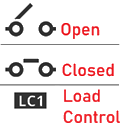
Another indicator is in the bottom right-hand corner of the display, two little icons labelled (on my own meter) ı and ıı. The upper one shows the state of the internal contactor for the constant (always-on) circuit. The lower one is for the switched-circuit contactors.
The upper one (ı) should always be closed unless the power has been cut. The lower one should be open during peak hours. During offpeak hours, it will not show open. What it does show depends a bit on how the internal switches are configured; on my meter, when offpeak kicks in, I see LC1 LC2 indicating that both the 100A contactor for the storage heaters and immersion heater and the 2A switch for a (non-existent) external contactor are closed.
So, having established that your switched circuit is energizing at ~10 minutes past the nominal time, you should watch the meter display screen from a minute before the nominal switching time to ten minutes later. You should see both indicators - the Active TOU Number and the load control switch icons - change simultaneously.
If they don’t, I’d suggest you take a clear photo of the meter, with the display screen illuminated and showing the Active TOU Number and the lower load control icon in the wrong state. The picture should include the Meter Serial Number (MSN, which is the number starting with the two-digit year of certification followed by an ‘M’) and - if you can work out how to do it - with a watermark giving the precise time and date. You then have some concrete evidence to present to the smart team if the meter doesn’t start behaving itself in a day or two. I’d expect the IHD to fall into line eventually, too.
* The meter should have been configured to record peak consumption on register tier 1 and offpeak on tier 2. This should be the default nowadays, but it’s always possible that a meter is misconfigured in this respect. Please check carefully that the Active TOU Number is 1 during peak hours ...
@dutyhog Hope you are well and apologies for taking a few days to get back to you.
Everything is functioning as it should! Youve got a random offset applied to the meter to turn on the ‘extra load’ 575 seconds after coming into and out of the off peak window (Youll hear the loud clunk on the meter when it starts/ends), everything fed by the meter will be at the lower rate at this time.
Your IHD isn’t as smart as the meter and will show when you enter the off peak timeslots but without the delay of 575 seconds, so bear that in mind when look at the IHD.
It seems that the IHD does it's own timing for peak and off peak periods then and is not actually reflecting the status of the smart meter which applies a random time offset. That is a useful bit of information to know.
Reducing my yearly fossil fuel usage with an EV (-900 litres petrol saving about £950/year), A2AHP (-8,700 kWh gas, cost neutral) and Timed Immersion heater (-1,500 kWh gas, £20/year more expensive but reducing as the gas price goes up)
I’m wondering about that message Tariff rate will change. Of course there will always be a tariff change ahead, so could it be that the message only shows in the period from 60 minutes before the nominal change time to the end of the randomized delay? I’m sure I’ve seen other customers documenting a change of tariff on the IHD at the end of the delay. The countdown scale is also showing that the change is n minutes ahead, perhaps 1<n<10.
It’s annoying if the IHD can’t be relied on to indicate when it’s safe to have a shower or when it’s time to turn the oven off.
Noel | I have no official status; I'm just a volunteer who comes here to help other customers. My gear: Aclara SGM 1416-B Electricity-only E7 meter; Chameleon IHD3-PPMID-AAA | It may look as if I know what I’m talking about, but don’t let that fool you. |
It seems odd that the IHD hasn't been programmed to read the tariff that the meter will display. I can’t imagine that there isn't enough capacity to transmit, receive and store the small amount of extra data (unlike all those years ago when, with slow computers and little memory, I needed to write and endlessly debug machine code rather than high-level languages to run a machine).
Firedog: The countdown seems to start 60 minutes before the nominal change rather than the actual. The displayed 10 minute steps makes it a bit vague.
We’ll just live with the offset, and treat the IHD indication of the tariff changing as early warning to switch things on or off if convenient.
... I needed to write and endlessly debug machine code rather than high-level languages to run a machine) ...
Machine Code. Luxury! We used to dream of writing machine code. We used to have to manually punch cards and feed them into a card reader and hopefully not chew them up.
That was actually true in my case for an Elliot 803. The kids today don't know how lucky they are …😃
Peter
Reducing my yearly fossil fuel usage with an EV (-900 litres petrol saving about £950/year), A2AHP (-8,700 kWh gas, cost neutral) and Timed Immersion heater (-1,500 kWh gas, £20/year more expensive but reducing as the gas price goes up)
Peter, this is turning into a Monty Python Yorkshiremen boasting session. I often used a slide rule until about 1978, but started computing in 1962 with 5-hole paper tape. A company I was in had an IBM stand-alone computer around 1972 with card input. I thought that cards were a big step up. The deal was that you joined a queue with your stack of cards in your hand. When your turn came you put it into the reader and watched it run, and finished when it did the job, or more often crashed. The next person in the queue was always keen to get on. You may have had to wait hours before getting back on again. I wrote a program that could have needed to run for a week, and managed to hog the computer for hours by making it pause often to let me read the printout to change parameters by shuffling into the input pack cards with altenative code or data that I'd prepared in advance to cover many eventualities. Fortunately it only needed a couple of hours to get an answer, good enough to provide a patentable design that solved a big problem. Nowadays I suppose it would take seconds on a Raspberry Pi with an SD card for storage. Or even maybe a spreadsheet could do it?
I've just paused to see if GPT-4o mini could show me a design to solve the problem. In seconds it came up with an answer with full details and explanation. My patent deliberately hadn't given all that useful detail. Maybe it got it from someone who found the answer since 1972 and published it. Maybe it guessed because it looks as though it may be wrong - I’ll check tomorrow.
It just astonishes me that we had punched cards in 1970 and we have AI chatbots today. What is really different is that computing is so embedded in our lives, could we do anything without them?
Reducing my yearly fossil fuel usage with an EV (-900 litres petrol saving about £950/year), A2AHP (-8,700 kWh gas, cost neutral) and Timed Immersion heater (-1,500 kWh gas, £20/year more expensive but reducing as the gas price goes up)
Paper tape? 1962? Sounds like EDSAC2, where I cut my computing teeth in 1965. Any task running for more than three minutes was unceremoniously terminated, but even so the queues for tape readers were long:
I graduated to new-fangled punched cards in a later incarnation, but I remember the violent repercussions when one of our number surreptitiously removed just one little card from our unloved head of department’s 3-ft high stack of cards constituting his magnum opus.
Noel | I have no official status; I'm just a volunteer who comes here to help other customers. My gear: Aclara SGM 1416-B Electricity-only E7 meter; Chameleon IHD3-PPMID-AAA | It may look as if I know what I’m talking about, but don’t let that fool you. |
This thread really has drifted to old codgers’ stories.
I had a summer holiday job at a scientific equipment manufacturer in N London in 1960. We made a primitive calculator/computer for on-line correction of output data from a spectrograph used in the steel industry. It used Dekatron tubes for program and data storage, and displaying the results. I liked them. They were fancy valves, which displayed the result on one end of the tube and counted in tens, just as humans do - none of that tedious binary nonsense. It was a very simplified version of the 1951 Harwell Dekatron (now WITCH, and at Bletchley). The most useful thing I learned from that, apart from how difficult it is to automate quite simple human activity, was knowing the colour codes on electronic components - which I've now forgotten!
In 1963 I sent punched tapes to a Lyons teashop computer, LEO (Lyons Electronic Office), to do statistics on my large amount of experimental data. It did work.
In 1964 I joined a Glasgow company that had just made (and sold) the first computer built in Scotland (Solidac). Years later they got it back and used it for a while. It was beautiful to see in its dark waxed wooden casing. Someone wrote “it looked like something from a 1950s scifi movie. A big analog clock on the front, filament lamps, and a black knob you could turn to adjust the clock speed. The circuit boards were in drawers like those on an old filing cabinet. You could flip through them. Discrete components, so things like flip-flops were made from individual transistors and passives.Standing nearby was a heavy cast-iron paper tape unit. The tape was five-hole, like early Colossus.”
It took me until about 1969 to get my hands on really useful computers - ones that didn't almost always crash, or reply with error messages 99% of the time. The only “programming” I’ve done since 1993 is hand code html and css for web sites.
This thread drift is getting more old codgers tales.
I had a summer holiday job at a scientific equipment manufacturer in N London in 1960. We made a primitive calculator/computer for on-line correction of output data from a spectrograph used in the steel industry. It used Dekatron tubes for program and data storage, and displaying the results. I liked them. They were fancy valves, which displayed the result on one end of the tube and counted in tens, just as humans do - none of that tedious binary nonsense. It was a very simplified version of the 1951 Harwell Dekatron (now WITCH, and at Bletchley). The most useful thing I learned from that, apart from how difficult it is to automate quite simple human activity, was knowing the colour codes on electronic components - which I've now forgotten! In 1963 I sent punched tapes to a Lyons teashop computer, LEO (Lyons Electronic Office), to do statistics on my large amount of experimental data. It did work. In 1964 I joined a Glasgow company that had just made (and sold) the first computer built in Scotland (Solidac). Years later they got it back and used it for a while, including for generating music. It was beautiful to see in its dark waxed wooden casing. Someone wrote: “it looked like something from a 1950s scifi movie.A big analog clock on the front, filament lamps, and a black knob you could turn to adjust the clock speed. The circuit boards were in drawers like those on an old filing cabinet. You could flip through them. Discrete components, so things like flip-flops were made from individual transistors and passives.Standing nearby was a heavy cast-iron paper tape unit. The tape was five-hole, like early Colossus.” It took me until about 1969 to get my hands on really useful computers - ones that didn't almost always crash, or reply with error messages 99% of the time. The only “programming” I’ve done since 1993 is hand code html and css for web sites.
I have enjoyed following this thread, not just because I too am an old codger (punched-card vintage), but also because I have just had my THTC meter arrangement changed for an E10 smart meter, last Friday, 18th July - see photo. My location is Lochalsh, MPAN 17.
The installation went smoothly, and appears to be functioning correctly, though I have yet to see any changes on the OVO platform. The SW, WAN, and HAN lights are all flashing correctly at 5s intervals. My new installation is identical to @dutyhog’s in all significant respects, and I too see a discrepancy between the meter TOU changeover and the tariff change on the Chameleon IHD. In my case the discrepancy is only about 4 minutes, so not as significant.
What is vexing me at the moment is the question of what cellular technology is being used in both these installations. In this forum thread, and in others, I see the 'SKU1 cellular' communications hub, and 4G mentioned in the same breath. However, after some research, I came across some DCC specifications (see here, section 3.2.3), which would seem to indicate that an SKU1 hub is mandatorily 2G/3G. If this is indeed the case, then this would seem to be a rather retrograde step by OVO as both technologies are due to be retired by 2033 (3G even earlier, I believe). I don't relish the prospect of having the same hassles as with the RTS shutdown, in getting the comms module replaced when that switch-off happens. Particularly so, as I have a perfectly good 4G signal. Perhaps some of the more expert forum members can comment on whether I am right to be concerned.
I suppose I should be grateful to have a working smart meter even if it is using "punched card" technology.