Our Aclara SGM1416-B was fitted on Friday 6th June 2025. Nick F was excellent, and answered all our many questions. In this remote Argyll location we have no radio control signal, but we do have O2 4G and the WNC UBC-TN6 SKU1 connects to it. So all the worries that I've picked up from reading this forum evaporated.
One puzzle is that off-peak switches on/off 10 minutes after the tariff changes. I know that the switching time needs to vary a bit in an area to prevent massive changes destroying transmission gear, but I thought that the signal change would coincide with the tarrif change.
The IHD (IHD3-PPMID-AAA type 1) shows the tariff changing at exactly the times listed for Economy 10, eg 2:30pm and 5:30pm, but the storage heating switches 10 minutes later.
So we are charged too much for 10 minutes. I know this may not add more than about £50 a year, but it’s a niggle. Is it likely to synchronise as the system settles down?
This is irregular, and I wonder whether it might not settle down eventually. The randomized offset - unique to every meter - is there to prevent shocks to the network caused by many power-hungry devices - like storage heaters - being switched on at the same instant. It is supposed to act on both the tariff switching timetable and the auxiliary load control switch (ALCS) timetable, so they should be perfectly synchronized so long as they’re set to the same timings.
I’d suggest having a look at the meter itself to check when the tariff changes. You may have to experiment a bit with the buttons to find out just how yours is set up, because the menu options are configurable, so your menus won’t necessarily be the same as anyone else’s. On my own Aclara SGM 1416-B, repeated presses of orange button B eventually reveal a screen headed Active TOU Number, giving the number of the active tariff register. This will change from 1 to 2 and back as the tariff changes.*
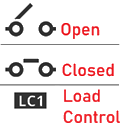
Another indicator is in the bottom right-hand corner of the display, two little icons labelled (on my own meter) ı and ıı. The upper one shows the state of the internal contactor for the constant (always-on) circuit. The lower one is for the switched-circuit contactors.
The upper one (ı) should always be closed unless the power has been cut. The lower one should be open during peak hours. During offpeak hours, it will not show open. What it does show depends a bit on how the internal switches are configured; on my meter, when offpeak kicks in, I see LC1 LC2 indicating that both the 100A contactor for the storage heaters and immersion heater and the 2A switch for a (non-existent) external contactor are closed.
So, having established that your switched circuit is energizing at ~10 minutes past the nominal time, you should watch the meter display screen from a minute before the nominal switching time to ten minutes later. You should see both indicators - the Active TOU Number and the load control switch icons - change simultaneously.
If they don’t, I’d suggest you take a clear photo of the meter, with the display screen illuminated and showing the Active TOU Number and the lower load control icon in the wrong state. The picture should include the Meter Serial Number (MSN, which is the number starting with the two-digit year of certification followed by an ‘M’) and - if you can work out how to do it - with a watermark giving the precise time and date. You then have some concrete evidence to present to the smart team if the meter doesn’t start behaving itself in a day or two. I’d expect the IHD to fall into line eventually, too.
* The meter should have been configured to record peak consumption on register tier 1 and offpeak on tier 2. This should be the default nowadays, but it’s always possible that a meter is misconfigured in this respect. Please check carefully that the Active TOU Number is 1 during peak hours ...
@dutyhog Hope you are well and apologies for taking a few days to get back to you.
Everything is functioning as it should! Youve got a random offset applied to the meter to turn on the ‘extra load’ 575 seconds after coming into and out of the off peak window (Youll hear the loud clunk on the meter when it starts/ends), everything fed by the meter will be at the lower rate at this time.
Your IHD isn’t as smart as the meter and will show when you enter the off peak timeslots but without the delay of 575 seconds, so bear that in mind when look at the IHD.
Hello Firedog - here’s a time-stamped photo of the meter at 11:59 today during a peak period, TOU 1. It seems to be set up like your description (apart from no LC1 etc yet). Unfortunately the screen is very scratched, especially over the switch icons, so it’s difficult to light it well. But you can see that the switching is as expected.
From it’s number it seems to be an old meter - 2021 - maybe it’s been used before?
Thanks. That’s just what I was hoping for. I know that there have been supply problems with Aclara meters, so it may be that they’re having to resort to installing refurbished ones. It’s a bit surprising that you got one with a damaged screen, though. So long as the meter keeps communicating both with OVO and your IHD, you might never need to look at the meter again once we’ve got this present wrinkle ironed out.
Now you know what’s required, you have to check whether the two timetables (the tariff switching schedule and the ALCS calendar) are aligned as they should be or not. When you spot the icon change, it’s a good idea to note the exact time. This won’t ever change unless there’s a significant shift in the meter’s clock, so you know when it’s safe to turn on power-hungry stuff like electric showers and tumble dryers - even hoovers. Running these at offpeak rates can save a lot of money over a year.
Noel | I have no official status; I'm just a volunteer who comes here to help other customers. My gear: Aclara SGM 1416-B Electricity-only E7 meter; Chameleon IHD3-PPMID-AAA | It may look as if I know what I’m talking about, but don’t let that fool you. |
I like this one and will do some digging but regardless of what the IHD say the Tariff timings will be set by the meter so if there is an offset it should be charged correctly! Im now going to go into the rabbit hole with this one.
OVO Operations Excellence Manager and Former Field Operations Team Leader
Here’s a sequence of time-stamped photos taken around the start of the afternoon Economy 10 off-peak period. There’s a nominal 1430 switch on. Again the IHD showed the tariff going down to 22.28p at about 1430. The storage heaters came on 10 minutes later. But the meter showed TUO 1 at 1439 then TUO 2 at 1440, confirmed by the botton RHS symbols. So it seems that the meter is OK, therefore my billing should be OK. I’ll find out how it goes around 1730 (probably 1740) when it should switch back again.
That is quite brilliant, so thank you so much for taking the trouble to document the changeover. Assuming the other time slots show the same behaviour - and I can’t imagine why they shouldn’t - the only fault left seems to be the IHD’s tariff-change timing. That may come right in due course, but it’s not in any way critical. If it’s still out of whack when the installation is six weeks old, ask Support to update its tariff configuration.
We haven’t mentioned hot water. I rather assume that you have an immersion heater, wired to the same switched circuit as the storage heaters. If there is a local control by the hot water tank that restricts its normal heating schedule, check that this too matches the new tariff switching times. It may not be necessary to have the immersion heater on for more than the early morning slot (05:39-08:39), so watch out for waste there. If you have an electric shower, be sure to use it only during offpeak hours.
One last comment, in response to your original post’s “I thought that the signal change would coincide with the tarrif change.” The timings are all set in the meter on installation, so there is no relying on a signal to switch anything like RTS did. A couple of times a night, OVO will connect to the meter and ask it to send meter readings and usage data. Unless the meter needs an update (e.g. when tariffs change), this is about all the traffic that the meter will be involved in.
Noel | I have no official status; I'm just a volunteer who comes here to help other customers. My gear: Aclara SGM 1416-B Electricity-only E7 meter; Chameleon IHD3-PPMID-AAA | It may look as if I know what I’m talking about, but don’t let that fool you. |
Thanks again, Firedog, for the very helpful responses. For completeness here are the photos over switching back to peak tariff. You can see the IHD changing from off-peak to peak rate at 1730, then the meter showing heating connected and active tariff 22.28p (I was too slow and missed the TOU) at 1738, then heating off and TOU 2 at 1739.
I'll try to be patient and wait 6 weeks now for it to sort itself out.
I didn't want to complicate the issue with mentioning hot water. The water tank has a bottom immerser with an off-peak connection and an upper immerser always on for boost. The latter was always off-peak with the THTC meter, but not now. We have a passive solar water heater (Solartwin with its own PV panel for its pump and controller) and tended to use that when possible rather than the bottom immerser, plus the boost at times. After 17 years its heat-absorbing rubber hose sprung a leak inside the panel, and I intend to get it off the roof and replace it. That investment should pay for itself within a year.
Thanks again. I think you can take comfort from the meter’s “Active Tariff Price 22.280 p Per kWh” at 17:38:32 and expect to be billed at offpeak rates for all usage during the precise offpeak hours you’ve now identified.
You might have a look at alternative tariffs; I see that there is currently a one-year fixed Economy 10 price offering with significantly lower unit rates but higher (£12 p.a.) standing charge. The Simpler Energy rates will fall next month, so you can have fun trying to make meaningful comparisons. If you visit switch.ovoenergy.com, you may be able to get E10 quotes, in which case they will be using the rates due to enter into force on 1 July.
(I keep thinking of more things to say ...) I’m fairly sure the switching times are set in UTC, so they will all change when summertime ends on 26 October to one hour earlier than today’s.
Noel | I have no official status; I'm just a volunteer who comes here to help other customers. My gear: Aclara SGM 1416-B Electricity-only E7 meter; Chameleon IHD3-PPMID-AAA | It may look as if I know what I’m talking about, but don’t let that fool you. |
@dutyhog Hope you are well and apologies for taking a few days to get back to you.
Everything is functioning as it should! Youve got a random offset applied to the meter to turn on the ‘extra load’ 575 seconds after coming into and out of the off peak window (Youll hear the loud clunk on the meter when it starts/ends), everything fed by the meter will be at the lower rate at this time.
Your IHD isn’t as smart as the meter and will show when you enter the off peak timeslots but without the delay of 575 seconds, so bear that in mind when look at the IHD.
OVO Operations Excellence Manager and Former Field Operations Team Leader