Our Aclara SGM1416-B was fitted on Friday 6th June 2025. Nick F was excellent, and answered all our many questions. In this remote Argyll location we have no radio control signal, but we do have O2 4G and the WNC UBC-TN6 SKU1 connects to it. So all the worries that I've picked up from reading this forum evaporated.
One puzzle is that off-peak switches on/off 10 minutes after the tariff changes. I know that the switching time needs to vary a bit in an area to prevent massive changes destroying transmission gear, but I thought that the signal change would coincide with the tarrif change.
The IHD (IHD3-PPMID-AAA type 1) shows the tariff changing at exactly the times listed for Economy 10, eg 2:30pm and 5:30pm, but the storage heating switches 10 minutes later.
So we are charged too much for 10 minutes. I know this may not add more than about £50 a year, but it’s a niggle. Is it likely to synchronise as the system settles down?
This is irregular, and I wonder whether it might not settle down eventually. The randomized offset - unique to every meter - is there to prevent shocks to the network caused by many power-hungry devices - like storage heaters - being switched on at the same instant. It is supposed to act on both the tariff switching timetable and the auxiliary load control switch (ALCS) timetable, so they should be perfectly synchronized so long as they’re set to the same timings.
I’d suggest having a look at the meter itself to check when the tariff changes. You may have to experiment a bit with the buttons to find out just how yours is set up, because the menu options are configurable, so your menus won’t necessarily be the same as anyone else’s. On my own Aclara SGM 1416-B, repeated presses of orange button B eventually reveal a screen headed Active TOU Number, giving the number of the active tariff register. This will change from 1 to 2 and back as the tariff changes.*
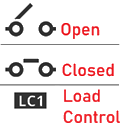
Another indicator is in the bottom right-hand corner of the display, two little icons labelled (on my own meter) ı and ıı. The upper one shows the state of the internal contactor for the constant (always-on) circuit. The lower one is for the switched-circuit contactors.
The upper one (ı) should always be closed unless the power has been cut. The lower one should be open during peak hours. During offpeak hours, it will not show open. What it does show depends a bit on how the internal switches are configured; on my meter, when offpeak kicks in, I see LC1 LC2 indicating that both the 100A contactor for the storage heaters and immersion heater and the 2A switch for a (non-existent) external contactor are closed.
So, having established that your switched circuit is energizing at ~10 minutes past the nominal time, you should watch the meter display screen from a minute before the nominal switching time to ten minutes later. You should see both indicators - the Active TOU Number and the load control switch icons - change simultaneously.
If they don’t, I’d suggest you take a clear photo of the meter, with the display screen illuminated and showing the Active TOU Number and the lower load control icon in the wrong state. The picture should include the Meter Serial Number (MSN, which is the number starting with the two-digit year of certification followed by an ‘M’) and - if you can work out how to do it - with a watermark giving the precise time and date. You then have some concrete evidence to present to the smart team if the meter doesn’t start behaving itself in a day or two. I’d expect the IHD to fall into line eventually, too.
* The meter should have been configured to record peak consumption on register tier 1 and offpeak on tier 2. This should be the default nowadays, but it’s always possible that a meter is misconfigured in this respect. Please check carefully that the Active TOU Number is 1 during peak hours ...
@dutyhog Hope you are well and apologies for taking a few days to get back to you.
Everything is functioning as it should! Youve got a random offset applied to the meter to turn on the ‘extra load’ 575 seconds after coming into and out of the off peak window (Youll hear the loud clunk on the meter when it starts/ends), everything fed by the meter will be at the lower rate at this time.
Your IHD isn’t as smart as the meter and will show when you enter the off peak timeslots but without the delay of 575 seconds, so bear that in mind when look at the IHD.
This sounds like expected behaviour to me. The 10 minute thing is part of the random offset designed to avoid blowing up the grid - it’s fairly similar to the behaviour you would have seen with RTS and IIRC it’s kinda intended to replicate that fairly closely. The biggest difference, however, is that Smart Meters do all the switching stuff locally and don’t rely on control signals. It only requires the signal once to pull down the configs and after that, it’ll run by itself forever regardless of whether it can communicate with the WAN or not. I do note however, that based on the Comms Hub you mentioned, you’re running on the Cellular WAN. It’ll either be the Telefonica WAN running on 2G/3G, or the Vodafone WAN running on 4G. I can’t say for sure as I don’t currently know - but I wouldn’t be surprised if it’s the new 4G link.
As for the potential for billing issues… It could be argued that by the time you get to the end of Off-Peak, most Storage/Immersion Heaters will have pretty much had their entire fill and stopped taking a charge anyway so the extra costs are likely minimal.
I’ll fling this to the Forum backstage in the next couple of days though, just to be sure.
Securing energy by zapping security bugs... For that is The Blastoise Way! Remember, I'm just like you - AI Powered Evil Geniuses aren't Staff!
Nick said he’d installed it to work with O2, ie the Telefonica WAN (which I use for GiffGaff 4G to get my internet signal).
Our old storage heaters can still be on quite high power at the end of the off-peak period. I was waiting to see how the digital switch went before working out how to replace them with something more efficient. We’ve had some quotes, and it may seem best for us to stop using storage heaters altogether and have the convenience of heating us just when and where in the house we want (we are long retired and at home most of the time now). Maybe we can find out by experiment if that seems OK using the main storage heaters’ convector heater circuits instead of the storage circuits.
But my main point is that the meter, whether switching locally or remotely, ought to change tariff and switch off-peak simultaneously, regardless of the necessary offset of time from the nominal periods advertised.
I don't see a problem as the off peak energy used is switched to the off peak register at the same time (whenever that is). Peak usage is only accumulated in the peak register. Doesn't really matter at exactly what time that happens so long as it is somewhere near the right time. At least that is my understanding of how it works but I'm happy to be corrected though.
Peter
Reducing my yearly fossil fuel usage with an EV (-900 litres petrol saving about £950/year), A2AHP (-8,700 kWh gas, cost neutral) and Timed Immersion heater (-1,500 kWh gas, £20/year more expensive but reducing as the gas price goes up)
When I follow the IHD it shows switching to the off-peak rate at 14:30 but the storage heating doesn’t come on until 14:40. It then switches back to the standard always-on rate at 17:30 but the storage heating stays on until 17:40. It’s similar for the other off-peak periods. So I’m being charged always-on rate for 10 minutes each period. As I write I see that our storage heaters are still consuming their full power even now, 2.5 hours into the off-peak period on a (admittedly cold ) June day. That costs us 25.5p/day more than it should, £93/year. I think that OVO should see that as un-necessary. I know it won't save the planet to synchronise switching, and I can afford it (and more importantly afford to get some modern heaters).
This is irregular, and I wonder whether it might not settle down eventually. The randomized offset - unique to every meter - is there to prevent shocks to the network caused by many power-hungry devices - like storage heaters - being switched on at the same instant. It is supposed to act on both the tariff switching timetable and the auxiliary load control switch (ALCS) timetable, so they should be perfectly synchronized so long as they’re set to the same timings.
I’d suggest having a look at the meter itself to check when the tariff changes. You may have to experiment a bit with the buttons to find out just how yours is set up, because the menu options are configurable, so your menus won’t necessarily be the same as anyone else’s. On my own Aclara SGM 1416-B, repeated presses of orange button B eventually reveal a screen headed Active TOU Number, giving the number of the active tariff register. This will change from 1 to 2 and back as the tariff changes.*
Another indicator is in the bottom right-hand corner of the display, two little icons labelled (on my own meter) ı and ıı. The upper one shows the state of the internal contactor for the constant (always-on) circuit. The lower one is for the switched-circuit contactors.
The upper one (ı) should always be closed unless the power has been cut. The lower one should be open during peak hours. During offpeak hours, it will not show open. What it does show depends a bit on how the internal switches are configured; on my meter, when offpeak kicks in, I see LC1 LC2 indicating that both the 100A contactor for the storage heaters and immersion heater and the 2A switch for a (non-existent) external contactor are closed.
So, having established that your switched circuit is energizing at ~10 minutes past the nominal time, you should watch the meter display screen from a minute before the nominal switching time to ten minutes later. You should see both indicators - the Active TOU Number and the load control switch icons - change simultaneously.
If they don’t, I’d suggest you take a clear photo of the meter, with the display screen illuminated and showing the Active TOU Number and the lower load control icon in the wrong state. The picture should include the Meter Serial Number (MSN, which is the number starting with the two-digit year of certification followed by an ‘M’) and - if you can work out how to do it - with a watermark giving the precise time and date. You then have some concrete evidence to present to the smart team if the meter doesn’t start behaving itself in a day or two. I’d expect the IHD to fall into line eventually, too.
* The meter should have been configured to record peak consumption on register tier 1 and offpeak on tier 2. This should be the default nowadays, but it’s always possible that a meter is misconfigured in this respect. Please check carefully that the Active TOU Number is 1 during peak hours ...
@dutyhog Hope you are well and apologies for taking a few days to get back to you.
Everything is functioning as it should! Youve got a random offset applied to the meter to turn on the ‘extra load’ 575 seconds after coming into and out of the off peak window (Youll hear the loud clunk on the meter when it starts/ends), everything fed by the meter will be at the lower rate at this time.
Your IHD isn’t as smart as the meter and will show when you enter the off peak timeslots but without the delay of 575 seconds, so bear that in mind when look at the IHD.
Noel | I have no official status; I'm just a volunteer who comes here to help other customers. My gear: Aclara SGM 1416-B Electricity-only E7 meter; Chameleon IHD3-PPMID-AAA | It may look as if I know what I’m talking about, but don’t let that fool you. |
As always with meter issues @Firedog comes back with a more compete answer than mine
Reducing my yearly fossil fuel usage with an EV (-900 litres petrol saving about £950/year), A2AHP (-8,700 kWh gas, cost neutral) and Timed Immersion heater (-1,500 kWh gas, £20/year more expensive but reducing as the gas price goes up)
Thanks very much all, especially for Firedog’s detailed suggestion. The meter is outdoors and it’s a very wet day, so unless it gets drier this afternoon it may be tomorrow before I take the photos.