

Best answer by Firedog

Updated on 15/08/25 by Emmanuelle_OVO:


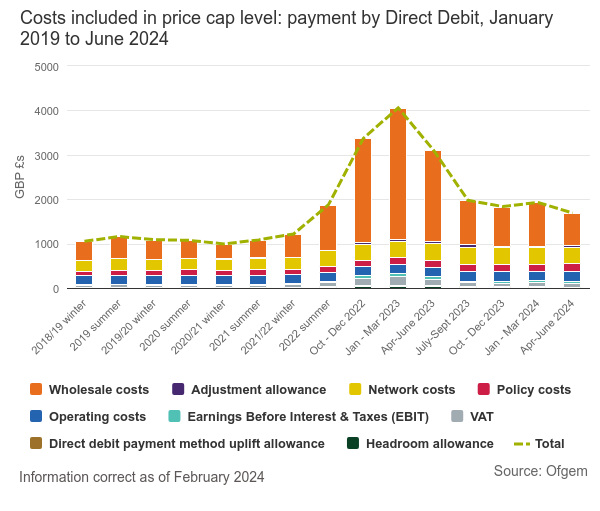
The Standing Charge is set by Ofgem in the Price Cap, to cover costs other than that of fuel. You can see what’s included here: Energy price cap | Ofgem. Changes over the past few years are shown in the chart below. The orange bit at the top of each bar is the cost of fuel, and everything below that is in the Standing Charge. This image is reproduced from this interactive Ofgem page.


There’s much more detailed information available at the Ofgem site.

51 replies

Blastoise186
Super User
Super User
December 16, 2024

You will NEVER overtake SkyNet Blastoise! The Leaderboard is Mine, All Mine! MUHAHAHAHAHAHAHAHAHAHAHAHAHAHAHA!

Seriously, it literally took me over four YEARS of absolutely carpet bombing the Forum every day to get the 94k Points I currently hold. You’re welcome to try and challenge me for the top spot… But it’s gonna take at least that long to get close…

You’re probably right though! Quite literally the only way anyone is going to beat me is probably by making me retire. And that’s not happening anytime soon!

Securing energy by zapping security bugs... For that is The Blastoise Way! Remember, I'm just like you - AI Powered Evil Geniuses aren't Staff!
Firedog
Super User
Super User
December 16, 2024


From the document you cite: “… While we do not set standing charges...”. Doesn’t this completely contradicy youor assertion that they absolutely do?
 

I don’t think so. Ofgem set the maximum (“cap”) that suppliers can charge. If they want to, suppliers are at liberty to vary the prices they charge so long as the typical customer wouldn’t end up spending more than the overall price cap. For example, some suppliers offer tariffs with no standing charge at all, but the customer has to pay a high unit rate for the first couple of kWh used each day. This would only be of advantage to customers using less than that each day.  


The document … ppints to using Suppliers Of Last Resort as one of the main reasons.
  

It was for a time. The document was prepared almost two years ago, and much has changed since then. The current standing charge includes very little (if anything at all) for SoLR costs. Sorry, my search for the details took me down so many rabbit holes that I gave up looking. You can see from the chart that already by October 2023 it was down to 2-3p/day.

Noel | I have no official status; I'm just a volunteer who comes here to help other customers. My gear: Aclara SGM 1416-B Electricity-only E7 meter; Chameleon IHD3-PPMID-AAA | It may look as if I know what I’m talking about, but don’t let that fool you. |
Newcomer
December 17, 2024

Well, either I’m not thinking clearly (a definite possibility) or you’re contradicting yourself.
I started by saying OFGEM sets a standing chatege CAP and you said no, it sets a PRICE. I showed you the quote contrasdicting that assertion and now you agree with the quote but not any self-contradiction. So at this point, well, biscuits. And tea. Certainly tea.

Firedog
Super User
Super User
December 17, 2024

Oh dear, perhaps you’re not the only one not thinking clearly. Let’s try again.

The price cap sets a maximum for what a supplier can charge a customer on the SVT. If a customer went away and customer didn’t use any energy at all for a whole year, the maximum the supplier could charge is the Nil kWh figure given in the tables. Since Ofgem also publish figures equivalent to those in the tables, but presented as unit rates per kWh and per day, it seems that that’s how they expect them to be applied. It wouldn’t be possible, for example, for our hypothetical customer to be charged nothing at all for the first six months of his absence, then double the price-cap standing charge for the next six months. Even though the Nil kWh sum charged was the same, the tariff wouldn’t have been legal because the standing charge levied per day in the latter half was higher than that mandated. 

Every supplier must offer an SVT, but they’re at liberty to offer others with different arrangements; it’s possible that someone might invent a tariff with a higher SC but lower rates per kWh, although I’m not aware of any.

Noel | I have no official status; I'm just a volunteer who comes here to help other customers. My gear: Aclara SGM 1416-B Electricity-only E7 meter; Chameleon IHD3-PPMID-AAA | It may look as if I know what I’m talking about, but don’t let that fool you. |
Rocksteady
Rank 2
Rank 2
January 2, 2025

Well what a hot topic. We were looking back over oir bills filing from 2014  10+ years ago (having a clear out) and found SSE Swalec bills with a dailly standing charge of 18p. That has now increased to 63p, so over that 10 year period it has gone up by 450%. This is way above anything that could even remotely be called inflation. 

While we all know that the infrastructure needs updating and maintaining, 450% increase over 10 years is a bit of a blinder.

Our standing charge cost over the year was £212.98 wheras our actual units used came to £197.21. I think something is definately amiss here!!!

Don't throw it away, save it for RON.
Emmanuelle_OVO
Retired Moderator
Retired Moderator
January 3, 2025

Hey ​@Rocksteady 

I agree it’s significant how much energy prices have increased. This is the information I found on the OFGEM webiste:


Energy price cap standing charges and unit rates for your region
 

The actual rates you are charged will depend on where you live, how you pay your bill and the type of meter you have. Get energy price cap standing charges and unit rates by region.
 

Costs included in energy price cap
 

There are different costs included in the price cap. Any changes to these costs will affect how much the price cap will be each time it is reviewed. For example, if the amount a supplier has to pay goes up, the level of the price cap will go up. If the cost goes down, the level of the price cap will go down.
 

You can also see how the costs have changed in each price cap level


Ofgem’s energy price cap limits what you pay for gas or electricity on a variable rate plan. You can see the latest information regarding the price cap levels and date changes on the Ofgem site here.


The way energy suppliers set prices is impacted by:


The price cap – set by Ofgem, the energy regulator. This limits the amount customers on variable rate plans will pay for each unit of gas and electricity and sets a maximum standing charge.


Ways to get financial support


If you’re struggling financially or you’re worried about your energy bills, we’re here to support you. Find out about the different ways we can help here.


How do I register for the Priority Services Register (PSR)?


Check out the Customer Support package here: https://winter-support-package.ovoenergy.com/

Renewable Energy? Big Fan.
Rocksteady
Rank 2
Rank 2
January 3, 2025

Hi Emmanuelle,

Its not the energy price that's the problem, that has only increased by 26% over that 10 year period, which is well acceptable, but the standing charge is absolute daylight robbery on a massive scale at 450% increase over the same period.

I know that as a houshold, we are pretty economical with our energy use compared to many, but it is really an insult when the standing charge price exceeds the units used price even for just a couple like my wife & I.

Sorry, I just looked back at my last post and realised I had put the standing charge at 18p 10 years ago, but in fact it was 14p. The 18p was the unit rate back then (typo)😕

Don't throw it away, save it for RON.
Firedog
Super User
Super User
January 3, 2025

The UK retail price index on 31 December was 373.30, while ten years ago it was 250.1. I make that very nearly a 50% increase, so the 26% increase you’re seeing in unit prices is unnaturally low by comparison. It’s equivalent to an annual increase of 2.3%!

Perhaps you’ll see, then, that some of the costs that used to be incorporated in the unit price have now been shifted on to the standing charge. These are largely ‘network costs’, which are of course largely independent of consumption. To my mind, that is a reasonable change - why should a customer using twice as much electricity as his next-door neighbour pay twice the network cost, when the actual cost is identical? 

Incidentally, home generation is one of the factors driving up some of those network costs. Distribution networks built half a century ago have to be upgraded to carry the sort of load that solar PV arrays are creating and are likely to create in the future as more and more panels are added, with customers hoping to be paid for their excess production. This is quite apart from the upgrade to the transmission network that commercial renewable generation is requiring.


Noel | I have no official status; I'm just a volunteer who comes here to help other customers. My gear: Aclara SGM 1416-B Electricity-only E7 meter; Chameleon IHD3-PPMID-AAA | It may look as if I know what I’m talking about, but don’t let that fool you. |
Rocksteady
Rank 2
Rank 2
January 3, 2025

?

Don't throw it away, save it for RON.
Firedog
Super User
Super User
January 3, 2025

?
  

Which bit of what I wrote don’t you understand?

Noel | I have no official status; I'm just a volunteer who comes here to help other customers. My gear: Aclara SGM 1416-B Electricity-only E7 meter; Chameleon IHD3-PPMID-AAA | It may look as if I know what I’m talking about, but don’t let that fool you. |