

Why has my standing charge gone up from:
24.61p per day in 2022 to
43.39p per day in 2023 to
60.31p percday from 1st April 2024?
This is way higher than inflation.
Why has my standing charge gone up from:
24.61p per day in 2022 to
43.39p per day in 2023 to
60.31p percday from 1st April 2024?
This is way higher than inflation.
Best answer by Firedog
Updated on 15/08/25 by Emmanuelle_OVO:
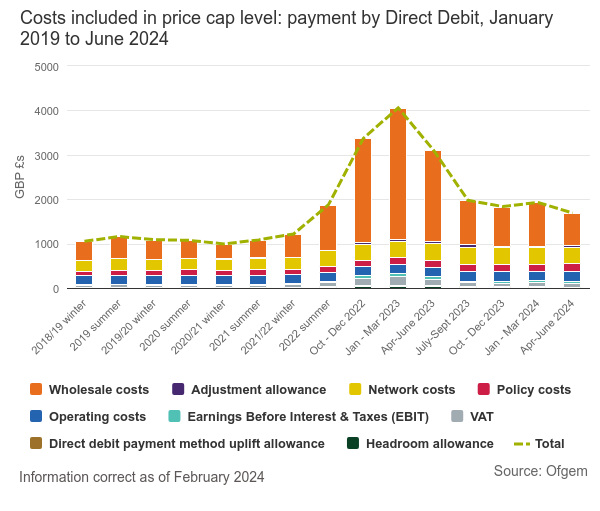
The Standing Charge is set by Ofgem in the Price Cap, to cover costs other than that of fuel. You can see what’s included here: Energy price cap | Ofgem. Changes over the past few years are shown in the chart below. The orange bit at the top of each bar is the cost of fuel, and everything below that is in the Standing Charge. This image is reproduced from this interactive Ofgem page.

There’s much more detailed information available at the Ofgem site.
Hey
I agree it’s significant how much energy prices have increased. This is the information I found on the OFGEM webiste:
The actual rates you are charged will depend on where you live, how you pay your bill and the type of meter you have. Get energy price cap standing charges and unit rates by region.
There are different costs included in the price cap. Any changes to these costs will affect how much the price cap will be each time it is reviewed. For example, if the amount a supplier has to pay goes up, the level of the price cap will go up. If the cost goes down, the level of the price cap will go down.
You can also see how the costs have changed in each price cap level.
Ofgem’s energy price cap limits what you pay for gas or electricity on a variable rate plan. You can see the latest information regarding the price cap levels and date changes on the Ofgem site here.
The price cap – set by Ofgem, the energy regulator. This limits the amount customers on variable rate plans will pay for each unit of gas and electricity and sets a maximum standing charge.
Ways to get financial support
If you’re struggling financially or you’re worried about your energy bills, we’re here to support you. Find out about the different ways we can help here.
How do I register for the Priority Services Register (PSR)?
Check out the Customer Support package here: https://winter-support-package.ovoenergy.com/
Hi Emmanuelle,
Its not the energy price that's the problem, that has only increased by 26% over that 10 year period, which is well acceptable, but the standing charge is absolute daylight robbery on a massive scale at 450% increase over the same period.
I know that as a houshold, we are pretty economical with our energy use compared to many, but it is really an insult when the standing charge price exceeds the units used price even for just a couple like my wife & I.
Sorry, I just looked back at my last post and realised I had put the standing charge at 18p 10 years ago, but in fact it was 14p. The 18p was the unit rate back then (typo)😕
The UK retail price index on 31 December was 373.30, while ten years ago it was 250.1. I make that very nearly a 50% increase, so the 26% increase you’re seeing in unit prices is unnaturally low by comparison. It’s equivalent to an annual increase of 2.3%!
Perhaps you’ll see, then, that some of the costs that used to be incorporated in the unit price have now been shifted on to the standing charge. These are largely ‘network costs’, which are of course largely independent of consumption. To my mind, that is a reasonable change - why should a customer using twice as much electricity as his next-door neighbour pay twice the network cost, when the actual cost is identical?
Incidentally, home generation is one of the factors driving up some of those network costs. Distribution networks built half a century ago have to be upgraded to carry the sort of load that solar PV arrays are creating and are likely to create in the future as more and more panels are added, with customers hoping to be paid for their excess production. This is quite apart from the upgrade to the transmission network that commercial renewable generation is requiring.
?
Which bit of what I wrote don’t you understand?
Just to mention, it seems your comment was edited, it previously mentioned your claim that
Probably worth noting that the OVO Forum is primarily powered by Forum Volunteers and we’re customers just like you are. We don’t work for OVO ourselves, but we have direct contact with people who do, usually via the Forum Moderators (who are OVO Staff themselves). In actual fact, none of the Forum Volunteers so far have ever worked in the Energy Industry at all, so it gives us total independence from it but we still bring specialist skills of our own to the table.
It’s all done this way deliberately - because then it means we’re free to do our own thing and as long as we play by the same House Rules as everyone else, we’re free to roam the Forum and basically share our own opinions freely. We just… Happen to be able to also use our advanced knowledge as part of that.
Hope that helps clarify things a bit!
Yes, I did edit it because my comment was a bit of a hasty one. After mulling it all over I compared it to paying road tax for the car, which is a fixed fee whether one does 1000 miles a year or 10,000 miles per year. I do however, still believe that each of these types of charges or levvys would be more fairly financed if done according to how much you buy.
For instance, I buy a loaf of bread and a pot of jam "or any other such items" when I buy them, the materials, production and transport costs along with profits along the way to the shelf have all been taken into account, part of what I paid has contributed to creating that service.
My original comment was hasty because there did seem to be quite a bit of unnecessary diversionary chaff thrown into the wind regarding PV panels loadings on 50 year old systems etc. If the machinery making my loaf of bread & pot of jam needs substantially and unexpectedly upgrading, they simply make each loaf and pot a tad more expensive, it's woven in rather than a seperate issue.
It’s not just upgrades that have pushed up Standing Charges…
For a while, all those dead suppliers did too, but I think those will drop off sooner or later. Then you’ve got stuff like energy theft - if it’s “written off” then it gets thrown onto Standing Charges for everyone else as a Technical/Non-Technical Loss.
And then you’ve got other things too...
… I buy a loaf of bread and a pot of jam … costs along with profits along the way to the shelf have all been taken into account …
Yes, but … You get the car out and drive to the supermarket, you pop in and buy a loaf of bread, then drive home again. Another time, you manage to fill two trolleys with all sorts of stuff, costing very much more than a loaf of bread. But the cost of getting you to the shop and home again with the shopping is pretty much the same. Not so much a standing charge as a driving one, but you get the idea: your wallet is in both cases lighter by (cost of shopping + driving charge).
… unnecessary diversionary chaff thrown into the wind regarding PV panels loadings on 50 year old systems etc.
Not really. Like you, more and more people are turning to home generation to cut their expenditure on energy. Many of them will be hoping to sell any excess production back to the grid. The local network will not have been dimensioned to carry this new load, which is why electricity distributors have to approve any such scheme and if necessary impose limits on how much can be accepted. Those limits can only be raised by upgrading the network cabling and switchgear etc. The same applies to the wider use of electric vehicles charged at home.
How should that upgrade cost be apportioned, do you think?
Good point about car chargers and selling pv generation to the grid. I have both (come the sunnier days) so I’m indebted to everyone as I haven’t had to pay for this privilege. In fact my ev charger cane with a grant so cost me nothing back in 2020.
I get your point Firedog, but equally mine is valid. I might walk or cycle or bus or other "than drive" to the shop, but that at least has offered me a choice other than Hobson's choice. A little per unit in my book is fairer than a fixed fee. Likewise vehicle tax on the road could be levvied per mile at MOT time so again that would be fairer.
It's just an opinion, but very similar to many others. I could run a small generator for a very long and considerable time on £200.00 worth of diesel, but that would not be agreeable in today's environment.
I understand the logic of infrastructure upgrading due to more & more homes having PV panels installed. That must be some local loading nightmare in some places with mains distribution transformers being swung quite off balance by the effects of multiple single phase feedbacks that can't balance effectively due to where the sun is shining. And, with a bit of careful observance, there are a good few PV instalations up and down the country that are overshadowed by tree foliage (it's obvious that some PV installers neglect to point this out to the customer).
I could go on, but their just opinions, but without opinions what would change?
‘A little on a unit ...is fairer than a fixed fee would be detrimental to large families on a limited income or those in poor health and low income who rely on electrical devices to support them. There is no ‘fair’ option. Ofgem are carrying out a study to see if costs can be be redistributed but in essence it's a zero sum game. Some people will be better off and some will be worse off as all costs have to be paid for. Ofgem may do a few tweaks here and there but there isn't much they can do.
Peter
Thing is, I like OVO, but I loathe the inflexibility of not being able to choose my direct debit amount. My bill averages £47 annually, but my DD is £72 just to keep one month’s credit. Make it make sense!
And another thing… howwwww are my last bills £30+ when my flat’s been empty 👀 Are the cameras, smart lights, and internet really eating up that much power?
Take the whole company away. I’m done, because OVO’s moving like Drake if you ask me.
But maybe I’m missing something here. 🤔
How do y'all keep your bills low?
Should I change my plan?
Is this “low” and I should stop moaning because it could be worse? I mean, it’s not even winter yet. In winter I can take the £100, but £30 for an empty flat? Really?
Hi
That’s probably stuff like Daily Standing Charges and Usage Charges for anything that was left running.
Could you show us the numbers please?
Hey
Ahhh the infamous standing charges… you might be right crap. I didn’t really think about that. Do you mean the total units or just add a screenshot?
A screenshot of the charges and breakdown will help a ton - just make sure to redact personal info.
Also, do you have a smart meter?
I have the smart meter. Here’s this month’s and last bill


Thanks! Yeah, those Standing Charges are what hit you there.
What plan are you on now?
The only way to keep bills down as with most energy companies is of course to use less and take full advantage of offers such as Power Move. With regards bill paying I have gone for full bill on demand as Direct Debit is now only offered for payment spread across the year as opposed to full bill paid monthly. I only pay for what I use each month which means lower summer bills but higher winter ones.
The problem with Pay On-Demand however, is it’s the most expensive way to pay. Use with caution.
DD means you still ultimately only pay for what you use - it just stays in the account and spreads the cost evenly.
I’m lost in the sauce when it comes to these things. I am on the simple energy
Pay as you go Top-up is a different way of paying for your energy. This is usually a key you top up at a retailer. Paying on demand means you get a bill, usually monthly and pay it in full. Blastoise186 is correct in saying this is a more expensive way to pay. However, unlike for example mobile phone contracts most energy companies do not now operate variable direct debit payments.
I see.
Going back on a fix deal may be best if you want the lowest possible rates - Simpler Energy is the Standard Variable Rate tariff and is usually the MOST expensive one.
I’d suggest looking at what the fix deals OVO has available are. Let us know what you’re being offered.
My offer:


Thank you for breaking things down for me yall. I really appreciate it.
Ask your question to our members - they have the experience you're looking for:
Ask our communityNo account yet? Create an account
Enter your E-mail address. We'll send you an e-mail with instructions to reset your password.
Sorry, we're still checking this file's contents to make sure it's safe to download. Please try again in a few minutes.
OKSorry, our virus scanner detected that this file isn't safe to download.
OKOVO Energy Ltd, registered office 1 Rivergate Temple Quay Bristol, BS1 6ED, company no. 06890795 registered in England and Wales.
OVO (S) Gas Limited is registered in England and Wales (Company No. 02716495) at 1 Rivergate, Temple Quay, Bristol, BS1 6ED.
OVO (S) Gas Limited is part of OVO Group Ltd