Reach out to our Support Team in order to schedule in an engineer visit. As a non-essential maintenance job there is a charge for this, check this guide to see the current cost.
What's an isolation switch?
An isolation switch (also known as a 'double-pole isolator') is a piece of equipment which can be installed on a metering supply that will allow the supply to be de-energised post-meter. The isolation switch should be fitted after the meter but before the consumer unit.
What's the purpose of an isolation switch?
An isolation switch is designed to act as a circuit breaker on the mains electrical supply, so that any electrical work that needs to take place within a property can be completed safely by a private electrician. It also negates the need for a supplier to send an engineer to the property to de-energise the cut out (and re-energise afterwards) so that any internal electrical work can take place.
What does an isolation switch look like?
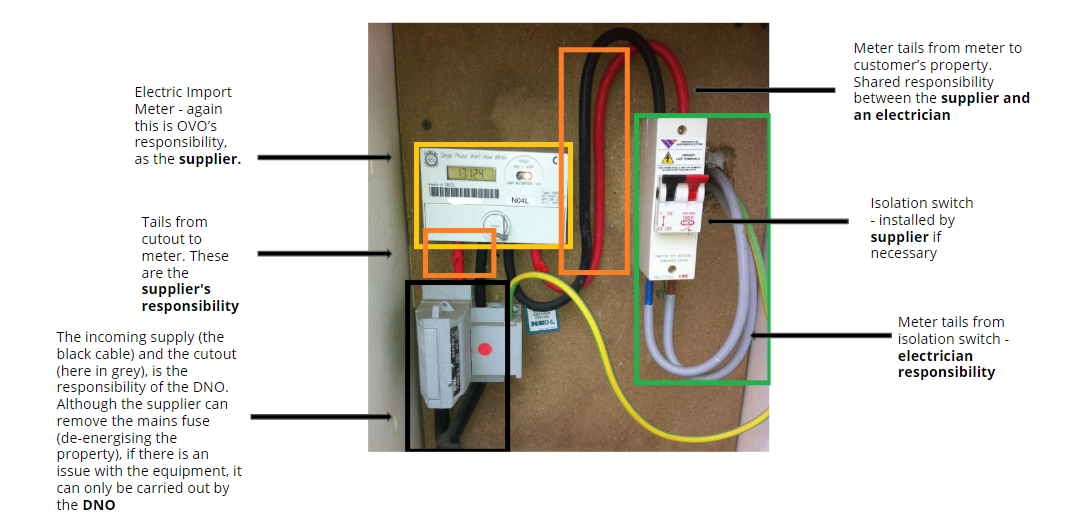
The isolation switch is located on the right of this photo. When the switch is turned off, there would be no power after the isolation switch, which in turn would allow a private electrician to complete any maintenance work or repairs on the member's internal electrical set up.
Who's responsible for installing an isolation switch?
An isolation switch needs to be installed by your supplier. This is because the supply would need to be de-energised via the cut out and private electricians are not permitted to work on the cut out. Therefore, the supplier would need to arrange for an engineer to go to the property to install one. For more on who’s responsible for what parts of the equipment, check out the Library topic below:
Carbon neutral - we need a community to get there! My green tech: Aclara SGM 1411-B smart meter, Chameleon IHD6
You usually have to arrange this with your local electricity distributer. You can find that online with the right searching. It's NEDL where I live. As a sparky myself we 'used' to pull the service fuse to enable a board change and most new installs have an a isolator fitted between the meter and the board. He obviously isn't happy to pull the service fuse which is right enough. Not sure what they'll charge you for fitting the isolator though.
Thanks, that's really helpful. As you say, he wasn't happy to pull the service fuse which is fair enough. We'll see what the financial damage will be !
The DNO in my area (Western Power) have never charged my sparkys when they attend on-site to re-establish the anti-tamper seals on Main-Fuse or meter. The Sparky just phones them when he starts work and they agree a time (a couple of hours hence) when they'll send an engineer to check the new connections and make the seals.
Here's my separate isolator:
Nor have I been charged when I've asked Western Power to shield overhead cables running close to my scaffolding. They even refitted the bracket completely free.
So I'm guessing that either policy changes with different DNOs or perhaps it's something to do with the rapport with the Sparky. :)
Western Power's strategy seems to concentrate on safe-practice. If they arrive on site to find something has been done without notifying them, then they start charging. This obviously favours the "good guys" and ensures that everything is done properly.
I've been told I need an isolation switch. Can anyone advise how much these cost - currently an OVO electricity only customer...Appreciate any help with this. Thanks
Reach out to our Support Team in order to schedule in an engineer visit. As a non-essential maintenance job there is a charge for this, check this guide to see the current cost.
What's an isolation switch?
An isolation switch (also known as a 'double-pole isolator') is a piece of equipment which can be installed on a metering supply that will allow the supply to be de-energised post-meter. The isolation switch should be fitted after the meter but before the consumer unit.
What's the purpose of an isolation switch?
An isolation switch is designed to act as a circuit breaker on the mains electrical supply, so that any electrical work that needs to take place within a property can be completed safely by a private electrician. It also negates the need for a supplier to send an engineer to the property to de-energise the cut out (and re-energise afterwards) so that any internal electrical work can take place.
What does an isolation switch look like?
The isolation switch is located on the right of this photo. When the switch is turned off, there would be no power after the isolation switch, which in turn would allow a private electrician to complete any maintenance work or repairs on the member's internal electrical set up.
Who's responsible for installing an isolation switch?
An isolation switch needs to be installed by your supplier. This is because the supply would need to be de-energised via the cut out and private electricians are not permitted to work on the cut out. Therefore, the supplier would need to arrange for an engineer to go to the property to install one. For more on who’s responsible for what parts of the equipment, check out the Library topic below:
Carbon neutral - we need a community to get there! My green tech: Aclara SGM 1411-B smart meter, Chameleon IHD6
I've been told I need an isolation switch. Can anyone advise how much these cost - currently an OVO electricity only customer...
Good question, @Nells
Fitting this without any other work being done costs £158.25, or £325 if you have a 3-phase supply.
Call us for more info and to book this in for a Monday-Friday appointment at least 17 working days in advance. You can call the team on: 0330 303 5063. Our opening hours are 8am-6pm Monday to Friday.
Appointment slots are:
8am-12pm 10am-2pm 12pm-4pm 2pm-6pm
Tim, if i have an isolation switch installed at the same time as having a smart meter installed, what would the cost be?
@Andrewhr - It’d still be the same cost as they’d need to be booked separately.
We can’t guarantee that the installer who installs your smart meter is trained to install isolation switches, and vice versa, so we’d need to book each one individually.
If I was adding my isolation switch now, I might buy a bigger (wider) enclosure and place a pair of lightning / anti-surge devices next to it. That could be a better position than having them within a consumer unit.
It rather depends on the physical layout of the Distribution Grid in your area.
If there’s a large number of overhead cables, then an incoming surge is probably more likely.
On the other hand, if you have a workshop with machine-tools (or a welder!) then you need to also protect against spikes created within your home. So in that case place the surge-protection devices within the Consumer Unit and make sure you have a separate feed to that workshop!
Even if you don’t want anti-surge protection at this stage, just leave room to add a pair of modules later on.