Reach out to our Support Team in order to schedule in an engineer visit. As a non-essential maintenance job there is a charge for this, check this guide to see the current cost.
What's an isolation switch?
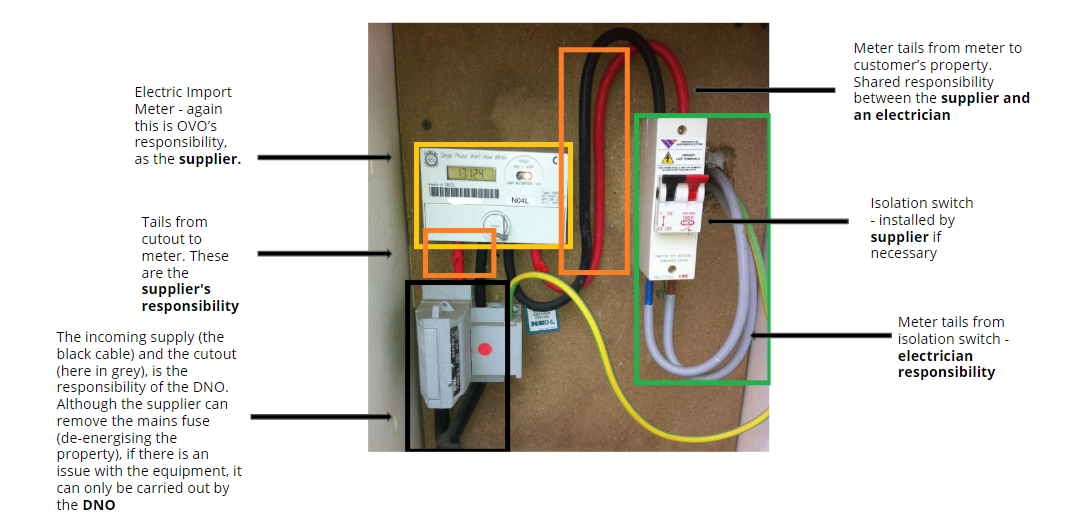
An isolation switch (also known as a 'double-pole isolator') is a piece of equipment which can be installed on a metering supply that will allow the supply to be de-energised post-meter. The isolation switch should be fitted after the meter but before the consumer unit.
What's the purpose of an isolation switch?
An isolation switch is designed to act as a circuit breaker on the mains electrical supply, so that any electrical work that needs to take place within a property can be completed safely by a private electrician. It also negates the need for a supplier to send an engineer to the property to de-energise the cut out (and re-energise afterwards) so that any internal electrical work can take place.
What does an isolation switch look like?
The isolation switch is located on the right of this photo. When the switch is turned off, there would be no power after the isolation switch, which in turn would allow a private electrician to complete any maintenance work or repairs on the member's internal electrical set up.
Who's responsible for installing an isolation switch?
An isolation switch needs to be installed by your supplier. This is because the supply would need to be de-energised via the cut out and private electricians are not permitted to work on the cut out. Therefore, the supplier would need to arrange for an engineer to go to the property to install one. For more on who’s responsible for what parts of the equipment, check out the Library topic below:
Carbon neutral - we need a community to get there! My green tech: Aclara SGM 1411-B smart meter, Chameleon IHD6
@Andrewhr - It’d still be the same cost as they’d need to be booked separately.
We can’t guarantee that the installer who installs your smart meter is trained to install isolation switches, and vice versa, so we’d need to book each one individually.
On thx. Tbh if the installer isn't competent to install an isolation switch i wouldnt want them anywhere near the rest of the installation.
If I was adding my isolation switch now, I’d might buy a bigger (wider) enclosure and place a pair of lightning / anti-surge devices next to it. That could be a better position than having them within a consumer unit.
It rather depends on the physical layout of the Distribution Grid in your area.
If there’s a large number of overhead cables, then an incoming surge is probably more likely.
On the other hand, if you have a workshop with machine-tools (or a welder!) then you need to also protect against spikes created within your home. So in that case place the surge-protection devices within the Consumer Unit and make sure you have a separate feed to that workshop!
Even if you don’t want anti-surge protection at this stage, just leave room to add a pair of modules later on.
I'll be uprating to an 18th ed. CU with SPD and RCBOs but thanks for the suggestion.
For the sake of others who come across this discussion over the ensuing months, may I just translate your TLAs into English?
CU = Consumer unit (which contains the fuses or trips)
SPD = Surge Protection Device
RCBO = Residual-current Circuit Breaker with Overcurrent protection. That means it will trip either if the current (Amps) is exceeded, or if there is electricity leaking from the circuit (residual current), which is a safety protection. All eight of my power-circuit trips in the photo above are RCBOs.
18th Ed. = 18th edition of the Wiring Regulations, which qualified electricians must comply with. In this case the most obvious requirement, which it’s likely that Andrew has in mind, is the need for the Consumer Unit to be made of non-flammable material (ie metal).
The fact that Andrew is using these terms shows that he’s competent in understanding what’s required.
He may indeed being selecting these items himself and then employing the qualified electrician to install them and provide the test certification. That’s what I do.
If others reading this would like further clarification, then please post here and ask. That’s one of the major benefits of this being an open-discussion Forum.
On thx. Tbh if the installer isn't competent to install an isolation switch i wouldnt want them anywhere near the rest of the installation.
@Andrewhr - I can completely understand your thoughts on engineers being able to do one or the other. It’s simply the way they train them, some are trained in one field, others in another. We do have engineers trained in both, however, we just can’t guarantee they’ll be the ones turning up to do the job!
You sound really knowledgeable on the technical side of things, how would you fancy doing a topic or 2 on the installation of the isolation switch and the smart meter, just so others can see the process?
@Transparent - Thanks for the explanation of the technical terms, really helpful (even for me!)
Really hoping to get somewhere on this forum. Recently got an electric car and have been trying every fortnight by phone and what’s app to arrange to get a switch fitted in order to have a charging unit installed. Started trying 4 months before we received the car. We just aren’t getting anywhere. We are fobbed off at every turn, transferred again and again on the phone, and promised a call back which we never receive. We are rural Scotland and my husband has to go and drive 15 mins to then sit at a charging point for hours. The other day he had to work in the car while it was charging. It really is becoming an inconvenience not having a charger at home.
Has anyone had any success in getting an isolator switch fitted recently and how have you managed it?? I would really love to know the secret!
One was fitted at the same time as my smart meter. I'm surprised that customer services haven't been able to book in a request to fit one.
Why do you need one to get a car charger installed? Do you not have space in your consumer unit for the charger circuit? Or do you need an additional consumer unit to be fitted for the charger?
1992 4 bed detached house. Solar PV + battery, Zappi EV charger, Mitsubishi Ecodan ASHP and i-life2 fan assisted radiators.... No gas 😊
Thanks for your reply. Customer services have been useless. I thought it would be a case of requesting the job, paying for it and getting it done but no.
The EV company told us we needed one before installing the charger. My husband dealt with them.
I was just hoping there might be a magic number or way of getting this done! It’s really inconvenient.