I have 3 x flats that have just the one meter supplied by Ovo.
I want to split into 3 x meters by Ovo. I want to avoid using power networks and getting in a 3 phase supply as they are suggesting
can this be done?
the supply is already going to all 3 so its about metering although i don’t want private meters, I would like 2 separate accounts for the tenants to pay themselves.
Each meter must be connected to a Service Fuse in one direction and a Consumer Unit in the other.
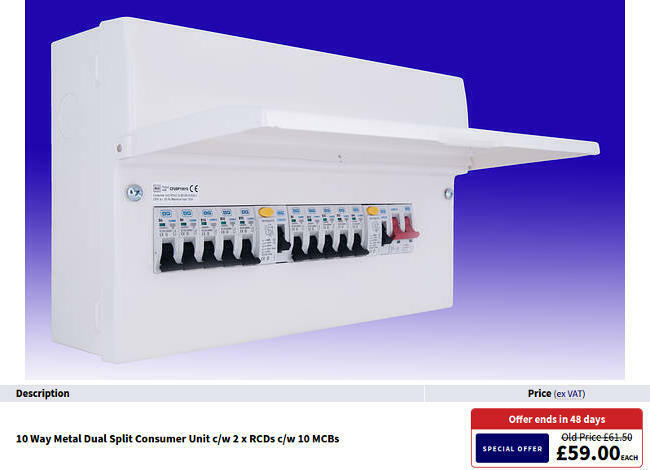
A Consumer Unit is not itself an expensive item, especially if purchased as a package with all the trips pre-installed:
BG 10way Consumer Unit currently on offer from TLC-Direct
As yet @calli hasn’t said how the existing arrangement of flats is served by any existing Consumer Unit.
Unless there is a separate Consumer Unit for each flat, with the certification from a qualified electrician, then I can’t see how any Installer would be prepared to put in a meter. It would be in breach of SMICoP regulations. This Smart Meter Installation Code of Practice is the agreement by which engineers working for Energy Suppliers are licensed to break the seals on the Service Fuse without the attendance of the Distribution Network Operator and a qualified electrician on site.
As you would expect, the SMICoP regulations are primarily about safety. This doesn’t just mean the safety of the meter installation itself either. The Government (through Ofgem) are using the Smart Meter installations as an essential opportunity to verify that the gas and electricity supplies to each dwelling are up to the basic requirements.
No Installer could risk connecting a new meter to a Consumer Unit if there was a chance that the wiring somewhere in a flat might not be fed entirely from that Unit.
If they were to do so, then a later intervention by the DNO to run 3-phase into the building would leave the occupants with the risk of there being 440v within a room.
Now I still do have ideas as to how to save money in having this work done. But I cannot foresee any way that the issue can be resolved without the regulations being fully and correctly implemented. The rules are not onerous - they are actually just common sense, and successfully keep us alive!
In this instance your DNO would need to install a new 3 phase fuse or 2 new single phase fuses, so you’d also need to arrange for them to attend on the same day as your supplier’s engineer. You can book a new supply connection through OVO.
Requesing a new connection
We’ll check that you have the supporting infrastructure in place:
Electricity: cabling from the mains should already be on site
Gas: pipework from the gas main in the street should be on site
Hmm… This sounds like it would be a pretty complicated job to do. I can certainly see why you’d want to split up the flats to have one meter each which is probably for the best.
I’m assuming you want to completely split them up so that it becomes:
Flat 1 takes/keeps the first meter
Flat 2 has the second meter
Flat 3 grabs the third meter
You didn’t mention whether this includes gas as well, or just electricity. But my guess is that while it probably can be done, there’s some serious work involved in getting you there.
I’m going to summon @Transparent to advise on exactly how you might go about getting those meters installed and set up. He’s great at offering advice here.
My initial thoughts are that it would just be a case of getting the new meters installed and having all the wiring done so that everything goes to the right places, just like how you’d get a brand new property connected and on-supply for the very first time. But if you’re currently on a three flats one meter setup, then it’s going to also have to be a case of pulling the other flats out of the current meter and getting the wiring moved over so that the other meters can be installed.
But here’s the good news for you. And I do mean good news. Once you get the flats split up onto their own meters, signing each one up with OVO will be as simple as signing up just about any other property. But you’d have to get there first.
Do feel free to reply in this thread with any progress updates or if you get stuck. We’ll help you out as best we can.
Securing energy by zapping security bugs... For that is The Blastoise Way! Remember, I'm just like you - AI Powered Evil Geniuses aren't Staff!
OK. Let me dive in. What the others have already said is largely true.
It might help if refer to the diagram from the Topic Who Owns What? which goes on to discuss fault reporting.
This shows that the Distribution Network Operator (DNO) is the only organisation which can assign the supply up to the meter.
The DNO takes account of loading on the existing Feed cable, and the prevailing imbalance of phases at the substation. Their priorities are:
Safety
Minimising losses
ensuring adequate capacity for the future
If they have stated that you require a 3-phase connection, then it’s very important that one is provided.
There are numerous tales of woe where a householder has extended the loading on a single-phase supply beyond what was allowed for in the original design. If you want to look for some, try searching for news stories about fires in flats above shops, because it’s a classic problem when the shop owner no longer lives on the premises and he lets the flat to a tenant.
Once you have three separate 100A Service Fuses for each flat, you still can’t get the Energy Supplier to install two more meters.
You will first need a qualified electrician to fit a Consumer Unit for each flat and ensure that the existing wiring doesn’t run between these flats. If this isn’t done properly, then there will be 440v between sockets or lights-circuits within the same room, which is very dangerous.
The electrician will also re-run the heavy-duty (6mm²) cables required for larger loads such as a kitchen (think microwave, toaster, kettle, washing machine and oven) and an electric shower (typically 10-13kW). These cables must not run through insulation or tight spaces where heat cannot escape. If they do, then you’ll require 10mm² cable.
Depending on the connection provided by the DNO there will be a need to install (and check) some sort of earthing arrangement for each flat. Once again, this is a safety issue.
Only then can you get the two new meters fitted. The electrician will provide you with the relevant Part-P certificate (Building Regulations) together with the pages showing the results of his tests. The Meter Installer is likely to ask to see this paperwork. You will also need these in order to insure the flats.
So that’s my overview of what’s required to comply with the Regulations.
As I’m a self-builder I have very hands-on experience of how to achieve the practicalities of this work and minimise your costs. So if you’d like further advice on that, then please ask.
It is possible to split up the three flats onto their own meters
A three-phase supply is the safest way to split up the three flats
Each fuse supplies one flat and each flat has independent meters/consumer units
Doing it correctly means nothing will go bang in a years time
In which case, that definitely makes sense. Is this something that can all be done in a single day, or perhaps a couple of days as it sounds like a big job? No doubt that three smart meters can be installed on the same day for example, but what about the rest?
Securing energy by zapping security bugs... For that is The Blastoise Way! Remember, I'm just like you - AI Powered Evil Geniuses aren't Staff!
Also @Tim_OVO this one might require some help from one of the specialists at the office.
I noticed you mentioned that it is possible to fit new meters for properties where OVO already supplies the customer, presumably because you can do upgrades for example. So if I wanted to get my current meter swapped out for a new one of the same type e.g. from SMETS1 Single Phase to SMETS2 Single Phase, piece of cake right?
In this case however, the rules are a bit unclear as this is a massive edge case. Technically speaking, @calli is already an OVO customer and is getting a supply from OVO on the existing meter. This also kinda means that all three flats are getting a supply from OVO under the same supply/account and I could argue that it does come within the jobs list.
But erm… I’m not sure that this one is as easy as a simple yes or no here… So what happens on that front? (Might also be useful to see if you guys can offer new supply installs in the future btw!)
Securing energy by zapping security bugs... For that is The Blastoise Way! Remember, I'm just like you - AI Powered Evil Geniuses aren't Staff!
a 3 phase installation is one way to do it but it is really expensive and complex.
as @Blastoise186 rightly says, these 3 flats have been operating for over 10 years on one supply so they really have no need of any extra “juice”, it should be the case, in my mind, that if my electrician prepares the internals, Ovo can take out their current meter and put in 3 new meters instead. I’m probably oversimplifying but why not?
It might be a bit of a complex job, but we’ll be happy to offer advice as best we can. Even if it’s a case of you having to sign up the new meters somewhere else temporarily on a Standard Variable tariff and then immediately fire up the switch process to OVO, that’s one possible method.
Ultimately though, you can’t put a price on the safety of your tenants. Having it all upgraded to three-phase and getting a total overhaul might not be cheap, but it’s much cheaper than the costs that could arise if something goes wrong from a bodged job
Securing energy by zapping security bugs... For that is The Blastoise Way! Remember, I'm just like you - AI Powered Evil Geniuses aren't Staff!
a 3 phase installation is one way to do it but it is really expensive and complex.
as @Blastoise186 rightly says, these 3 flats have been operating for over 10 years on one supply so they really have no need of any extra “juice”, it should be the case, in my mind, that if my electrician prepares the internals, Ovo can take out their current meter and put in 3 new meters instead. I’m probably oversimplifying but why not?
So that’s this option then, @calli:
Power networks can visit to install 2 new supplies, each with their own single phase cut out, and their own meter.
Once again, in this scenario you will then need to get a supplier able to create new supplies to visit on the same day, to install the meters
I noticed you mentioned that it is possible to fit new meters for properties where OVO already supplies the customer, presumably because you can do upgrades for example. So if I wanted to get my current meter swapped out for a new one of the same type e.g. from SMETS1 Single Phase to SMETS2 Single Phase, piece of cake right?
Yep @Blastoise186 we can physically turn up and rip out that SMETS1 smart meter and replace it with a SMETS2. BUT this would come at a charge, as there is no fault to that meter.
@calli’s situation is different as he requires for NEW supplies to be created. Currently OVO can’t do this, which as @Transparent calls out is a curious situation considering.
Carbon neutral - we need a community to get there! My green tech: Aclara SGM 1411-B smart meter, Chameleon IHD6
Each meter must be connected to a Service Fuse in one direction and a Consumer Unit in the other.
A Consumer Unit is not itself an expensive item, especially if purchased as a package with all the trips pre-installed:
BG 10way Consumer Unit currently on offer from TLC-Direct
As yet @calli hasn’t said how the existing arrangement of flats is served by any existing Consumer Unit.
Unless there is a separate Consumer Unit for each flat, with the certification from a qualified electrician, then I can’t see how any Installer would be prepared to put in a meter. It would be in breach of SMICoP regulations. This Smart Meter Installation Code of Practice is the agreement by which engineers working for Energy Suppliers are licensed to break the seals on the Service Fuse without the attendance of the Distribution Network Operator and a qualified electrician on site.
As you would expect, the SMICoP regulations are primarily about safety. This doesn’t just mean the safety of the meter installation itself either. The Government (through Ofgem) are using the Smart Meter installations as an essential opportunity to verify that the gas and electricity supplies to each dwelling are up to the basic requirements.
No Installer could risk connecting a new meter to a Consumer Unit if there was a chance that the wiring somewhere in a flat might not be fed entirely from that Unit.
If they were to do so, then a later intervention by the DNO to run 3-phase into the building would leave the occupants with the risk of there being 440v within a room.
Now I still do have ideas as to how to save money in having this work done. But I cannot foresee any way that the issue can be resolved without the regulations being fully and correctly implemented. The rules are not onerous - they are actually just common sense, and successfully keep us alive!
In this instance your DNO would need to install a new 3 phase fuse or 2 new single phase fuses, so you’d also need to arrange for them to attend on the same day as your supplier’s engineer. You can book a new supply connection through OVO.
Requesing a new connection
We’ll check that you have the supporting infrastructure in place:
Electricity: cabling from the mains should already be on site
Gas: pipework from the gas main in the street should be on site
It’s tricky to find the ‘best answer’ in this topic.
@calli what do you think? I can copy and paste @Transparent’s advice above on consumer unites, and add that to another comment. Just can’t choose which……
Carbon neutral - we need a community to get there! My green tech: Aclara SGM 1411-B smart meter, Chameleon IHD6