



Abby_OVO
Community Manager
Community Manager
January 10, 2022
SHARE YOUR EXPERIENCE

Heat pumps - What’s your experience of the benefits and downsides to an ASHP?
  • January 10, 2022
  • 106 replies
  • 5002 views
Heat pumps - What’s your experience of the benefits and downsides to an ASHP?

Updated on 03/07/26 by Abby_OVO


Advantages and Disadvantages of Air-Source Heat Pumps (ASHPs) - Share your experience


As one of the leading options in our journey to decarbonising the way we heat our homes, Air Source Heat Pumps (ASHPs) are really heating up (pun intended) and generating much discussion, both amongst the AHSP trialists here on the OVO community and in this recent article written by our content team covering both the advantages and disadvantages of this low carbon heating set-up.


We know a lot of you here have gained first-hand experience of life with an ASHP in 2021 and we want to give you another chance to share your stories and help others considering an ASHP installation in 2022 and beyond!


 As the article outlines one of the main benefits of opting for this heating system over alternatives will be it’s green credentials:


“They don’t give off any nasty carbon emissions”


How important was this as a factor in making you decide on an Air-Source Heat Pump and how do you think the positive environmental impact could be supported?  

@nealmurphy@M.isterW  - be honest here: did reducing your home’s carbon footprint play a factor in your choice to go for a heat pump? 


We know, as with any new technology, there might be some misconceptions about ASHPs which could be putting off other potential adopters. Have you heard the one about how noisy heat pumps are?:


“They can make noise – but not as much as you might think”


We’ve ‘heard’ that the noise of an ASHP hasn’t been the issue you might have been led to believe before getting one installed - isn’t that right, @James_N and  @jason.lewis? Can you dispell this myth once and for all?!

Was this a concern you had before the installation and if so what put your mind at ease when giving the go ahead to the install?

What would you say to others who might be concerned by the noise factor? Are there times that the pump might be louder than others or is it a constant hum? 


Cost is always a major factor when making home improvements and could be the deciding factor for some. As the guide calls out, currently installation costs for ASHPs are much higher than for a standard gas boiler replacement:


“They’re more expensive to install than a boiler”


Whilst I know many of you here are participating in a trial so didn’t incur these installation costs, there may be other financial impacts to consider such as the ongoing running costs. This can be complicated to work out, but is essential information. @Gingernut49 and @hambrook - What advice would you give to someone trying to calculate the affordability of an ASHP over other options?


For those considering an ASHP in future there’s some positive news ahead:


“You can get some financial support for installing one”


We’ve also seen a few community members with ASHPs who aren’t part of any trials that OVO are involved in, and we want to hear from you on this one! @Heatherd@plodder@Sean T@Graham110011@Roy_and_Becky and @PNorman - Did you get any financial support towards your installation or running costs? Any top tips for someone thinking of applying for this now? 


“You’ll need proper insulation to get the best out of your heat pump”


This is another big and complex factor to consider when changing from a gas boiler to an ASHP. Pipe insulation is one thing, loft insulation is another and the overall heat retention properties of a house can impact the cost effectiveness. @hydrosam and @Transparent @hambrook - How can someone work out whether their house is suitable for an ASHP or what changes might be needed first? Better to get an expert in, or reaching for the thermal sensors?


@juliamc  we know you have first hand experience of some DIY insulation post-install: looking back, any tips you can share on how to go about this, or would you now advise the installer takes a lead? 


And what about radiator sizes? -  @sylm_2000  we know you had changes made: Share your overall lessons for someone unclear on whether their radiators are fit for purpose in an ASHP home of the future!


Potential heat pump owners, over to you!


As it’s usually the largest contributing factor in the carbon impact of a household, making such a radical change to the way we do things (over 85% of UK homes are currently heated by gas) will no doubt generate plenty of questions. We’re hopeful that by having honest and constructive communities (like this one!) on hand to de-mystify the process, this will give others the confidence to take the leap -  @Jeffus and @Gum168, we know you’re both eco-minded but yet to invest in an ASHP- Has participating in discussions here altered your view of heat pumps or encouraged you to learn more?


What would be the number one thing you’d want to know before making the ASHP journey? 

106 replies

juliamc
Rank 20
Rank 20
November 2, 2022

Ah - then turning down at the stop valve is probably the answer. That’s what our installers did.

Newcomer
June 27, 2023

Hi guys. 
I have a super insulated log house of about 110m2. It has underfloor heating, heated from a thermal store utilising an ASHP currently 7kw. I have 3.9kw of solar panels installed and look to store electricity in a battery.

Thinking of combining the thermal store and battery storage into one or maybe two, heat battery instead of the solar battery?

How do I size the heat battery necessary to supply sufficient heat to the floor?

M.isterW
Rank 6
Rank 6
June 27, 2023

I've had heat batteries (Sunamp) with a heat pump and I would suggest not to bother. Sunamp's technology for low temperature heat batteries that work with a heat pump isn't good enough yet. I don't know what other companies are doing so there might be someone else who has got their batteries working at low temperatures.


Storing electricity is a much better option than storing heat. You have more flexibility and the storage is smaller. My 6.5kWh solar battery is about 1/4 of the size of the 9kWh heat batteries we used to have. I can use the stored electricity to run our heat pump, charge the car, boil a kettle and loads of other things. All you can do with stored heat is heat water and the house.

1992 4 bed detached house. Solar PV + battery, Zappi EV charger, Mitsubishi Ecodan ASHP and i-life2 fan assisted radiators.... No gas 😊
Tim_OVO
OVO Staff
OVO Forum Legend
August 16, 2023

Heat pump chimneys - never knew that was a thing...

Carbon neutral - we need a community to get there! My green tech: Aclara SGM 1411-B smart meter, Chameleon IHD6
Newcomer
April 1, 2024

Disadvantages:

Cost. They're expensive, even with govt subsidies. There's an argument that the subsidies actually increase costs but that's probably a debate for a different thread.

Here in Australia, a homeowner can get a heat pump hot water system for $33 with state government rebate.


Super User
April 2, 2024

Just a few observations.

TRVs and zoning

Turning radiators down or off, zoning parts of the heating, or running the heating intermittently will reduce the average temperature of the house and hence reduce the heat losses from the house.

Operating the heat pump at a higher flow temperature will reduce its efficiency, so running it for longer at a lower temperature should make it more efficient.

The question is does the increase in efficiency outweigh the increase in house losses?

In some ways this is like comparing taking a bath or a shower. Baths are much more efficient because the energy in the bath far exceeds the losses in the pipework, but showers use maybe a quarter of the energy, so they are by far the most economic.

If the load on the heat pump is much less than its rating (excessive zoning), then the heat pump will be continually cycling, pulsing heat in, then waiting for the return flow to cool. Think filling a bowl with hot water in the kitchen, then taking it upstairs to fill the bath, then returning to the kitchen to repeat the process.

Heat up times.

The time for a room to re-heat is determined by the power output from the radiator. If the radiator has been resized so that it outputs the same power (at the reduced flow temperature) as the original radiator (operating at gas boiler temperatures) then the room will reheat in the same time.

Weather compensation may mean that the (initial) flow temperature may be less than the design flow temperature (for -3°C ambient), so the cooler radiator outputs less power and the room heats slower. 

However a "TPI" thermostat on a gas boiler system will adjust the heating duty cycle to run the boiler cooler (to increase efficiency), so it too will heat slower on warmer days.

Annually: Petrol 1315l to 442l, Electricity 3779 kWh to 2465 kWh, Gas 17,853 kWh to 9128 kWh. 20 years of monitoring and tweaking.
Chris_OVO
Community Manager
Community Manager
April 3, 2024

Those are some really thoughtful observations @BeePee

I don’t know if you have seen this article yet but I would definitely recommend giving it a read 

Keep us updated with your findings

Renewable energy jokes never get old.
Newcomer
May 1, 2024

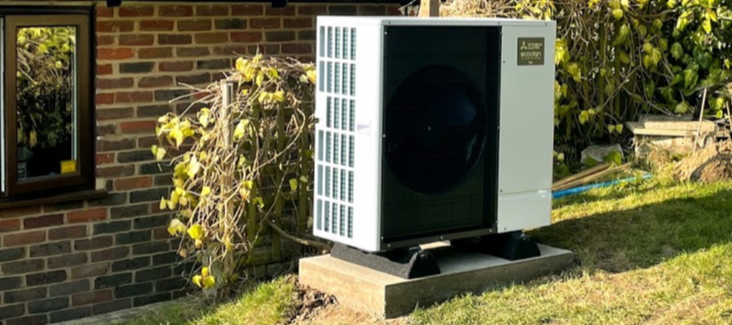
I Iive in a terraced house. Could I have a heat pump installed?  If so where would it go?

Peter E
Super User
Super User
May 1, 2024

On the revised App there is a Heat Pump section on the Home page and you register your interest. It doesn’t commit you to a course of action but it does take you down the path where by the Heat Geeks can establish where the best place for all the elements of the system need to be.


If you commit to going ahead with the survey then I think the fee is £350 which I believe is refunded as part of the cost of the installation. I followed that process but for practical reasons I didn't complete but the house heat loss survey was very useful and I opted to stay with my gas boiler for the time being but I've upgraded a couple of large windows to triple glazing and upsized a radiator in the hallway which was an extension to the house and hadn't been sized properly.


Peter

Reducing my yearly fossil fuel usage with an EV (-900 litres petrol), A2AHP (-8,700 kWh gas) and Timed Immersion heater (-1,500 kWh gas)
Newcomer
May 1, 2024

Whereabouts on the home page?  I can't see it. Can you send a screen shot?