


Question

Effect of new price cap on my Direct Debit

  • July 26, 2026
  • 6 replies
  • 96 views

The email I received from OVO on 17 July 2026 informed me that my Direct Debit has gone up by 29.8%.

It says “These are the possible reasons for why your payments need to go up”, and lists all the possible reasons Obviously the new price cap is one reason, but how can I tell whether any of the others apply, and what those effects amount to?

My latest bill shows that, as of 1 July 2026, my electricity price went up by 6%, and my gas price by 28%. Daily charges for both are down very slightly.

Given that I do use electricity - about 1/3 of a typical winter bill - it seems likely that the increase in my Direct Debit is not fully explained by the increase in the Price Cap. Hence, I’d like to know, or be able to work out, what the other factors are. The email from OVO does not help me do that.

Regards, George

 

6 replies

Jasmin10
Rank 4
Forum|alt.badge.img+2
  • Rank 4
  • July 26, 2026

That’s a good question George, I look forward to seeing any answers.

Also, I thought the point of being on a fixed tariff, as I am, is to protect me from prices changing in the year. My direct debit has gone up by £17/month which is a huge amount for me living on my own.

Jasmin


Forum|alt.badge.img
  • Rank 2
  • July 26, 2026

The only way to see why there has been a significant change in the direct debit is to look at the last few monthly bills. With OVO if you are on a Direct Debit this is calculated to be enough over 12 months to cover your bills through to March each year. The OVO Year runs April to March.

On Direct Debit your bills will seem much higher than necessary now as the balance will build up to cover the higher winter bills so it should all even out. If not you will need to claim a refund.

Only alternative to this situation is not to pay by Direct Debit and instead pay your monthly bill in full as I do. This way you know exactly where you stand but OVO do not allow full bill payment by variable Direct Debit.


Firedog
Super User
Forum|alt.badge.img+8
  • Super User
  • July 26, 2026


I’d like to know, or be able to work out, what the other factors are.
  

It’s not difficult - but a bit tedious - to work out what the DD should be. Refer to the Plan page of your online account and find the Future Annual Consumption (FAC) figures, the unit rates and standing charges. Then:

  1. For each fuel, 
    1. Multiply the FAC by the unit rate and add 5% VAT to find the projected annual fuel cost;
    2. Multiply the standing charge by 365 and add 5% VAT to find the annual charge;
  2. Add the four figures together to get the total projected annual cost;
  3. If the account’s in credit, subtract the current balance from the total; if it’s in debit, add the current balance;
  4. Divide the result by 12 and add the result to the total cost (to provide the ‘one month’s credit’ buffer at 31 March);
  5. Divide this final figure by 12 to find the approximate DD. It’s only approximate, because it changes a bit over the year to account for higher usage in winter, so it depends on when the calculation is made.

You can see the results of the actual calculation on the Direct Debit calculator page, where you can also see the effect of raising or lowering the DD. 

Now, to your question: apart from the tariff changes, a common reason for changes in the DD is a change in the FAC, which is based on the previous year’s consumption. An unusual major change in consumption will affect the FAC and consequently the DD.
 

[This may be totally unrelated to your unexpected increase, but a week ago I saw a completely unexplained reduction in my own FAC. This might have been a temporary glitch, but it could indicate a change in the way the FAC is determined. I’m busy investigating this as I write and I’ll come back if I learn anything worth sharing.]


PS: After drafting this reply, I see that ​@DavidWSR has also responded. I’d just point out that paying on demand as he does costs significantly more that paying by DD. 


Forum|alt.badge.img
  • Rank 2
  • July 26, 2026

As Firedog points out paying by a non Direct Debit method does cost a little bit more. However, I do make savings during the summer months allowing me to make some interest on that in the bank or building society ready for the higher bills in the winter.

Perhaps another advantage is calculating payments is not required as a pay bill in full on demand customer. I just pay each month what is due. SSE used to and I believe Octopus Energy do allow a variable Direct Debit payment of the full bill monthly. There will be a reason OVO and some other energy providers do not allow this method of payment which is used by other utilities such as telecoms providers. Not sure what this reason is.

The VAT rate is due to change from 5% to 0% in October so you may wish to factor this into the calculation.  


Forum|alt.badge.img+2
  • Rank 12
  • July 27, 2026

That’s a good question George, I look forward to seeing any answers.

Also, I thought the point of being on a fixed tariff, as I am, is to protect me from prices changing in the year. My direct debit has gone up by £17/month which is a huge amount for me living on my own.

Jasmin

If you are on a “fixed tariff”, you are protected from price changes, BUT that just fixes the amount that you pay per kWh and the amount you pay for your daily standing charge, it does not fix the Direct Debit which is determined by your actual usage. Direct Debits are reviewed, regularly, by OVO and they have a responsibility to ensure that customers do not run the risk of debt. 

However, if you think that this increase is incorrect, it is worth contacting OVO. I never phone OVO and always use the Messenger facility on Facebook.  Whenever I have been faced with this situation, I send evidence showing why I think that their amount is incorrect. 

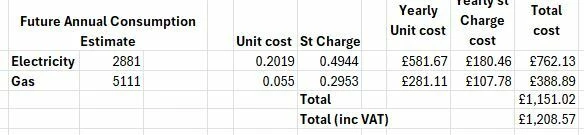
First of all, I work out, using the Future annual consumption (found on your My Plan page when you LOG IN to your account) what a reasonable estimate for my annual costs will be. This is what mine would look like at the moment.

If I divide my total by 12, this gives £100.71 as a reasonable Direct Debit.

However, OVO expect you to have a credit of, at least, one month’s DD payment in your account AT ALL TIMES. So for me, I would have to add this £100.71 to my Total giving  1309. 28. I then have to divide that total by 12. This would give £109.11. It is likely that OVO would suggest £110 for me.

These calculations assume no credit (which I would subtract from the Total figure) or debt (which I would add to the Total figure) BEFORE working out a sensible DD amount. 


Firedog
Super User
Forum|alt.badge.img+8
  • Super User
  • July 28, 2026

As Firedog points out paying by a non Direct Debit method does cost a little bit more.
  

The term I used was ‘significantly more’. Of course, what is significant for one may be insignificant for another, and one man’s little bit might cause another to choke. I just did a back-of-an-envelope calculation to see how big the difference is in fact. Using the GB average figures for single-rate electricity and gas for this quarter and the current typical usage values (electricity 2700 and gas 11500 kWh/year), this was the result:
 

Payment

method

Fuel
Unit

rate
Standing

charge
Fuel

cost

SC

Total
Diff.  

OD - DD
Payment

method

Fuel

p/kWh

p/kWh

£/year

£/year

£/year

£/year
Direct

Debit
Elec 26.11 57.19 704 209 913 70
  Gas 7.33 29.04 843 106 949 72
  Total     1548 315 1863 142
On

Demand
Elec 27.56 65.74 744 240 984  
  Gas 7.71 36.69 887 134 1021  
  Total     1631 374 2005  

Apologies for any mistakes. The Direct Debit total of totals comes to £1862(.66), widely reported as the price cap for the current quarter.

These sums show that it would cost the typical dual-fuel customer £142 annually - almost £12 a month - for the privilege (some would say ‘inconvenience’) of paying on receipt of bill.