




Jequinlan
Rank 10
Rank 10
April 22, 2022

How do my solar generation stats compare? Discussion.

  • April 22, 2022
  • 35 replies
  • 1343 views

1 month on from solar and this is my stats of my 4kwp system with 3 6kw inverter and 10.2kw battery. 


Was wondering how it fared against others of similar.
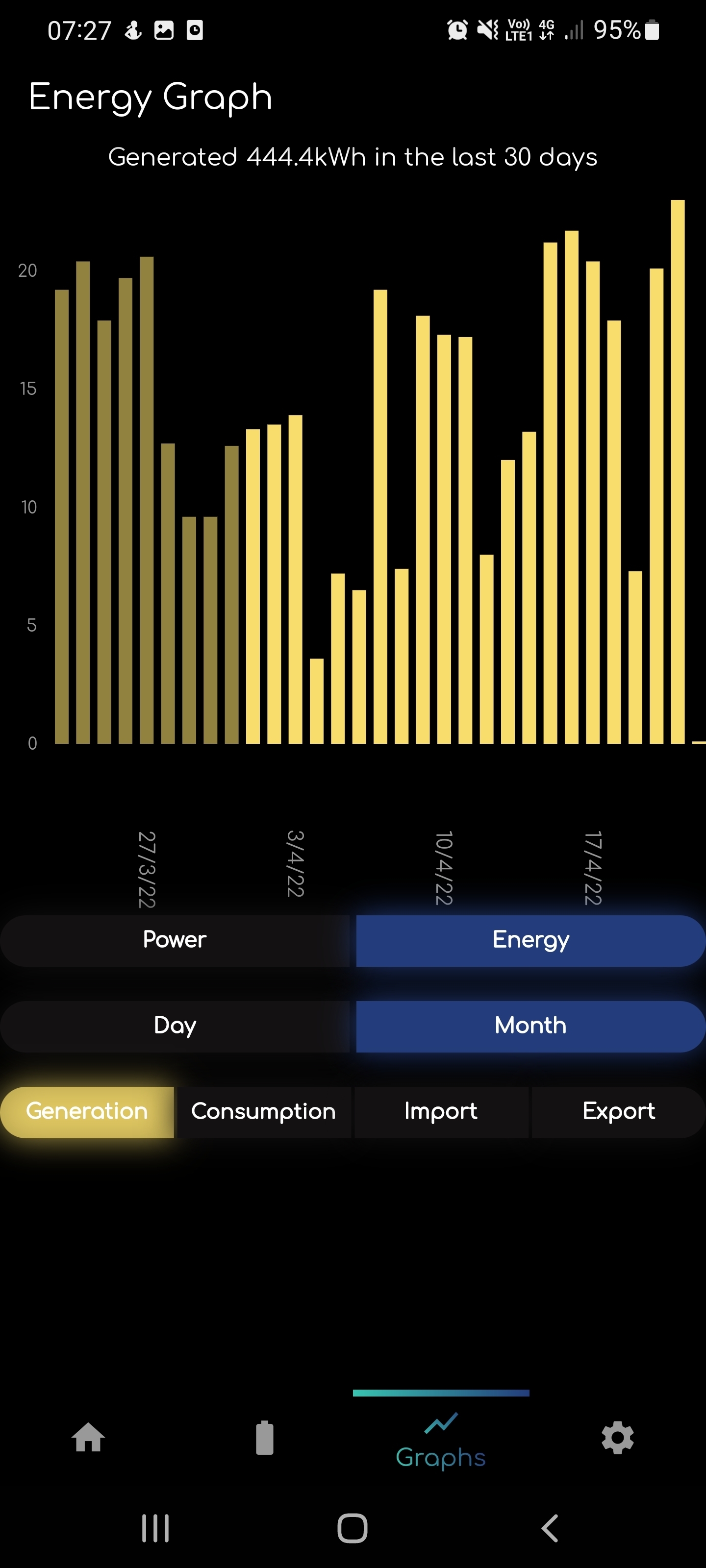


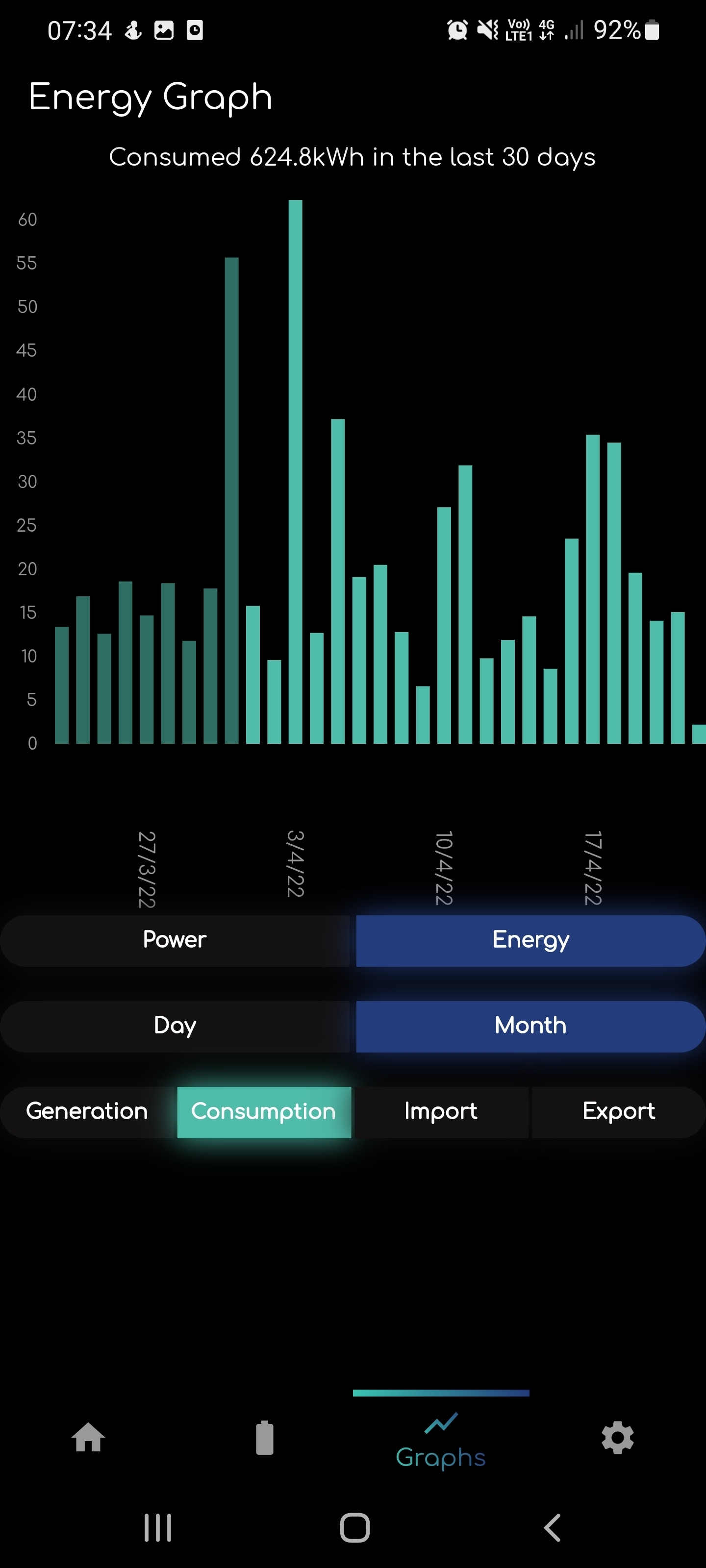
And total house usage (i have a nissan leaf pure ev) hence odd peaks.
 

35 replies

BPLightlog
Super User
Super User
June 3, 2022

That looks like a good saving y-o-y @amackayj. I guess that’s with the solar PV help?

sorry but I can’t help with the Solis inverter. I have an couple of old Efinity inverters (installed early 2009) and have recently added battery storage. 
We have a LuxPower controller added to monitor the solar generation and manage the battery system. They have an app (and web site) to log and monitor data so you get a full picture of solar, battery, consumption and draw from the grid. 


Bring me Sunshine ~ E&E {Solar PV, Battery Storage, Hybrid EV, ASHP and Home Assistant automation}
Newcomer
September 25, 2022
  • @BPLightlog: how are you? Can I ask a few questions on your system/graphs please?
  • What is your set-up, which battery (1 or 2 and type) and what are its specs?
  • How quick can your grid/battery/solar react to appliances using energy?
  • I can’t quite see from your graphs whether your battery can alone, when charged sufficiently, deal with usage of 3000W to 3500W?
     
BPLightlog
Super User
Super User
September 26, 2022

Hi @ogeitenhoeve
we have a 3.75kw PV array split over 2 facings to give a spread of Solar through the day. 
this feeds into a LuxPower control system which also has 2 battery banks connected with 9.6kW of storage. The batteries are modular PylonTech US2000’s. 
The batteries can deliver just over 3kW at peak and switch within a few seconds but I do not get an immediate switch over as the system balances the various inputs and possible exports to the grid also. 
Hope this helps. 
 

Bring me Sunshine ~ E&E {Solar PV, Battery Storage, Hybrid EV, ASHP and Home Assistant automation}
Newcomer
September 26, 2022
  • @BPLightlog: useful.

    Have US3000 with 3.6Kwh, nominal (dis)charge 37A at 50V and max at 74. However, we cannot get more wattage than 37x50=1750 (have seen 1916W charging). What I cannot understand is why setting cannot be set at <=60W so
    that we can run a kettle on battery? Nominal is nominal not maximal.
  • Your US2000 has 25A nominal at 50V, so 1250W, so two at 2500W (but  you can reach 3000W).  
  • Our switching takes 5min so we have loads of instances were we use the grid while the battery could and should take it. How can one adjust the programming of this imo inappropriate balancing? See the graph attached. LuxPower one. See how grid kicks in just after 12:00 without need and the 3rd grid peak the  big one down at ~15:30. Thanks.
BPLightlog
Super User
Super User
September 26, 2022

@ogeitenhoeve 

there are several others with more knowledge than I have on this - prompt … @Blastoise186 ?

But as far as I understand it, the max output is controlled by the inverter controller rather than battery capacity. You also need to remember that the app is not real time and only updates every few minutes so that might explain your apparent 5 min delay to switching. 

Our batteries by the way are 4x which might explain the 3kW.

Just fyi, there is a way to link directly to the Wi-Fi of the system controller so that you can check the real time switching but you will need the extra details of your module (Wi-Fi channel name and connection).

Bring me Sunshine ~ E&E {Solar PV, Battery Storage, Hybrid EV, ASHP and Home Assistant automation}
Blastoise186
Super User
Super User
September 26, 2022

I’m really sorry but this isn’t something I can help with. I will review the entire thread just in case though, please bear with me as my thread trawls can take a while!

Securing energy by zapping security bugs... For that is The Blastoise Way! Remember, I'm just like you - AI Powered Evil Geniuses aren't Staff!
Blastoise186
Super User
Super User
September 26, 2022

Ok, thread trawl complete! Thanks very much for your patience! :)

@M.isterW @nealmurphy this seems right up your street. Would you be happy to stop by?

Securing energy by zapping security bugs... For that is The Blastoise Way! Remember, I'm just like you - AI Powered Evil Geniuses aren't Staff!
Newcomer
September 26, 2022
  • @BPLightblog; great; 4x batteries would do the job.
    Our inverter can handle it, i.e. it is 4000W. Also we were told (afterwards) that 2 batteries would be needed for 3500W but that the inverter can handle it; I still think that one battery on 60A would do the job if the ceiling is raised from <=37A to <=60A. We would not fill two batteries, generally speaking.
  • Ah, you saying that the data are somewhat wrong but that nobody can explain to me, if the data are taken every 3min or 5min, then the instantaneous measurements taken should not show the grid taking over when it should not.
  • I had asked for the real-time switching data; that would help to assess whether the data are right or wrong. I will try to see how to get those data.
BPLightlog
Super User
Super User
September 27, 2022

@ogeitenhoeve yes, the system controller switches every few seconds - bear in mind that it is coping with changes in PV production, coupled with demand, coupled with battery energy and so it is juggling these to try to make the best match. The app however, only updates every few minutes ( I see an update today with the time stamp of the latest reading taken) and so if you refresh your screen, you will see the slower reading record - the time does not update until the next record slice


Bring me Sunshine ~ E&E {Solar PV, Battery Storage, Hybrid EV, ASHP and Home Assistant automation}
Newcomer
October 1, 2022
  • @BPLightlog Yes, I know system only updates every 5min but:
    - instantaneous measurements should be correct and they are not;
    - when the battery is >=90% the system, stops loading the battery with max current & instead leads a large amount for free or at a low rate to the grid; I don’t want that but it is completely unclear how to block that (app owners probably made some deal with the energy suppliers such that they can snoop a little bit of many to gain a lot)
    - when I run something above max sun-input then the battery should step in if it is loaded >=10%, not 5min later; the issue is that the controller is not a local program uploaded and acting fast (on [sub]second scale) but seems to be steered from outside only every 5min, meaning also that if there is no wifi one is screwed and delivers again for little or nothing to the grid. (E.g., Arduino technology puts the controlling program on a local chip and one can upload updates if one wants to so the functionality needed exists but apparently there are some external motives not to make it happen, see above?).
    - When the battery fails and needs [we had one within 5wks] a manual reset is needed and then the default settings kick in being that grid loads the battery even when there is full sunlight so one manually has to reset everything on the app while there should be an automatic default set by the individual users [i.e. if one is not checking the system continuously one can be messed up for days].
    - All the above indicates that the controllers are very poorly designed.
    - Who controls the app, from the outside? If from the upside does that mean when there is a crises the country with the app can mess our solar energy supply up?  How independent is the system for the user? What happens if the grid falls out? 
    - My supplier refuses to answer these questions.