



Balancing the electricity grid - a guide
Updated on 08/12/23 by Emmanuelle_OVO:
Good news! OVO now offer two grid balancing schemes for eligible customers! Earn rewards while reducing pressure on the grid. Want to find out more? Check out our FAQs:
The electricity grid in balance - guide
We are more often hearing energy experts use the phrase “Balancing the grid”. It is an important concept and one with which we should try to be engaged as we accelerate towards a zero-carbon, energy-efficient future.
However the term “Grid Balancing” is applied in various ways according to which part of the electricity grid is being referred to. A Government spokesman will use grid balancing in a very different way to a Network Planner working for a Distribution Network Operator (DNO).
1: National Grid Balancing - Supply and Demand
This is the concept of grid balancing which is most often being referred to, and is the simplest to understand. It is also one that has existed since the formation of the National Grid in 1926.
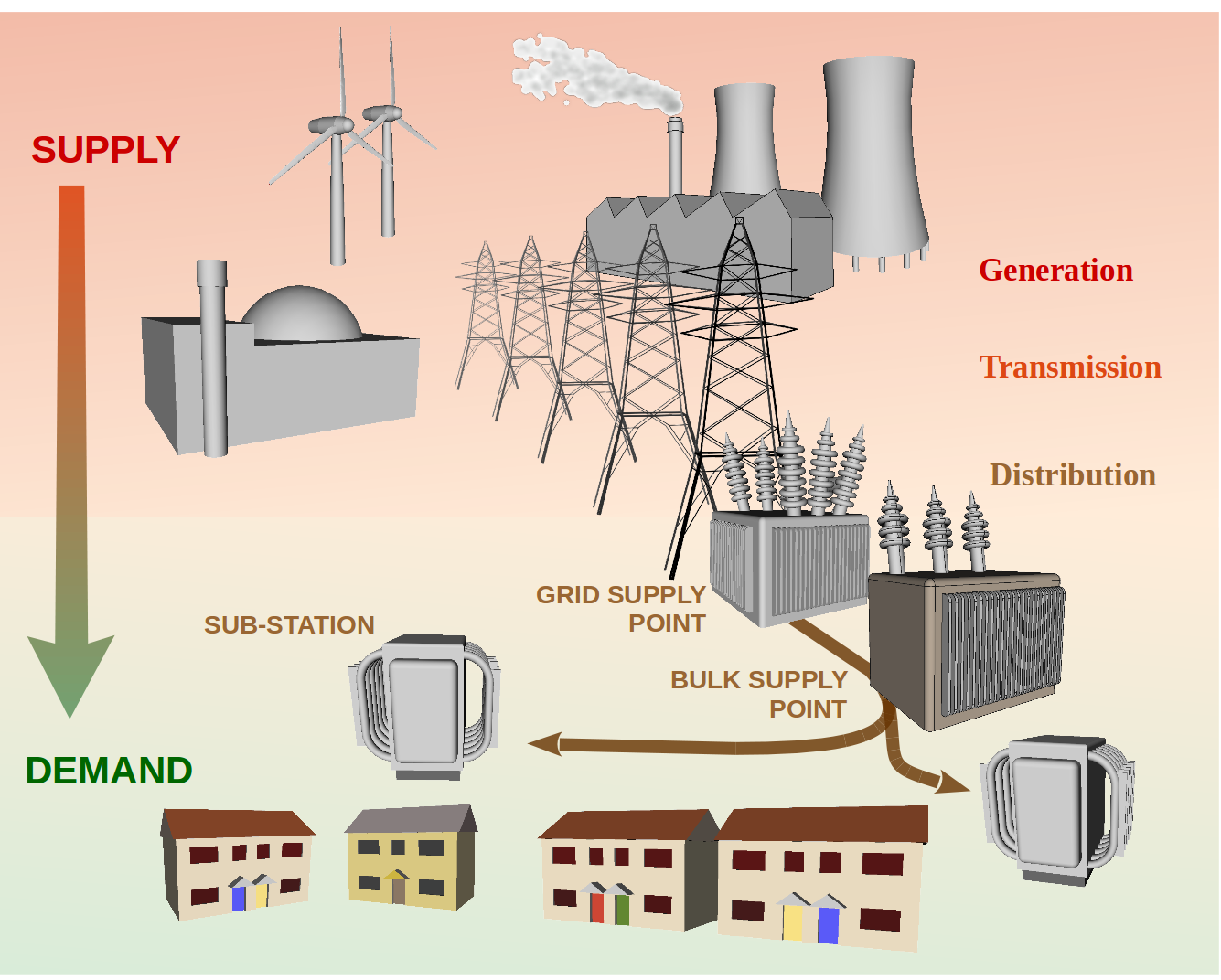
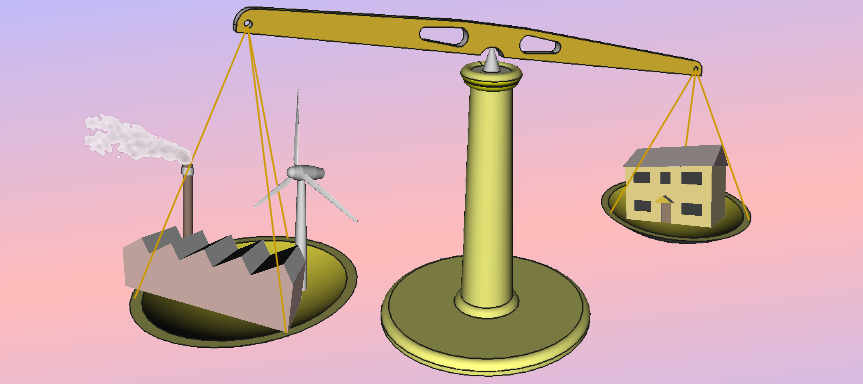
To keep the electricity grid in balance, the amount being generated (the Supply) must equal the quantity required for consumption (the Demand).
This is the task of National Grid PLC. However, they are only directly in control of the Transmission Grid - a network of cables throughout the UK which operate above 132kV.
Electricity generation is the province of a plethora of other companies of which only the largest will supply power directly to the Transmission Grid.
As the UK electricity supplies are ever diversifying to a wide range of renewable generation techniques, the majority of these feed in their energy via the regional Distribution Grids. Nevertheless that energy is offered/traded at the national level without the involvement of the Distribution Network Operators.
It therefore remains the role of National Grid to ensure that Supply meets Demand, whether they are dealing with EDF offering megawatts from a large nuclear site, or Kaluza negotiating on behalf of 400 owners with Nissan Leaf EVs plugged in via their V2G chargers.
2: National Grid balancing services for Export
The electricity grid is divided into two main parts - Transmission and Distribution.
Joining these parts together are the Grid Supply Points (GSPs) - large oil-cooled transformers that take the 400kV of the National Grid and deliver 132kV to the regional DNOs.
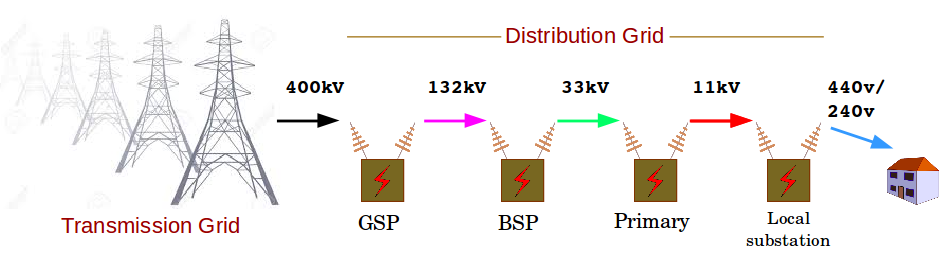
Many of these large transformers were designed and manufactured 20+ years ago, before we entered the period of widespread renewable generation.
By 2015, 116 of the 350 GSPs exported power back onto the National Grid, since when that figure continues to rise.
A typical GSP might be rated at 200MW. Unless they were designed with “reverse power” in mind, their ability to feed energy back up the line is restricted to approximately 50% of their forward capacity.
The region that is most often exporting back to the Grid is Scotland, due to the large number of hydro-electric generation sites connected to the Distribution Network.
National Grid PLC make a charge for balancing services: BSUoS (Balancing Services Use of System charge). As of autumn 2020 this is capped at £10/MWh, chargeable every half-hour.
The BSUoS reflects the system usage to absorb the exported power, particularly from renewable sources whose output can’t be controlled (primarily solar and wind). This includes the need to maintain generating stations “in reserve” which can be called upon at short notice to deliver power when there is a rapid fall-off with solar or wind energy.
3: Constraints on the regional Distribution Grid
There are areas on the Distribution Grid which have insufficient power available during short periods of the day or during some weeks of the year. These are called Constraint Management Zones (CMZs)
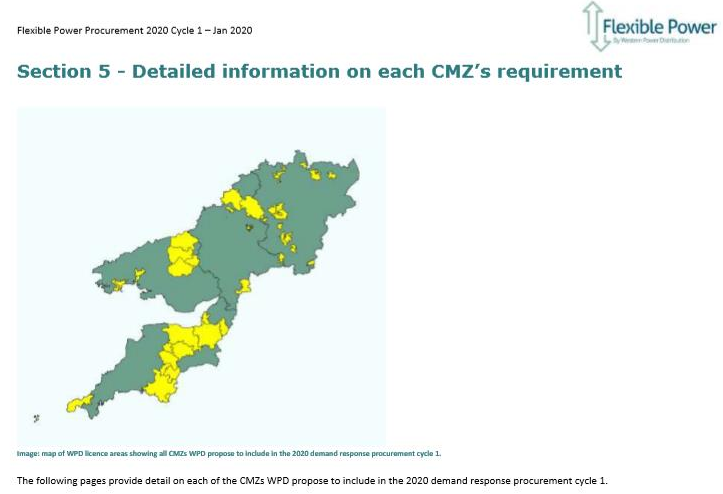
This map is taken from Western Power’s Flexible Power procurement document, 2020-Q1.
The yellow areas contain Constraint Management Zones (CMZs), within which there are various factors preventing Western Power being able to satisfy the required load. The constraints vary from month to month and hour to hour. So there is a large network of solutions which are brought together to resolve the issues.
In some cases larger commercial users will be compensated for reducing demand, whilst in other areas the DNO will buy stored energy from individuals and community groups. Payments can also be made for holding an electrical generation source on stand-by, even if it doesn’t actually get called on.
A copy of the CMZ Procurement document for the Summer 2020 round of bidding can be downloaded here. This covers 45 CMZ areas with a total requirement of 302MW.
Below is a brief extract of a Procurement Requirement for one CMZ:
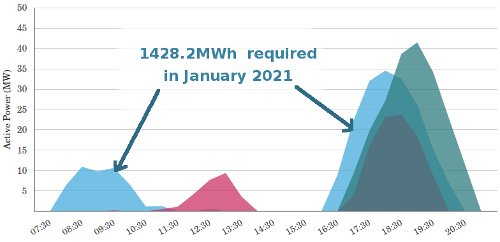
The predicted Energy Demands in this graph are for 2021 at the identified times of day.
Flexibility demand forecasts are calculated using computer modelling, and are for a variety of different reasons. The minimum offer is for 6kWh, which enables individual households to respond and help balance the grid.
4: Regional generation constraints due to over-supply
Single phase connections to the Distribution Grid are normally accepted if they are less than 16A (3.68kW) and comply with the relevant G98 standard (was G83). This covers the majority of inverters installed for the connection of PV Solar Panels. The standard is defined by the Energy Networks Association.
Other Distributed Energy Resources (DERs), including many Home Storage Battery units, fall within the G99 standard. The current version of the G99 Standard document can be downloaded here.
Those Resources limited to 16A per phase are categorised as G99: Type-A.
Power Generating Modules (PGMs) with export potential between 3.68kW and 50MW are divided into categories B, C & D and might be connected to a local substation (440v), a Primary substation (11kV) or a Bulk Supply Point (33kV).
G99 B, C & D installations are only granted consent if there is enough spare capacity at the transformer to accept that level of export energy.
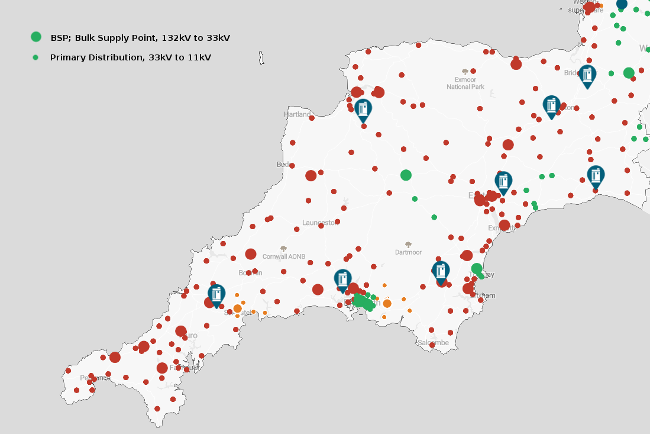
This is the status of the Distribution Network Capacity Map for Devon & Cornwall in summer 2020. The Grid Supply Points are the Blue/white pins. The smaller local substations are not shown.
Any BSP or Primary transformer which still has export capacity available for further renewable-energy connections is shown in green. Those already at full capacity are in red.
Whenever the SW Region supply of renewable energy exceeds demand, Western Power Distribution (WPD) require a proportion of Generating Sites to reduce their export or cease altogether until balance is restored.
Discarding renewable energy in this manner adversely affects our Carbon footprint. Depending on their contracts, some Generators also have to be compensated for lost revenue.
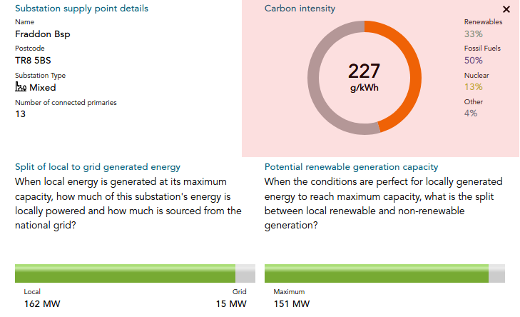
The data above is from a Bulk Supply Point in central Cornwall showing that the transformer is accepting 162MW out of the specified maximum 151MW of renewable power - an excess of 7%.
The figures in the zone highlighted pink are “live”. This data is publicly available from the excellent Carbon Tracer site provided by Western Power.
5: Mains power specification
The only constant parameter of mains electricity supply in GB is the 50Hz frequency. This means that every generator using a mechanical rotating shaft is spinning at the same speed.
It is not possible to connect additional generators to the National Grid unless the frequency is matched. Any attempt to do so would cause excess current to flow, thereby throwing the contact breakers open again.
The voltage must be kept within 230v -6% +10%, which equates to 216-253v AC.
As demand increases, the voltage at the far end of a cable will fall.
The regional DNOs have to set taps on their grid transformers in order maintain the voltage within these minimum and maximum limits. Too high a voltage causes premature aging of equipment. Too low a voltage means that renewable-energy sources will automatically de-couple themselves from the Grid, which is a required safety feature. {1}
Where there are locations fed by long overhead cables which suffer significant voltage drops at times of peak demand, the town from which that feed originates may have to suffer higher voltages in order maintain the overall balance.
The unfortunate consequence of this will be overly-high peak voltages in the town at times of low demand.
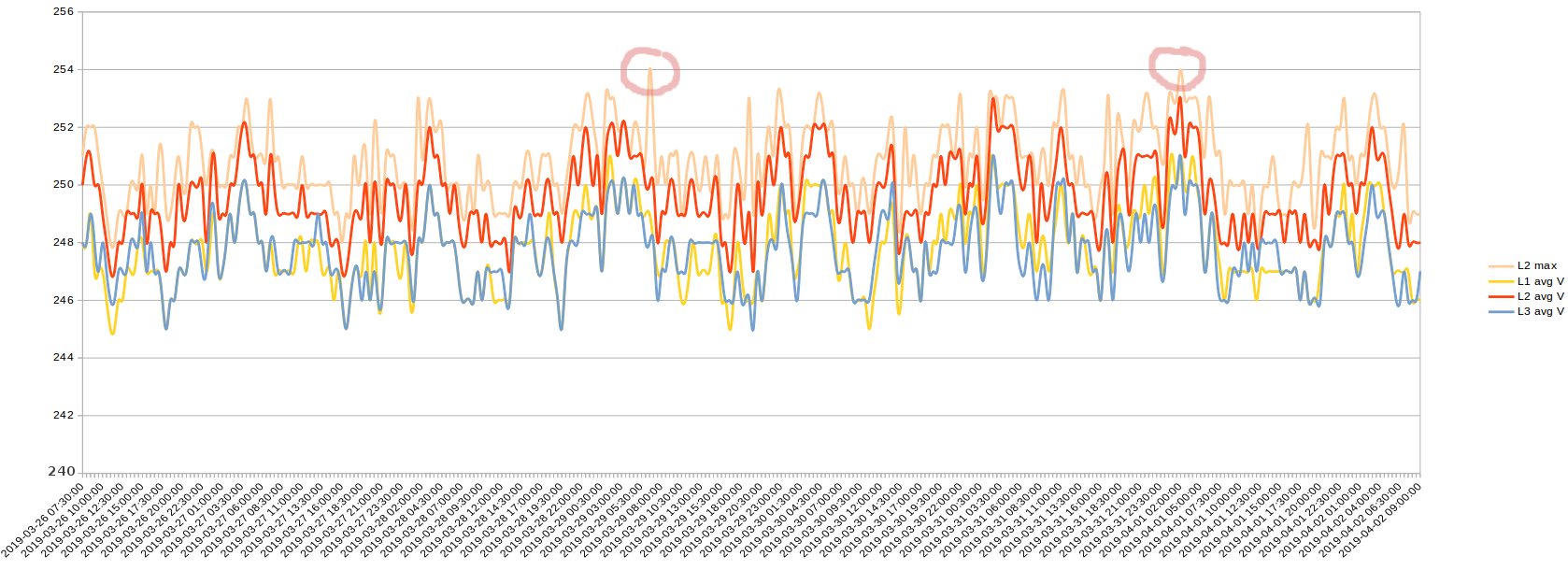
The graph above is from a monitored substation in a town which has long 11kV feeds to villages in the surrounding rural area.
Red, Yellow and Blue lines show the average voltage for each phase during a half-hour period. The higher orange line is the peak-voltage on the red (L2) phase. This reaches a maximum 254v at 7am on 29th March and again at 5:30 am three days later.
6: Substation meshing
Where there is medium scale housing expansion, it is often the case that a substation is running close to its limits but it isn’t viable to install a completely new substation for those houses.
Meshing resolves this imbalance by bringing in additional electricity from a nearby transformer that is more lightly loaded.
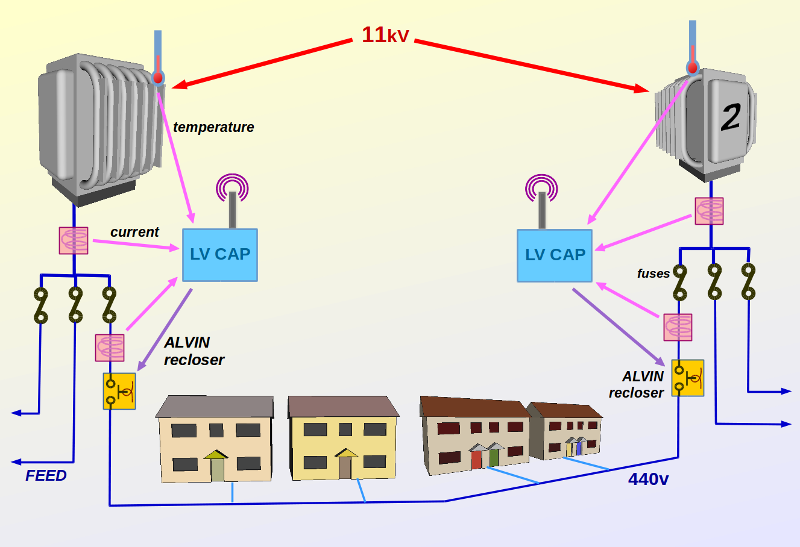
The houses above are always connected to substation-1 on the left.
Each transformer is equipped with temperature and current sensors providing data to an LV CAP™️ monitor.
When substation-1 is approaching its capacity limits, a signal is sent to the LV CAP™️ monitor at the second substation. Provided its sensors detect that it can accept the additional loading, an ALVIN Recloser breaker is energised. This allows the 440v Feed to those houses to be shared equally between the two transformers.
This isn’t a universal solution. For example, each transformer must have the same earthing arrangements and phase-topology (either DYN-1 or DYN-11).
On the positive side, meshing may provide a temporary solution to localised overloads as more consumers install EV Chargers at home.
7: Transformer losses due to imbalance
The two greatest causes of energy loss on the Distribution Grid are harmonics and phase imbalance.
7a: Harmonics are the result of non-linear and inductive loads such as motors with saturated magnetic fields.
These unbalanced loads create harmonics at frequencies that are multiples of the basic 50Hz. They are picked up by the coils in the grid transformers where they resonate, resulting in varying voltage and current. The energy from these unwanted fluctuations produces heat in the transformer windings due to a drop in efficiency.
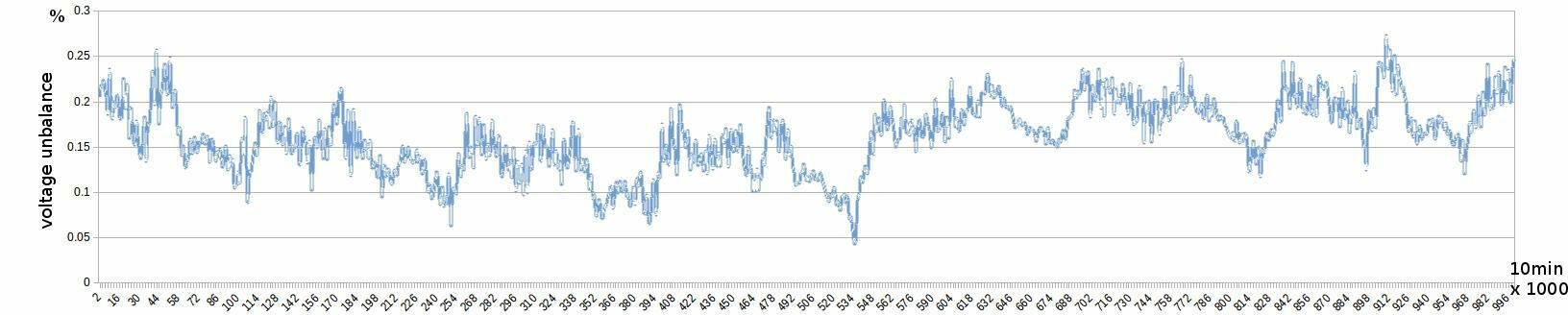
7b: Phase imbalances occur at local substations because most houses have single-phase connections (230v).
Houses with higher loadings, such as electric showers and EV Chargers take more current. This results in a greater voltage drop on that phase.
Houses that export from PV Solar Panels or Home Battery Storage will reduce the current required from the grid for that phase.
Since the introduction of Government subsidies for installation of solar panels around 20 years ago, losses on the Distribution Grid have risen from 5% to 10%.
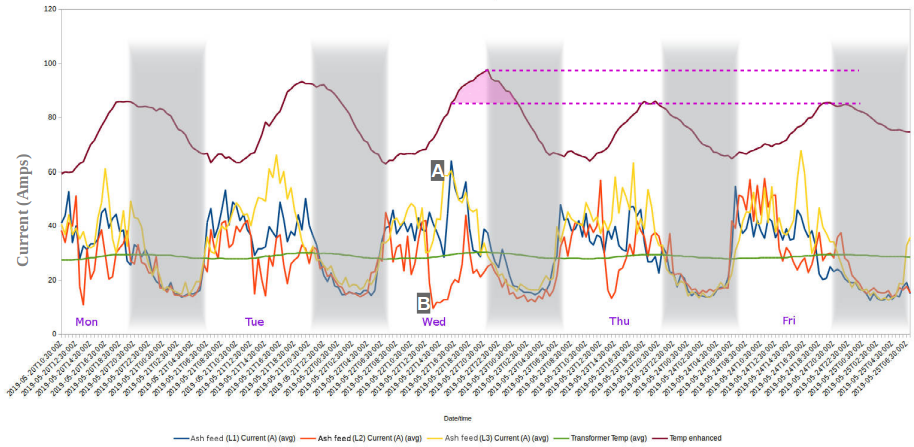
The graph is taken from a lightly-loaded ½MW transformer on the OpenLV Trial funded by Ofgem during 2019. It uses data logged in May from an LV CAP™️ monitor reporting the average current every 30-minutes.
During the daytime the transformer temperature (top magenta line) slowly rises. After 10pm it falls again as the domestic load reduces.
Phase-L2 has more solar export than the other two phases. On the Wednesday there was significant power being generated which resulted in less current being required from the grid B. The phase imbalance can be detected by the higher temperature of the transformer’s cooling oil.
In contrast the Friday was largely overcast with little solar generation. The daytime temperature rise is proportionally less because the current drawn from the three phases is more balanced. As a result the energy loss (pink area) is reduced.
Acknowledgements:
Ben Godfrey (Network Strategy) and Tom Weekes (Network Engineering) from Western Power, Karl Jones (Southwest Water Hydro-electric generation), Bridget Newbery and Rachel Haycock (Centre for Sustainable Energy), Ky Hoare (Regen) and EA Technology:- all of whom have put up with my numerous technical questions over the past two years. Finally a thank-you to Andy Wise whose inspiring explanation of grid-connection standards set me on the right course; Western Power won't be the same without you.