




Firedog
Super User
Super User
January 30, 2024
Solved

Lets understand usage data and meter reading precision

  • January 30, 2024
  • 12 replies
  • 2131 views

It is vitally important that electricity meters record accurately; meter readings form the basis for billing, so inaccurate readings will have financial consequences for both buyer and seller - customer and supplier. Meters have to be certified by the manufacturer to achieve a certain minimum degree of accuracy, and customers can usually assume that their meters are recording their usage with an accuracy of better than ±1%.

Customers with multi-rate tariffs like Economy 7 or Economy 10 have also to be confident that the readings on which their peak/offpeak usage is based are also accurate. There has been some doubt about this, so I checked my own experience.

Many OVO customers have been partaking in the Power Move scheme, encouraging us to shift consumption out of the period of highest demand into periods of lower demand. For the more pedantic of us, this has meant keeping a close eye on the half-hourly usage data smart meters provide. Modern smart meters record the usage in each half hour to the nearest Wh (0.001kWh); older ones may only record to the nearest 5 Wh. So we should be able to add up the usage for all 48 half-hours in a day to see the figure that should be added to last night's  meter reading (also to the nearest Wh) to get tonight's reading.

More than that, though, for multi-rate meters: the total of half-hourly usage in a day's offpeak period(s) should be equal to the difference between yesterday's offpeak reading and today's, and similarly for peak periods.

This was the result on one day for my Economy 7 meter, 120 days after its installation:  
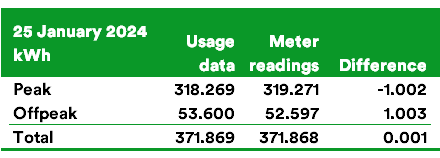


The meter total has remained within (to me) acceptable limits throughout the meter's active life; the 0.001 figure may well be -0.001 tomorrow. And it's remarkable that the sum of 5760 numbers is more or less identical in my computer and OVO's. However, the peak period register has consistently recorded a higher figure than the half-hourly data would suggest, while the off-peak register's reading is correspondingly lower.

It has taken 120 days for this discrepancy to reach 1.0kWh, so it is of course insignificant (1.0 kW charged at the wrong rate costs me 1.0 x 10p, being the difference between peak and offpeak rates. 10p in 120 days amounts to 30p a year). However, for big consumers, not to mention industrial ones, it could be a substantial figure, and of course it's a considerable amount of money in the bank for OVO.

How does this discrepancy arise? My guess is that it's just a question of timing. At midnight each day, the meter has to transmit both the half-hourly data to DCC for the period 23:30-23:59 and the meter readings to OVO. These two transmissions can't take place simultaneously, so there is bound to be a brief delay in one of them. It looks like it's the readings that are sent a little bit later. I haven't been able to find any correlation between the size of the discrepancy on any particular day with the power draw at the time, so I suspect it's completely random. It varies from 3Wh to 30Wh, with an average of (1.003/120=) 8.4Wh. It's interesting that - in this one-instance sample - the discrepancy is always in OVO's favour. I wonder if that's always the case.

Given this apparent fact of life - that offpeak usage will always be under-reported by a tiny amount - we have to consider how to minimize its effect. The easy way is to ensure that any equipment designed to take advantage of cheaper rates isn't activated until some time after the cheap period starts and is deactivated some time before it ends. This may well happen automatically if it's the meter that controls the timings, by virtue of the 'random offset' introduced to ensure that not all power-hungry appliances (e.g. storage heaters) switch on at precisely the same time. I don't know whether this offset is also applied at the end of the cheaper period; this may not be so important, because this type of equipment will usually not be active for the whole period, having achieved saturation some time earlier.


Bottom line:

  • Half-hour usage data for a day match exactly to meter readings, at least those recorded and transmitted with three decimal digit precision. Adding one day's usage to the meter reading at its start will produce the reading at its end ± 0.001kWh.
  • Readings taken from more than one register do not match exactly to their expected values arrived at by summing the half-hourly data for the periods covered by each register. In this one sample, offpeak usage is under-reported by about 2%.


 

Best answer by Emmanuelle_OVO

Updated on 05/12/25 by Ben_OVO


I received a very detailed response by one of our smart meter experts:


Bottom line:

  • Half-hour usage data for a day match exactly to meter readings, at least those recorded and transmitted with three decimal digit precision. Adding one day's usage to the meter reading at its start will produce the reading at its end ± 0.001kWh.
  • Readings taken from more than one register do not match exactly to their expected values arrived at by summing the half-hourly data for the periods covered by each register. In this one sample, offpeak usage is under-reported by about 2%.


This bit isn’t quite right as Half Hourly profile data does not 'exactly' match to meter readings, due to 2 specific reasons, UTC vs GMT and Randomised Offset.

No customer on a Smart meter is billed against their Half Hourly Profile data readings, they’re billed on the readings taken from the configurable Billing Registers for the periods in question. This then has a randomised offset applied to them that can make the offset anything up to 10 minutes variation. So the 2 are out of line but are explicitly based on the energy recorded through the metering. All of which must meet the tolerances set out to record energy in the UK.

So the key issue here is attempting to align the Half Hourly data to the meter reading (Billing) data, as they will not explicitly align, but we're not using them for billing purposes. They're for display purposes, so what Firedog is doing won't provide him the answer he wants or the outputs.


Please note this is nothing to do with accuracy of the device and all to do with confusion as to how the device operates. The data is accurate, the way it is calculated is accurate, but taking 2 separate data points, with different variables applied, and expecting them to match explicitly is what is creating this confusion.


So adding up the Half Hourly profile data to establish a value, and then trying to match that to the meter reading, will only work if you know the offset and how to apply it. But being the Half Hourly profile is not being used for billing, it's not needing to be done, it just gives how much energy was recorded in that Half Hour.

12 replies

Firedog
Super User
FiredogSuper UserAuthor
Super User
April 17, 2024

I really ought to have responded to this long ago - sorry!

We’re repeatedly told that the Hh data won’t ever align with the meter advance when a randomized offset is involved. You can’t expect the difference in readings timed at 00:05 on two consecutive days to equal the total of Hh usage from 00:00-00:00 on the first day, because the offset only applies to the registers and not to the Hh buckets.

This doesn’t tally with my own observations. These two figures - meter advance and Hh data total - match precisely (±1Wh) every day, remaining ±1Wh over a period of days, weeks or months.  The meter readings (peak and offpeak) are taken from the account website and their sum checked occasionally against the IHD, which helpfully shows total import to the nearest Wh. There hasn’t been any discrepancy in the life of this meter. Hh data are usually taken from DCC via n3rgy, again checked occasionally against OVO’s own API. Again, I’ve not noticed any discrepancy.

I can only assume that the first half-hour starts at exactly the same time as the meter register, contrary to what we’ve been led to believe. How else can this precise alignment be explained?

The part I have difficulty with is the recording of peak and offpeak usage by the meter on the one hand and by the Hh data on the other. Here, there is a discrepancy every day, which I’m happy to ascribe to the offset. Of course, if there were perfect alignment, there wouldn’t be any discrepancy at all. So I’m inclined to think that the offset is applied at the beginning of the day, but not at the end (in my E7 case) of the offpeak period. If the difference were random, I could accept it. But it’s not - the offpeak register advance is always a little bit less than the total of the corresponding 14 Hh figures. The peak register records the same amount more each day. In my case, it’s about 8Wh a day, so insignificant for me in money terms. I suspect the difference would be much more for a meter with a randomized offset closer to 30 minutes. Added together for all of OVO’s E7 customers, it could amount to a sizeable sum.

I wonder if your correspondent could show me the error of my ways, if I’ve got it all wrong again.

Noel | I have no official status; I'm just a volunteer who comes here to help other customers. My gear: Aclara SGM 1416-B Electricity-only E7 meter; Chameleon IHD3-PPMID-AAA | It may look as if I know what I’m talking about, but don’t let that fool you. |
Shads_OVO
Retired Moderator
Retired Moderator
April 18, 2024

Hi @Firedog,


I’ve managed to get a response from our smart meter expert. They’ve said:


“The randomised offset can be zero. It’s a random figure that is generated by the meter between zero and 1, so if the meter generates a figure of zero (randomly) it will apply an offset of no seconds but it’s different for every meter. There will be some with none but that is purely random. In those instances, the alignment is there but can’t be relied upon as a rule as it all depends on the value the meter has generated.”


Hopefully this helps.