First the easy one. The electricity should be measured in kWh on the meter. So to work out how much you’ve used since the last reading you simply take the old reading away from the current reading on the meter.
Now for the trickier one (science books at the ready)…
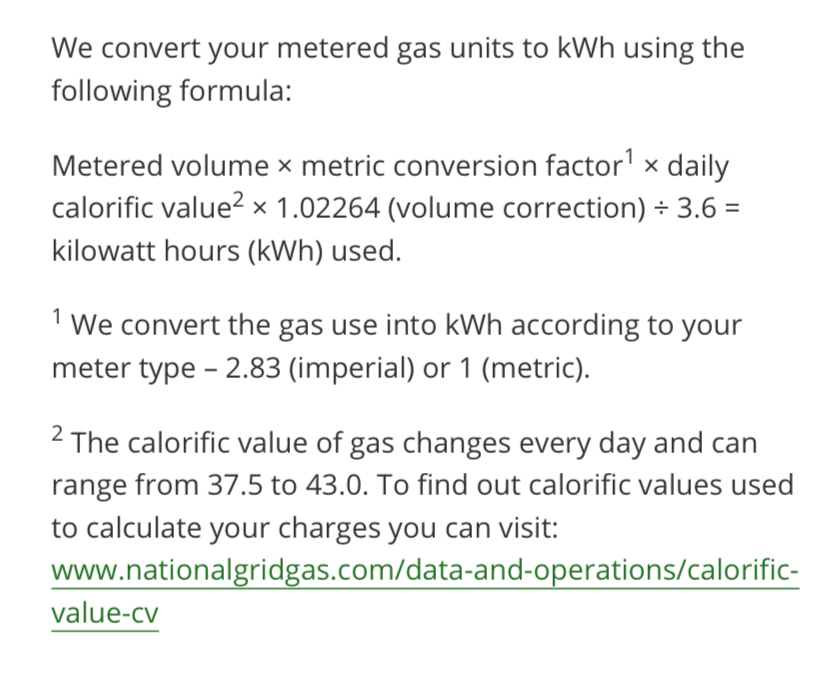
Gas meters can measure usage in cubic feet or cubic metres. If yours is measured in cubic feet then multiply the value by 0.0283 to get cubic metres.
The volume of a gas is dependent upon pressure and temperature and therefore varies. The volume of gas measured by the meter is adjusted by multiplying by a correction factor to take account of the temperature and atmospheric conditions. The correction factor used will be shown on your gas bill (e.g. 1.02264).
Next, the volume needs to be converted into a calorific value (CV) which is a measure of the energy released when a given volume of gas is completely combusted. This depends upon the gas’s composition. The CV usually ranges from 37.5 to 43.0 MJ per cubic metre. The value used should also be on your bill.
Finally. the thermal energy can be converted into kWh. 1 Watt is 1 Joule per second. 1 Joule is 1 Ws. 1 kWh is 1000x3600 Joules = 3.6 MJ.
So divide the CV by 3.6 to convert MJ into kWh.
There will be a test next week, so don’t forget to revise.
As mentioned below, the calorific value of gas changes every day and can range from 37.5 to 43.0. To find out calorific values used to calculate your charges you can visit: https://data.nationalgas.com/find-gas-data.
Hi, I was wondering if someone out there could help me check something. Below is my most recent bill calculation. When I do the calculation I get a totally different result. I am using the method shown on the OVO web site …. x 1.02264 - x 40.0 - / 3.6 but numbers turn out totally different. Is anyone able to do the calculation and confirm if the below 2744.906 kWh amount used looks correct ?
Hi @franR , that looks close to being the calculation for an imperial meter
See the extra x2.83 for those meters. If yours is not imperial but metric, you will need to get that changed via customer support. If you’re not sure, then post a photo of the meter and someone will be able to check for you
Bring me Sunshine ~ E&E {Solar PV, Battery Storage, EV, ASHP and Home Assistant automation}
Some of my Gas Readings are changing on subsequent days as per the example chart below … Mostly they are increased but sometimes they go down. Is this a sign that there is a problem with the meter or is it a ‘balancing up’ within OVO? The columns contain the historical readings which appear on each day. Data in Blue are the changes, if any, which appear a day or two afterwards.
Thank you … if that’s the case I’m not sure why only some of the values change … and one of them changed 2 days later …
From what I’m aware of, the figures are initially based on an ‘average’ figure. Because the cv’s are often different depending on region, that comes later. Suppliers reaction is partly based on figures being released by National Grid but I’m not sure if the timing varies. Of course if the initial calculation is accurate then it doesn’t need adjusting
Bring me Sunshine ~ E&E {Solar PV, Battery Storage, EV, ASHP and Home Assistant automation}
First, those aren’t ‘readings’. A meter reading is the number you see on the meter’s dial or display, nowadays almost always the number of cubic metres of gas that have passed through it since it was first installed. The numbers in your table are usage figures converted to amounts of energy consumed in a specific period. I’m not sure where you’re taking these figures from, but if they’re from the meter itself, these are for guidance only. The figures used for billing should be available online.
Next, BP has explained why these numbers might change, because the calorific value of the gas consumed on any particular day will not be known until a day later and sometimes a few days later.
The calorific value varies around 40 MJ/m³, but it should always be between 38 and 41 according to the OPSS, the standards body responsible. The line in your table that shows one figure increasing from 89.79 to 97.45 is suspicious, because the values can’t both be within the prescribed limits. If 89.79 was calculated using a CV of 38, it shouldn’t be possible for it to rise above (41/38) x 89.79 = 96.88. It’s possible, though, that an older OPSS direction allowing for a maximum CV of 42 MJ/m³ is still being applied. I don’t know it that’s legal, but that’s a question for OPSS and the gas transporter concerned. OVO have to use the figure published by National Grid.
From a quick survey of CVs for 17-20 February in my region, it doesn’t look like there has been any sort of revision of that order.
Noel | I have no official status; I'm just a volunteer who comes here to help other customers. My gear: Aclara SGM 1416-B Electricity-only E7 meter; Chameleon IHD3-PPMID-AAA | It may look as if I know what I’m talking about, but don’t let that fool you. |
Need advice from other members?
Ask your question to our members - they have the experience you're looking for: