Rank 4
July 10, 2023
Solved

Is it OK or not OK to have a debit balance?

  • July 10, 2023
  • 32 replies
  • 2046 views

My 16 July bill is going to have a zero balance. At current rates - I’m on a variable tariff - I expect to use roughly £80 worth of gas and electricity per month from now to mid-October, then £140 per month from mid-October to mid-April, then back to £80 per month over the summer. Therefore, £1320 in total.

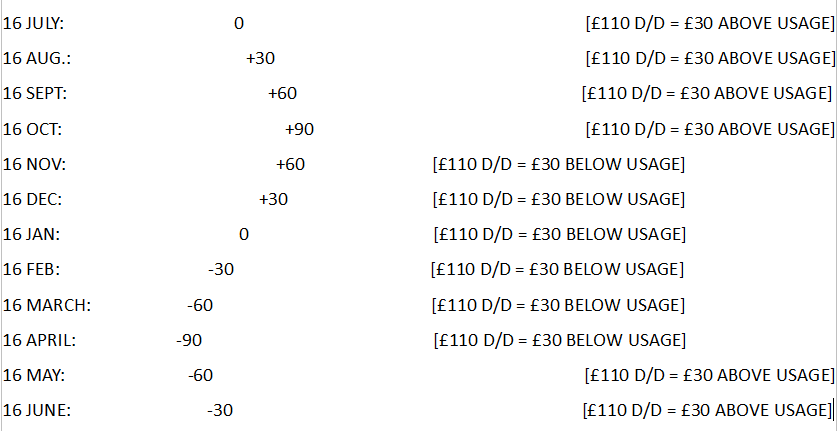
£1320 divided by 12 = £110 per month. Now, OVO’s system seems quite happy for me to set my monthly direct debit to £110. But if I do, this is what’s going to happen:


That is to say: every year going forward, five of my monthly bills will be in credit, five will be in debit, and two (for July and January) will have a zero balance.

My question is: is OVO fine with this, or will I be hassled - and my account end up in collections - when my account goes into debit in February?

Best answer by Firedog

Updated on 22/07/26 by Abby_OVO


How we work out your Direct Debit amount


The goal is to ensure you have enough credit in your OVO account for one month’s payment by the end of March. This will help cover changes in your energy use throughout the year.


For new customers, this process starts once you reach March. When you first sign up, we aim to make sure you have no remaining balance at the end of the year.


We will regularly check your Direct Debit payment to ensure it still covers your energy use.


If your account isn’t in credit, we're here to help


If your account isn’t in credit, that’s okay and it doesn’t necessarily mean your monthly payments need to change. We’ll let you know if it ever does.


If you’re worried about your payments changing or you can’t afford them, please speak to our team. We can make sure you get financial support that’s tailored to you and your situation. There are many options available for anyone who needs help. To get in touch with our team: 

  • Sign up to our online tool at ovoenergy.com/payment-support and we can find the best plan for you.

  • Call us on 0800 408 6615. We’re here Monday to Friday, 9am and 5pm, and 9am to 2pm on Saturday. 

  • Talk to us online Monday to Friday, 8am to 6pm, and 9am to 2pm on Saturday.


You’re correct in understanding that you are ‘okay’ to go into a debit balance while on Direct Debit.


Due to the agreement and the way that this is set up over the year, if you’re in a debit balance, that’s okay, as we intend for the Direct Debit to even out the balance throughout the course of the year. It’s typical for accounts on Direct Debit to go into debit through the winter period, and then build up credit again during summer when you’re maybe not using the heating or lights as much as winter. 


If you have any questions specific to your account, you can direct them to the Support Team for more information.


£1320 divided by 12 = £110 per month. 


It’s really encouraging to see a customer caring about the state of his account balance instead of simply moaning about the size of the Direct Debit. However, you missed an important factor when doing your sums. The calculation for a Standard Variable Tariff is DD = (Current balance less predicted costs) / 12.


If the current balance is negative, then of course the amount has to be added to the predicted costs if the end result is to be zero in a year’s time. 


One problem that some customers face is that their estimate of future costs doesn’t always agree with OVO’s. You can see how much energy in kWh they think you’re going to use in the next year on the Plan page of your online account. You’ll have to compare this with your bills to see whether it’s anything like, and it sometimes isn’t. 


Once you’ve done your sums: multiplying the amount in kWh by the applicable rate, adding 366 days’-worth of standing charges and adding 5% VAT, you’ll see how close this is to your estimate of £1320. 


If the calculations in your image are reasonably accurate, I would say that your predicted shortfall of £90 in April isn’t looking good. Quite a lot depends on at what stage in the billing period the DD is taken, but you should really aim for never going into debt, barring unforeseen circumstances, of course. This could be easily remedied by a payment of £90 now, to put your account into credit. The DD calculation would then work out at £103.


The calculator at the website would do this all for you, except that it can’t show you what changing your balance by means of a direct payment would do. And, of course, everything depends on regular meter readings, which is one very good reason to have a smart meter.


OVO don’t charge interest on debt (at the moment), so it’s really up to you and your conscience whether you’d rather take an interest-free loan from them than shell out an extra £90 now for peace of mind. I know what I’d do in your shoes, but I’d be keeping an eye on the Billing pages to be sure of the situation at any particular time. Sadly, I’m not quite sure what you’ll see there, because it’s very different for those like me who have a smart meter. Perhaps you could tell us by means of a screenshot.

 

32 replies

BPLightlog
Super User
Super User
July 16, 2023

The idea of energy account balances is fascinating as I used to specifically try to switch supplier during the last few months of a year so that I got to use their ‘credit’ during winter and catch up during summer. 
With OVO that has not been possible. When I switched (October), their calculations suggested I needed a much higher level of direct debit than I was prepared for. When challenged, I was able to manage my account but promised to keep it in credit - even by a pound or two in some cases - keeping my direct debit at reasonable levels. This has actually meant that by the end of my contract, I will be in a significant credit situation (hence my original calculations were correct) and am now in a situation to need to manage this. 
The overall question of account balances does need some attention but I do agree that any supplier should be sufficiently capitalised as to be able to manage their cash flow efficiently. The consumer also needs guidance as to what the expectation is for the contract term. 

Bring me Sunshine ~ E&E {Solar PV, Battery Storage, Hybrid EV, ASHP and Home Assistant automation}
Firedog
Super User
Super User
July 16, 2023

… by the end of my contract, I will be in a significant credit situation
 

The DD calculator shouldn’t allow this; it’s designed to produce a zero balance at the end of a contract, or in a year’s time for those on a variable tariff. What does your say?


Noel | I have no official status; I'm just a volunteer who comes here to help other customers. My gear: Aclara SGM 1416-B Electricity-only E7 meter; Chameleon IHD3-PPMID-AAA | It may look as if I know what I’m talking about, but don’t let that fool you. |
BPLightlog
Super User
Super User
July 16, 2023

… by the end of my contract, I will be in a significant credit situation
 

The DD calculator shouldn’t allow this; it’s designed to produce a zero balance at the end of a contract, or in a year’s time for those on a variable tariff. What does your say?


Well at the moment it’s telling me to reduce my dd to £5 (a minimum I believe)

Bring me Sunshine ~ E&E {Solar PV, Battery Storage, Hybrid EV, ASHP and Home Assistant automation}
Firedog
Super User
Super User
July 16, 2023

So what’s the problem?

Noel | I have no official status; I'm just a volunteer who comes here to help other customers. My gear: Aclara SGM 1416-B Electricity-only E7 meter; Chameleon IHD3-PPMID-AAA | It may look as if I know what I’m talking about, but don’t let that fool you. |
BPLightlog
Super User
Super User
July 16, 2023

So what’s the problem?

I’m not saying that I have a problem as such but … early in my contract, I couldn’t set my dd at a level I had calculated as appropriate. Now, even though I can reset it to the lowest level, I would still end up with a fairly high credit balance. 
Perhaps with more recent developments the calculator has been adjusted. I was simply commenting on the various inputs to say that although the op (and others) mention the nature of a credit and debit balance through their contract, mine originally would not let me set a level I knew to be correct which would have smoothed out over the term

Bring me Sunshine ~ E&E {Solar PV, Battery Storage, Hybrid EV, ASHP and Home Assistant automation}
Tim_OVO
OVO Staff
OVO Forum Legend
July 17, 2023

I’m surprised to hear you say that with a Direct Debit at the recommend amount (£5) you’d still end up with significant credit, @BPLightlog by your contract end date. As Firedog says, the system is designed to get you to £0. 

Carbon neutral - we need a community to get there! My green tech: Aclara SGM 1411-B smart meter, Chameleon IHD6
Jeffus
Rank 20
Rank 20
July 17, 2023

Interesting just how common it is for customers to go into into negative balances over winter with suppliers. 

This is from an Octopus blog last year

"This is fairly normal, within reason – and is the case for a lot of our customers. At the end of March, the average customer ‘owed’ us £214. At the end of last Summer, we owed the average customer around £36." 

userJPAuthor
Rank 4
July 24, 2023

Hi again everyone,

I’m a little bit bewildered here. I marked @Abby_OVO ‘s answer as the “best answer” because I thought it represented the official OVO stance on the issue. Now I find that @Firedog ‘s answer has been marked as “best answer” instead.

While I genuinely value @Firedog ‘s contribution, it wasn’t my choice as best answer. I don’t feel I “missed an important factor” when doing my sums - I did make it clear that I was starting with a zero balance, not a negative one. Also, I can’t really agree that there is a moral issue at stake here (“it’s really up to you and your conscience...”). If OVO paid interest on the credit balance without charging interest on the debit balance, then I could see a moral case against balancing a period in credit with a period in debit. But that isn’t the situation.

More importantly, Abby and Firedog take entirely opposite stances in response to my question. Abby says it’s OK to have a debit balance; Firedog disagrees. All I wanted was a clear, unequivocal answer as to what the official OVO position is. I thought ( had that with Abby’s reply, which is why I marked it “best answer”. But now I find the “solution” has been changed. So who is right? I’m plunged back into confusion.

Firedog
Super User
Super User
July 24, 2023

Sorry about that, JP, but it wasn’t me! 

Some of us regular contributors have had a bit of a chat about this off-board, and apparently it’s not quite as straightforward as it ought to be. 

  • Existing customers may be treated a bit more gently than new ones;
  • New customers starting during the summer may be treated differently from those starting in the winter;
  • The legally-enforceable terms of the contract may be varied by text on help pages or by agreement with a support agent;
  • Marking best answers is done either by the original poster or by OVO staff. I’m not sure why the answer marking was changed in this case, but it doesn’t smell right. 

Your basic question still isn’t answered, so perhaps it’s best just not to ask it. It’s fairly clear to me that your potential dip into debt in the winter won’t raise any red flags, so long as you’re still on track to zero in twelve months’ time then. 

Meanwhile, please check your private messages.  

Noel | I have no official status; I'm just a volunteer who comes here to help other customers. My gear: Aclara SGM 1416-B Electricity-only E7 meter; Chameleon IHD3-PPMID-AAA | It may look as if I know what I’m talking about, but don’t let that fool you. |
userJPAuthor
Rank 4
July 24, 2023

Many thanks @Firedog! That’s a very clear presentation of the situation. I would mark it as best answer (if I could) 😀.