





How is the FAC calculated?
Updated 27/08/25 by Emmanuelle_OVO:
[FAC = Future Annual Consumption. It has other names, but it’s a figure used by the Direct Debit calculator to determine a predicted cost for the period it covers. It’s akin to the EAC, a figure determined by the energy industry and made available to comparison sites, so they can all calculate annual costs on the same basis. OVO publish the FAC for an account on the Plan page in a browser, but it doesn’t seem to appear anywhere in the app.]
This question has been exercising me ever since my SMETS1 meter was exchanged for a SMETS2 model in 2023. Nothing I read anywhere could explain the odd FACs I was seeing. I eventually discovered that, despite what the documentation says, all historic data preceding a meter exchange (MEX) are discarded. The FAC is then calculated on the basis of actual consumption and a notional figure (the EAC) provided by 'industry'. That notional figure is also allegedly based on a nominal starting value, adjusted periodically for actual consumption. This just didn't happen for my account for a number of reasons, so it wasn't until a year after MEX that my FAC reached parity with actual consumption for the preceding year. Since then, my FAC has been quite reasonable, but it's not the same as the actual metered consumption. I think I've found a way to predict the FAC that tallies pretty well (but not precisely) with the published figure. These are the results so far this year:
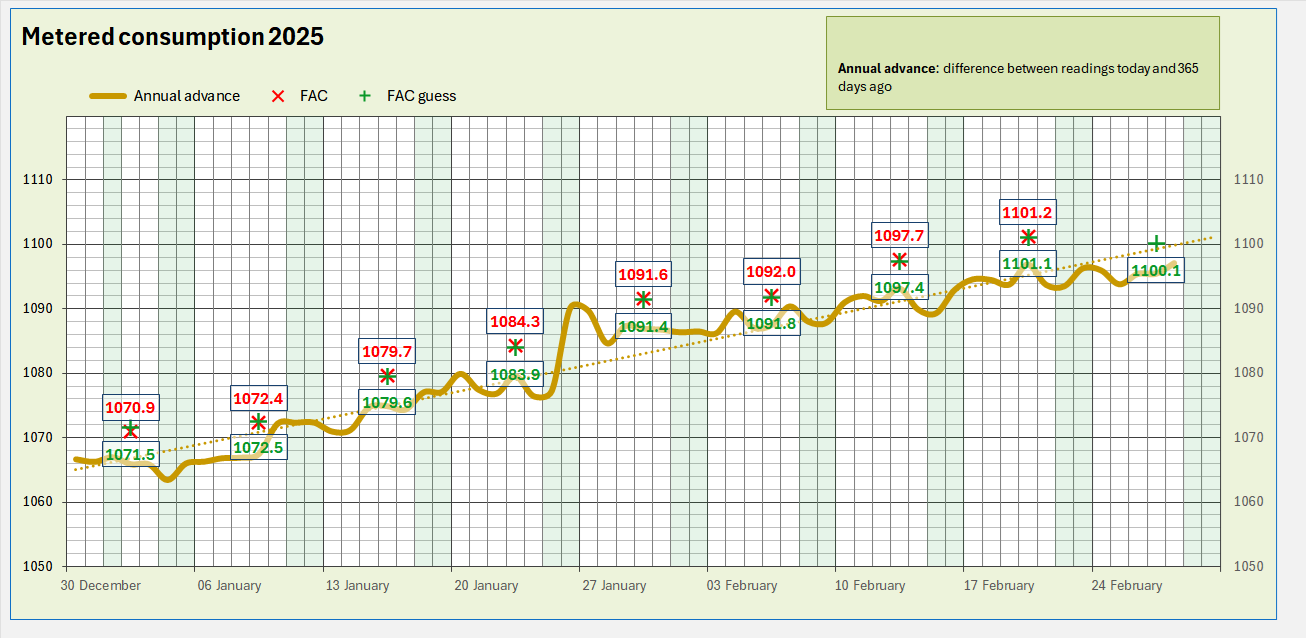
Major wobbles (e.g. 26 January) result from Power Move Flex Power Up events.
Points to note:
- This is an electricity-only household.
- The meter is configured for Economy 7 and the MPAN shows PC02, i.e. this is a domestic multi-rate metering point.
This is a bit trickier to handle, so the FAC is only updated weekly. I understand that single-rate (PC01) MPs may have their FAC updated more frequently. Even though I'm nominally on E7, I opted some time ago to pay the same rate for peak and offpeak usage.
- My new FAC appears in whole kWh on the Plan page like clockwork every Sunday morning.
I have to sneak round the back to find out what the precise figure is, so that I can do my own Direct Debit calculations. I get it from the DD API, which tells me what the yearly predicted energy cost is in £p. It's then a quick calculation to remove the VAT and the standing charge; what's left divided by the unit rate gives me the FAC, which I round to one place of decimals. This is the figure used to calculate DDs.
- It used to be quite simple to get the FAC for peak and offpeak usage, but that ability went away when my tariff was fixed last year, so I'm stuck with a single overall figure.
That may be the reason why there is a tiny (±0.05%) difference between my guesses and the actual outcome.
- Why is the published FAC consistently higher than the annual consumption?
I think it's because the calculation also looks at older data, in my case from MEX in September 2023. At the moment, these include two winters but only one summer, so of course the annualized consumption over the whole period is marginally higher (~0.8%) than the actual consumption over the past twelve months alone. I won't be able to see whether this hypothesis is true until we reach the meter's second birthday in September 2025. I don’t know how far back the calculation goes for older meters, but ISTR reading five years somewhere.
- While the newest FAC is published on Sunday morning, I had to experiment a bit to find which readings were actually being used. It seems to be the preceding Thursday's. I don't know whether the figure is the midnight snapshot or one polled specially for this purpose. If it is a one-off reading, this could also add to the 0.05% discrepancy.
I've chosen to publish these findings now, because the latest guess is for the first time this year lower than the preceding one. I can hardly wait to see whether Sunday's FAC will also be lower than last week's. Any betting people among you?