



Rank 2
October 23, 2022
Solved

Annual electric consumption of 12,000 kWh for only 2 people- What's wrong?

  • October 23, 2022
  • 34 replies
  • 2692 views

I have an OWL electricity monitor which gives readings close to my smart meter, but throughout every night (and though the day) there is a spike in consumption about every 30 mins amounting to about 2 kw.


I have tried turning off the hot water system as that seemed like a likely cause.


Our heating is gas powered underfloor and the pump doesn't come on at night at the temperature setting we have set.


This is a vital issue as even when we are away on holiday and the heating is on frost setting only, we still use 15 - 17 kWh per day!! When we are in the house is comes to between 35 and 40 kwh for an annual total of almost 12,000 kWh for electricity only.  


There are only two of us in the house, which is heavily insulated and four years old.


We have only normal and up-to-date appliances - washer, tumble dryer, kitchen ovens, etc. What on earth can be causing this level of consumption?

Best answer by Jeffus

Updated on 16/09/25 by Chris_OVO:

Can you get a more detailed chart from the OWL? That shows consumption over a few hours rather than several days. Then we can see how long the spikes last.


Also, 900w is a really high base load. Ours is 200-300w and we have two fridges, two freezers and a gecko to keep warm.

900w would be 21.6kWh a day…


That is extreme and would point to it potentially being nothing to do with the short spikes if it really is anything like that high. 


I would try the meter creep test then by turning everything off at the consumer unit and seeing if the meter still ticks over.


Then when you test each circuit as has been suggested , look out for anything that might have a high standby power due to an error or normal operation. 


Do you have any pumps in your heating system that have been wired to run permanently by design or mistake? 


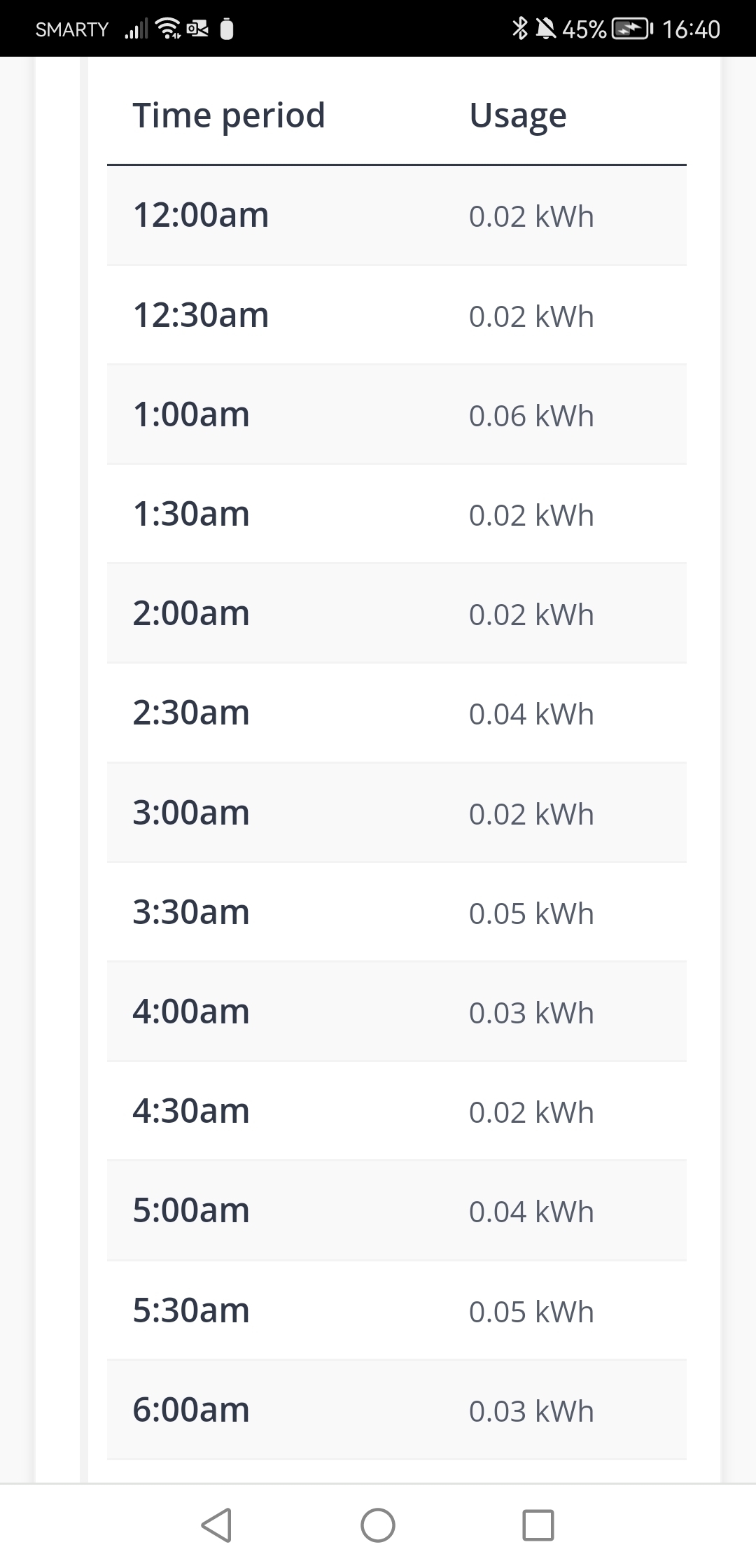
Just as an example here are our 30min slots from a night. 

34 replies

M.isterW
Rank 6
Rank 6
October 24, 2022

My advice would be to track down what's using that electricity by turning things off. I would switch each circuit off in the consumer unit until you find the one that's causing the problem. Then track down everything that's on that circuit.

1992 4 bed detached house. Solar PV + battery, Zappi EV charger, Mitsubishi Ecodan ASHP and i-life2 fan assisted radiators.... No gas 😊
Jeffus
Rank 20
Rank 20
October 24, 2022

Hi @edgood

I think the idea from @M.isterW is a good one.

Is your hot water electric?

Are you sure you don't have an immersion heater in your hot water tank permanently on? You probably have a separate circuit for this in your consumer unit. Try turning that off? 

Always on appliances that can go wrong include fridges and freezers, even relatively new ones. It would be worth checking the out the fridge freezers when you are doing the general checks.

You are right 12000kWh is a lot of electricity, especially for someone with gas heating. Definitely something wrong if that is the amount. Ofgem quote a typical domestic consumption value of 2900kWh a year for electricity. In fact 12000kWh is the ofgem typical consumption value for gas. 

edgoodAuthor
Rank 2
October 24, 2022

Hi Jeffus and M.isterW,

Thank you both for your responses. 

The hot water system is powered by gas. There is an immersion heater, but this has never been turned on. I turned off fridge-freezers over one night and this made no difference. I also switched off the MVHR system last night, to see if that was the issue - it wasn’t; power continued to be used throughout the night. 

I will now try the suggestion to take a whole circuit at a time using the consumer unit. 


nealmurphy
Newcomer
Newcomer
October 24, 2022

This is a mysterious one @edgood 

Are you able to post any graphs of the daily usage profile that show the spikes? Does your OWL monitor allow output in that level of detail, or are the spikes getting lost within each time band? 

How does the 30 minute output info from your smart meter look in comparison? Anything you can post here may help eliminate some options.

Jeffus
Rank 20
Rank 20
October 24, 2022

Hi Jeffus and M.isterW,

Thank you both for your responses. 

The hot water system is powered by gas. There is an immersion heater, but this has never been turned on. I turned off fridge-freezers over one night and this made no difference. I also switched off the MVHR system last night, to see if that was the issue - it wasn’t; power continued to be used throughout the night. 

I will now try the suggestion to take a whole circuit at a time using the consumer unit. 


@edgood 

The extreme is to turn off all the circuits for a short time. Take a reading at the start and end. Just to also double check your meter isn't ticking over with what looks like zero load.

edgoodAuthor
Rank 2
October 24, 2022


Thank you all for suggestions, which I will try.

Re graphs.  The Owl monitor graph below shows almost a two day period this week when we were away. Heating and hot water systems were turned off. 

The left side shows a spike in the morning, about 8pm, when we had coffee and then left the house. From then for the whole of the day (22 Oct) and the next, until we returned around 16:00 on 23rd, the graph shows a continuous pattern of usage. This usage amounts to around 15 kWh per day when we are not in the house or using any appliances, other than the fridge-freezers and MVHR (both of which I’ve checked to see if they are the culprits.  (When we are in the house, the average usage leaps to an average of 32 kWh per day, for a total (electricity only) of just under 12,000 kWh per year).

In the valleys between the spikes the usage is at a rate of (consistently) close to 0.9 kW. At the peaks the rate of consumption rises to between about 2.3 kW and 2.5 kW. The peaks tend to be very close to 30 mins apart.

The Octopus readings mirror this pattern, but record in KWh used in each 30 min period, rather than the rate of consumption at specific points.


juliamc
Rank 20
Rank 20
October 24, 2022

We like a puzzle ! You say your immersion has never been turned on, but is there any chance it actually is permanently on ? What kind of control does it have? When did you first notice this high electricity demand?

M.isterW
Rank 6
Rank 6
October 24, 2022

Can you get a more detailed chart from the OWL? That shows consumption over a few hours rather than several days. Then we can see how long the spikes last.


Also, 900w is a really high base load. Ours is 200-300w and we have two fridges, two freezers and a gecko to keep warm.

1992 4 bed detached house. Solar PV + battery, Zappi EV charger, Mitsubishi Ecodan ASHP and i-life2 fan assisted radiators.... No gas 😊
Jeffus
Rank 20
JeffusSolved
Rank 20
October 24, 2022

Updated on 16/09/25 by Chris_OVO:

Can you get a more detailed chart from the OWL? That shows consumption over a few hours rather than several days. Then we can see how long the spikes last.


Also, 900w is a really high base load. Ours is 200-300w and we have two fridges, two freezers and a gecko to keep warm.

900w would be 21.6kWh a day…


That is extreme and would point to it potentially being nothing to do with the short spikes if it really is anything like that high. 


I would try the meter creep test then by turning everything off at the consumer unit and seeing if the meter still ticks over.


Then when you test each circuit as has been suggested , look out for anything that might have a high standby power due to an error or normal operation. 


Do you have any pumps in your heating system that have been wired to run permanently by design or mistake? 


Just as an example here are our 30min slots from a night. 

Rank 2
October 24, 2022

This is probably a daft question but you don’t have an Electric Aga cooker by any chance?