I am a former Shell Energy customer. Under a bit of pressure last year I opted for a fixed energy tariff. The time has come to renew and I am faced with a range of other tariffs variable and fixed, I would appreciate hearing others opinions before I make a decision. For example Did I lose or gain last time by having a fixed tariff? Which of the other tariffs on offer are worth considering if any and why?
@billypop I’m always a bit reluctant to advise on the relative benefits of fixed and variable tariffs. There are just too many variables involved, not least of which is the value placed on knowing just what your costs are likely to be barring major changes in usage.
It’s worth remembering that Standard Variable Tariffs (‘SVT’, the ones subject to Ofgem’s price cap) are calculated on the basis of historical data. The prices to be published in a week’s time reflect changes that have taken place in the last few weeks. On the other hand, fixed rates are worked out according to predictions about costs over the fixed-price term, i.e. the next year or more.
You can see the difference as far as OVO is concerned by looking at the Plans page and comparing the prices of one- and two-year plans and the Extended fixes, which currently run for 15 months. The biggest variation I see is in the standing charge; there are increases in the offing to cover things like the cost of upgrades to the transmission grid and the cost of writing off the bad debt of customers who can’t or won’t pay their bills.
It became obvious a year ago that expanding the scope of the Warm Home Discount would require an increase in everyone’s standing charge to cover the cost. I watched the rates of the Extended Fixed tariff reduce little by little until they turned the corner towards the end of February and began to rise again. I was fortunate enough to latch on to its cheapest version, so that’s what I’m still enjoying even though we’ve seen some of the standing charge increases already. We still don’t know what effect the budget’s much-flaunted “£150 off your energy bill” is going to have. Of course, changes in the standing charge affect customers differently: an increase will hit the low-consumption customer harder than his high-usage neighbour, other things being equal.
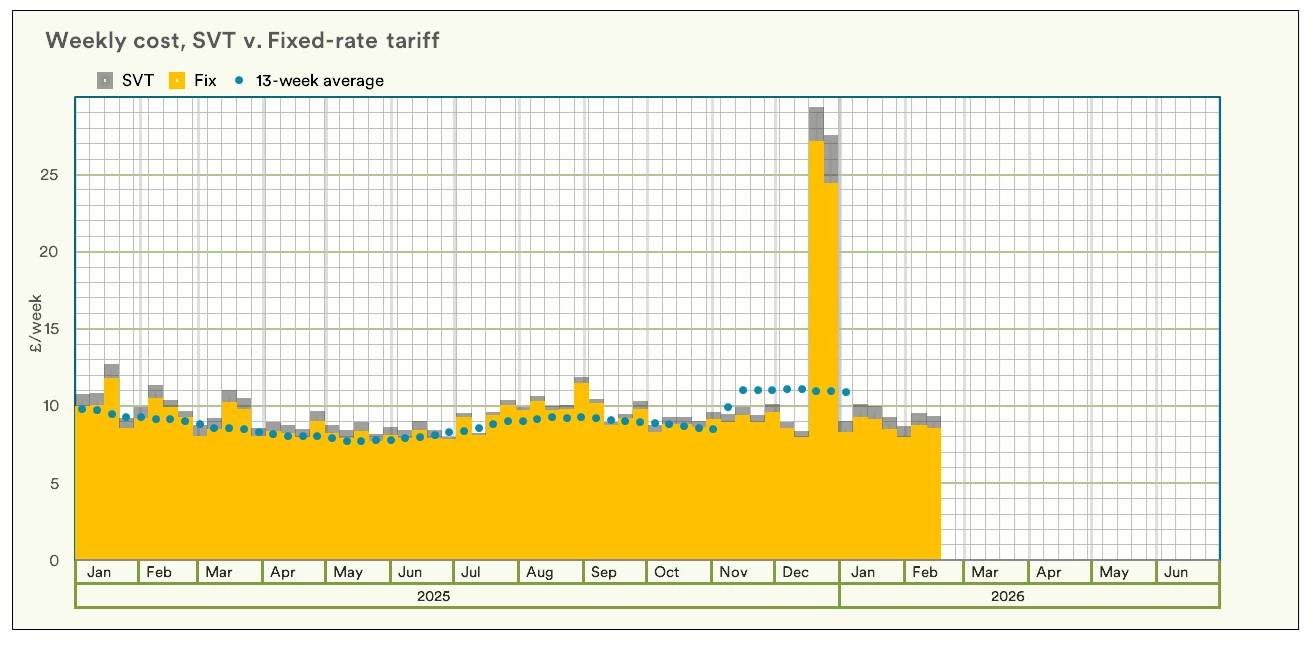
I know @Chris_OVO’s expecting to see one of my pretty graphics, so I won’t disappoint him. I wanted to illustrate the difference between a fixed rate and the SVT as it applied to me, so here goes (click on the image for a bigger picture):
The ‘Fix’ is the plan called Extended Fixed - 27/02/2025 East Midlands region.
A couple of oddities in the chart: the obvious one is towards the end of December, where a surfeit of Christmas spirit persuaded me to turn the electric heating on 25-31 December - lesson learnt, I think. The other is the unseasonal increase from July to September. This is all attributable to OVO fun and games with both the Power Move Flex and the ‘Two Hours of Free Electricity’ schemes. The costs shown in the chart are only unit rate x consumption + standing charge + VAT, so any rebate earned from the schemes doesn’t show.
The ‘saving’ attributable to the fix is the grey bit at the top of each week’s column, Seen like this, it’s not going to be world-shattering, although it does of course add up over time. I saved almost £30 in 2025, £3.60 of that in Christmas week alone.
The grey saving didn’t change much with last March’s fix, and it almost disappeared in the July quarter - but it picked up with October’s price-cap increase and rose even more in the new year. There’s no guessing what will happen in the next two quarters.
Last, I’d point out that other suppliers may have tariffs - fixed or variable - that suit your own usage pattern better than OVO’s offerings. There’s sadly no easy way to find out which, although comparison sites may help. It’s a question of dusting off the slide rule and applying the reluctant grey cells, I’m afraid.
I’m sorry if you’re even less certain now than before …
Fixed rate prices will give you the security of knowing how much your energy bills will be. Going fixed or variable is very much a tactical decision. If energy prices go up a fixed rate will leave you without the worry of increased bills. However, if energy prices fall you will not benefit from that change.
I think it might be wiser to wait a couple of months if you’re thinking of changing to a fixed tariff. As the weather warms up, you should find you use a lot less gas on heating, and your bills will start coming down.
My latest bill (Feb-Mar) is £99.90, down from the Jan-Feb Bill of £142.82, and should continue falling, so it wouldn’t make financial sense for me to change to a fixed rate tariff of something like £50 per fuel per month.
Just worth noting your rates are going to be adjusted soon regardless of tariff - OVO has permission from the government to knock off a levy which may see your rates (and bills) drop a little. They’ll let you know what the impact will be once it’s been verified.
Securing energy by zapping security bugs... For that is The Blastoise Way! Remember, I'm just like you - AI Powered Evil Geniuses aren't Staff!
Need advice from other members?
Ask your question to our members - they have the experience you're looking for: