juliamc
Rank 20
Rank 20
November 18, 2024
Solved

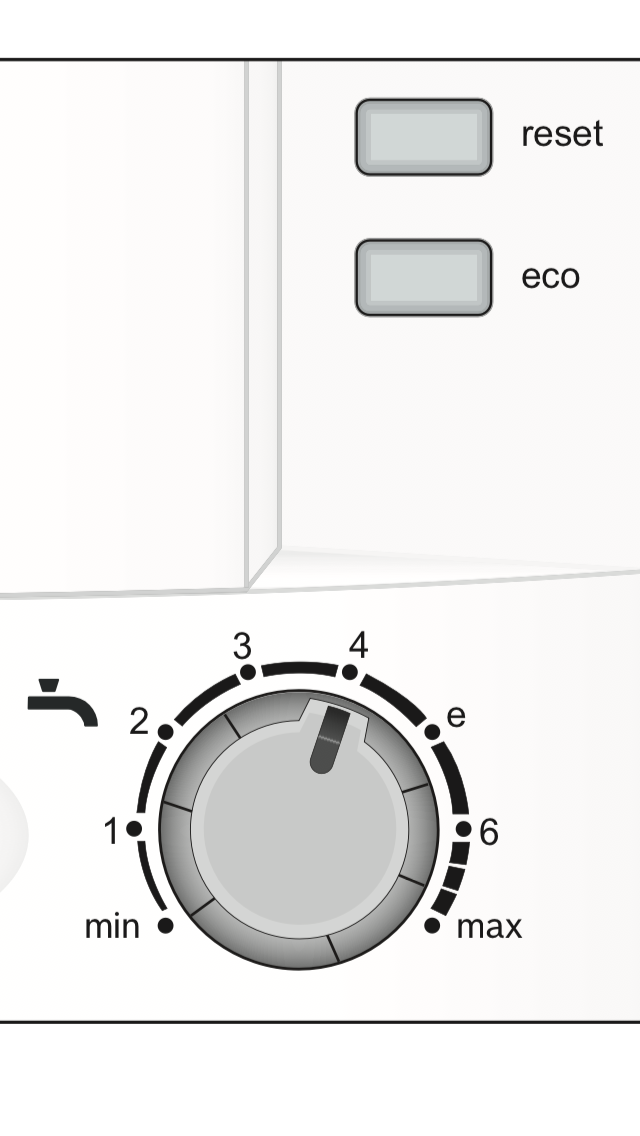
Worcester Greenstar combi boiler hot water settings: What does 'e' on the dial mean?

  • November 18, 2024
  • 28 replies
  • 11244 views

Why is there an ‘e’ on the dial ? Surely it is more efficient to lower the hot water temperature towards ‘min’ ?

What hot water temperatures do the different numbers give ?

Best answer by Nukecad

‘e’ for economy (or efficiency) perhaps?


Condensing boilers are at their most efficient at around 50-55 C water output temperature.
So going to a lower temp can be less efficient, just as going higher can be.


Personally, like many people, I like my hot water (and radiators) to be a bit higher than that at around 60 for the tap and 65 for the radiators


This is a good video about it although it is more about radiators than the tap water (because the radiators are usually on for longer than a tap): https://www.youtube.com/watch?v=T022zY9I__0&ab_channel=TheHeatingHub


Or just try it at the tap and adjust it to what feels OK once the tap has been running for 30 seconds or more. (Careful not to scald yourself, start cooler and work up).


Remember that for a mixer tap or a shower then how cold the cold water is (how cold it is outside the house) will make a difference to the temperature after mixing.


 

28 replies

juliamc
Rank 20
juliamcAuthor
Rank 20
November 19, 2024

Thanks ​@Nukecad amazingly observant that’s v useful !! I have to admit I haven’t been over to my friend’s place so this is all done via photos and texts. I’m just taking his word for it re the clock not working. He said they just click the heating on and off using the thermostat !!! I’m going to go over soon and sort him out - trying the timer properly is now on the list.

juliamc
Rank 20
juliamcAuthor
Rank 20
November 19, 2024

He reports that the timer doesn’t go to round !

Nukecad
Super User
Super User
November 20, 2024

Probably broken then, but might just be stuck.

It appears to be a Worcester MT10 timer:

https://plumbsave.com/product/worcester-mt10-mechanical-time-switch-7716192036/

Some (newer?) versions don’t have fingers:
https://www.stuartplumbing.co.uk/worcester-mt10-mechanical-plugin-time-switch-7716192036/

Replacing one looks fairly simple, but taking the boiler casing off may be a bit too daunting for some people to tackle (if in doubt get a boiler engineer in to do it):
https://www.youtube.com/watch?v=f56ZjdxQKjw&ab_channel=BoilersToBathrooms

I said, Hey - Watts going on.
Super User
November 20, 2024

Hi

Not sure if I would agree with all the comments on boiler efficiency and setting.

With regards vapour: The cooler the boiler settings, the less water content in the flue and hence the less “steam” from the flue. The amount of steam visible is more likely to relate to the outside temperature.; the colder weather, the more steam.

Generally 50°C to 55°C for the water circuit is reasonable. Ours is set at 50°C and this is hot enough for washing, showers and baths.

Radiator circuit is set to a similar 50°C, however on really cold days we may need to increase this slightly so that rooms with smaller radiators can reach temperature.

Both these settings are more relevant if you have young children or elderly who are at risk of scalding/burning. (A friends son once had a fit and got trapped between radiator and bed causing burns - the hospital asked so many questions). To-day (-1°C outside) our lounge radiator is sitting at 46°C and has warmed the room in just over an hour.

Start lower and then work up in temperature if you have to.

BP

Annually: Petrol 1315l to 442l, Electricity 3779 kWh to 2465 kWh, Gas 17,853 kWh to 9128 kWh. 20 years of monitoring and tweaking.
juliamc
Rank 20
juliamcAuthor
Rank 20
November 20, 2024

Thanks to both of you.. I found the timer on a well known suppliers website, then I found a debate on a diy forum re replacing said timer and whether it was a job for a gas safe engineer only. It seemed to depend on the model and what seal was between the casing and the components revealed under it. I expect they were offered a new timer at their latest service but declined as an unnecessary add on. 
Re the steam, there’s a short video of a flue at 70 v 35 deg showing steam v no steam. Not sure if the link can be included here but it’s from https://youtube.com/@tomasmcguinness?si=ZYjc_UY243pBdFyP which says to me lower is better ! 
My heat pump is running the rads at 42 deg at an outside temperature of -0.6 deg and house lovely and warm. 
My conversion with my friend about his boiler all started with him seeing a headline three figure sum from a well know energy supplier for a heat pump, and asking if it was possible !! 

Nukecad
Super User
Super User
November 20, 2024

 then I found a debate on a diy forum re replacing said timer and whether it was a job for a gas safe engineer only.

Always causes a debate.

It does depend on the particular boiler.
Manufacturers maintenance manuals will either say you need to be ‘qualified’ (ie Gas safe) to remove the cover, or they will say that you should be ‘competent’ (ie. know what you are doing) to remove the cover.

The ones that need it to be a GS qualified engineer that removes, or more importanly correctly refits, the cover usually have the timers, electrical wiring, etc. accessible/replaceable without removing it so the question doesn’t arise.

(On my Vailant combi boiler the timer unit just pulls off the front, with no need to remove the cover or even unscrew anything. It takes literally seconds to replace one).

If in doubt then get (pay for) a GS qualified boiler engineer to do the job.


I said, Hey - Watts going on.
Super User
November 20, 2024

If you have a few hours to spare have a play with heatpunk.co.uk . It is free to register and you can “design” your house in their online software. You will need details of the fabric of the dwelling such as the type of walls and the amount of insulation. When you add details of the radiators it can calculate expected losses from each room and the expected output from each radiator. The software was designed to aid the transition to heat pumps, identifying potential weak spots in the heating system. But the basic design calculations are good for any heating system. You can dial in the “heat pump” operating temperature (the water flow temperature) and it will show if the radiators are adequately sized or too small for each room. So you can work back, try different flow temperatures until all rooms are adequately heated. That will give a starting point for the optimum boiler temperature.

If the dwelling feels OK fine, otherwise you can tweak the temperatures.

If the software shows a flow temperature of 55°C is OK then that is good news if you are thinking of moving to a heat pump in the future.

Annually: Petrol 1315l to 442l, Electricity 3779 kWh to 2465 kWh, Gas 17,853 kWh to 9128 kWh. 20 years of monitoring and tweaking.
juliamc
Rank 20
juliamcAuthor
Rank 20
November 20, 2024

Ah ha.. Tomas (YouTube link above) was using HeatPunk in one of his videos, it did seem quite laborious. Have you used it ? I might give it a go just for fun - assuming it is 🤓

Meantime my friend is trialing a low flow temp (1.5 on the dial) and a lower hot water temp, no visible water vapour at the flue today, prob about 2 deg outside. House comfortable so far. He’s on Eon and in spite of having half hour data on his smart meter their online info doesn’t give more detail than daily usage data 🤦‍♀️