



Rank 4
July 5, 2022
Solved

Why is my Solis solar inverter drawing energy from the grid?

  • July 5, 2022
  • 52 replies
  • 28106 views

Hey everyone,


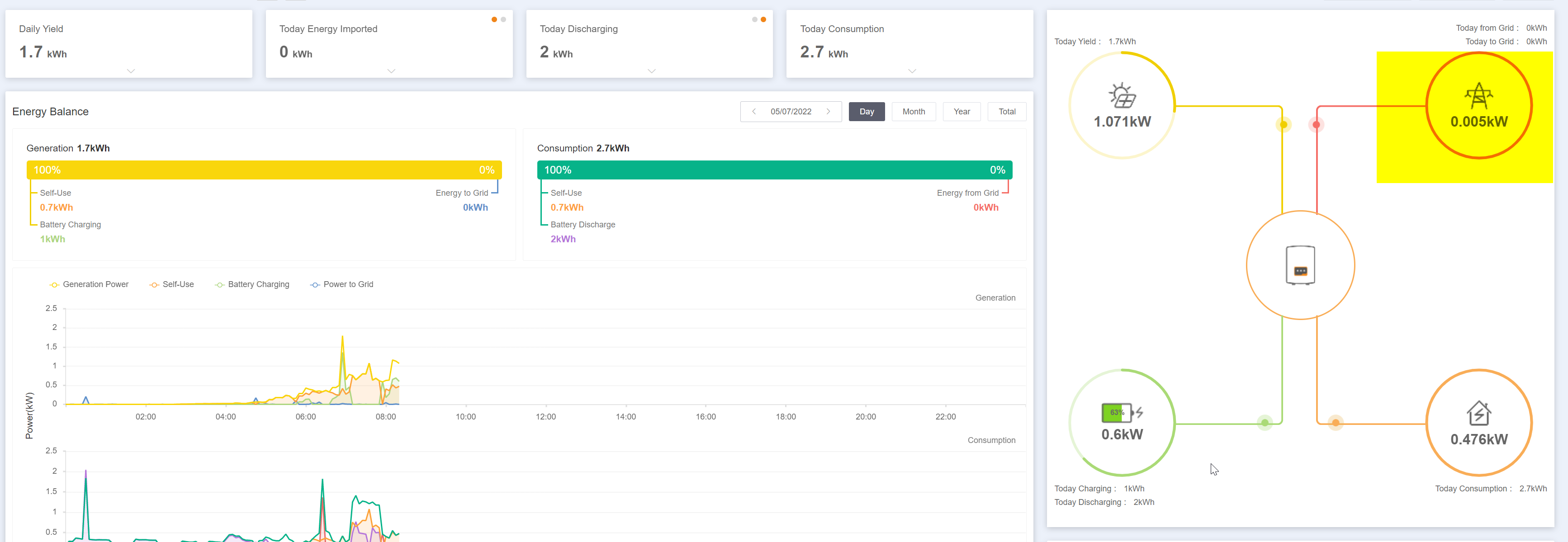
I need some help and advice.  My Solis Inverter still draws minimal energy from the grid even though my solar panels are generating enough energy for use and storage.  The problem is that this minimal amounts are costing me almost £1 a day, around £30 a month.


Is there anyone of fixing this issue? Solis says there is nothing that can be done at the moment but have raised a ticket that has not been allocated to anyone.  Would this be the same issue with all inverters?
 

Best answer by Jequinlan

Hi @Mbu1982 


Welcome and I hope below answers your question:


Yes the PV systems all draw (at times) an amount from the grid.


I have been monitoring mine for weeks and can confirm there are times there is :


A) a trickle from the grid, a cloud can drop PV suddenly and if charging a battery the grid may step up while the battery charge is adjusted

B) a trickle TO the grid, this happens most when PV panels suddenly gain more sun, or when battery is charged.

C) when the battery falls to 4% on my system the trickle to the grid is used to maintain the management of the PV system.


Pretty sure the net benefit of solar far exceeds this gain/loss scenario but it appears to be just the way it is.

52 replies

BPLightlog
Super User
Super User
June 21, 2023

I have a similar annoing issue. I have a new PV 3.2 kwp system, with Solis S5-EH1P inverter, US3000 C battery from Pylontech , SDM-120CT meter coupled with an Eastron split core ESCT-TA16. When the system is not exporting energy to the grid, the meter of my energy provider shows an average input power of 50W, but the inverter and the app show 0w from the grid. It seems like an “error” from the clamp: is it possible or is it a normal behaviour of the inverter?
Thanks in advance for any suggestion!

Hi @fabiodifa , the meter readings from your provider (smart meter?) will be more accurate. The clamp monitor is a general guide but not as accurate. These type of systems also tends to give an update every few minutes so can give false readings every so often. 
There are a couple of things to consider. 
The settings on your inverter which might look at a charge state overnight and

Switching routines which at low input levels from the solar and battery system can cause grid demand as they don’t switch as fast as the demand changes 

Bring me Sunshine ~ E&E {Solar PV, Battery Storage, Hybrid EV, ASHP and Home Assistant automation}
Newcomer
June 21, 2023

Hi @fabiodifa , the meter readings from your provider (smart meter?) will be more accurate. The clamp monitor is a general guide but not as accurate. These type of systems also tends to give an update every few minutes so can give false readings every so often. 
There are a couple of things to consider. 
The settings on your inverter which might look at a charge state overnight and

Switching routines which at low input levels from the solar and battery system can cause grid demand as they don’t switch as fast as the demand changes 


First of all, thanks for your reply. It seems like an "offset" related to low power consumption, so I think I can't solve it!

BPLightlog
Super User
Super User
June 21, 2023

You may be correct @fabiodifa. Your monitoring system and inverter will be taking its feed from the clamp so anything you can do to correct that would help overall. I know that several providers have updated their systems over the last few months so just ensure that you have the latest version (I’m sure you do) and the position of the clamp might be significant as well

Bring me Sunshine ~ E&E {Solar PV, Battery Storage, Hybrid EV, ASHP and Home Assistant automation}
Newcomer
August 26, 2023

I have similar situation with my Sunsynk system the grid seems to supply up to about 20% of my power use rather than draw from full batteries, whatever the load requirement is, But not all the time! Usually runs at about .05 Wfrom grid. 
I also notice that the energy supplied by solar panels , battery or grid seems to add up to about 20% more than the power required! Is this normal? 


BPLightlog
Super User
Super User
August 26, 2023

Hi @Coypu , most systems do have a need to still draw from the grid. Sometimes it depends on how the system has been set up. There will also be times when the solar production will drop due to clouds or suchlike and it can take a while for the battery to switch in. 
Inverters have their own system monitoring to detect and measure power flow but they are not as accurate and so can give differences in value. 
You might be able to adjust a few things if you thought it useful .. but it needs care when changing settings

Bring me Sunshine ~ E&E {Solar PV, Battery Storage, Hybrid EV, ASHP and Home Assistant automation}
Newcomer
May 21, 2024

Dear colleagues,


our SOLIS hybrid inverter draws a small amount of energy (30W) from the grid when it is charging the battery (at say 1.5 kW) and the house consumes say 500W. This small amount of grid energy is registered by our utility meter, so we have to pay for it, even though there is 1500W going into the battery at the same time :-( We would be happier, it would charge 30W less and draw zero from grid.


As long as we had no battery, we could set “maximum exported energy” (600W) and did consume no energy from the grid. Now we still draw a small amount, even though there is enough coming from the panels.


Any ideas?

BPLightlog
Super User
Super User
May 21, 2024

It’s all about the inverter settings @marsalek. There’s two considerations:

  1. The switch between enough solar to charge and supply the house is often slower than you might think and because it’s all designed to give you what power you need when you need it, there can be instances when you draw from the grid as well (even with a charged battery).
  2. The inverter monitors what is being drawn by the house (either via a CT or an internal monitor). This can be slightly off calculation and so not be measuring accurately. 

If via CT, there can be a programmed offset put into the calculations to better match need. 
If just switching time is slow, there’s not a lot you can do. 

Bring me Sunshine ~ E&E {Solar PV, Battery Storage, Hybrid EV, ASHP and Home Assistant automation}
Newcomer
May 21, 2024

You are right, the speed of regulation makes it impossible to accurately track sub-second load and PV-supply variations. I’d try to tweak the settings so that we supply a negligible amount into the grid. Where do I find the offset-settings for the CT meter? I am using Eastron SDM630mct. Thank you!

BPLightlog
Super User
Super User
May 21, 2024

You are right, the speed of regulation makes it impossible to accurately track sub-second load and PV-supply variations. I’d try to tweak the settings so that we supply a negligible amount into the grid. Where do I find the offset-settings for the CT meter? I am using Eastron SDM630mct. Thank you!

The offset is normally applied via the inverter settings. I don’t have a Solis so not sure if/where they sit. 
Mine (a LuxPower) has a field on the maintenance page 


Bring me Sunshine ~ E&E {Solar PV, Battery Storage, Hybrid EV, ASHP and Home Assistant automation}
BPLightlog
Super User
Super User
May 22, 2024

I found this article on the Solis support site ..

Although yours is a different type, the page might be of use

Bring me Sunshine ~ E&E {Solar PV, Battery Storage, Hybrid EV, ASHP and Home Assistant automation}