

Rank 3
April 28, 2026
Solved

Solar Panel limits in Summer

  • April 28, 2026
  • 28 replies
  • 337 views

Back again with a weird one. I’ve had to chase Octopus a couple of times for Outgoing payment since starting tariff in March. Which they have done when asked, just prefer not to be asking. Anyway since the last payment the Solar export figures have been way down. With the decent weather we’d been getting payments anywhere up to £1.15 per day. But as of last Weds after the payment they gave us most we have received is 19p. And we have had some amazing sun. Our usage hasn’t changed in the house but it’s dropped right off. It’s not as though it’s not doing its thing it’s just not as much as I would of expected considering it’s getting warmer.
Does something weird happen to panels if it’s very hot? Any insight would be really appreciated.

Also they’ve been in a year now do they ever need cleaning?
 

Best answer by juliamc

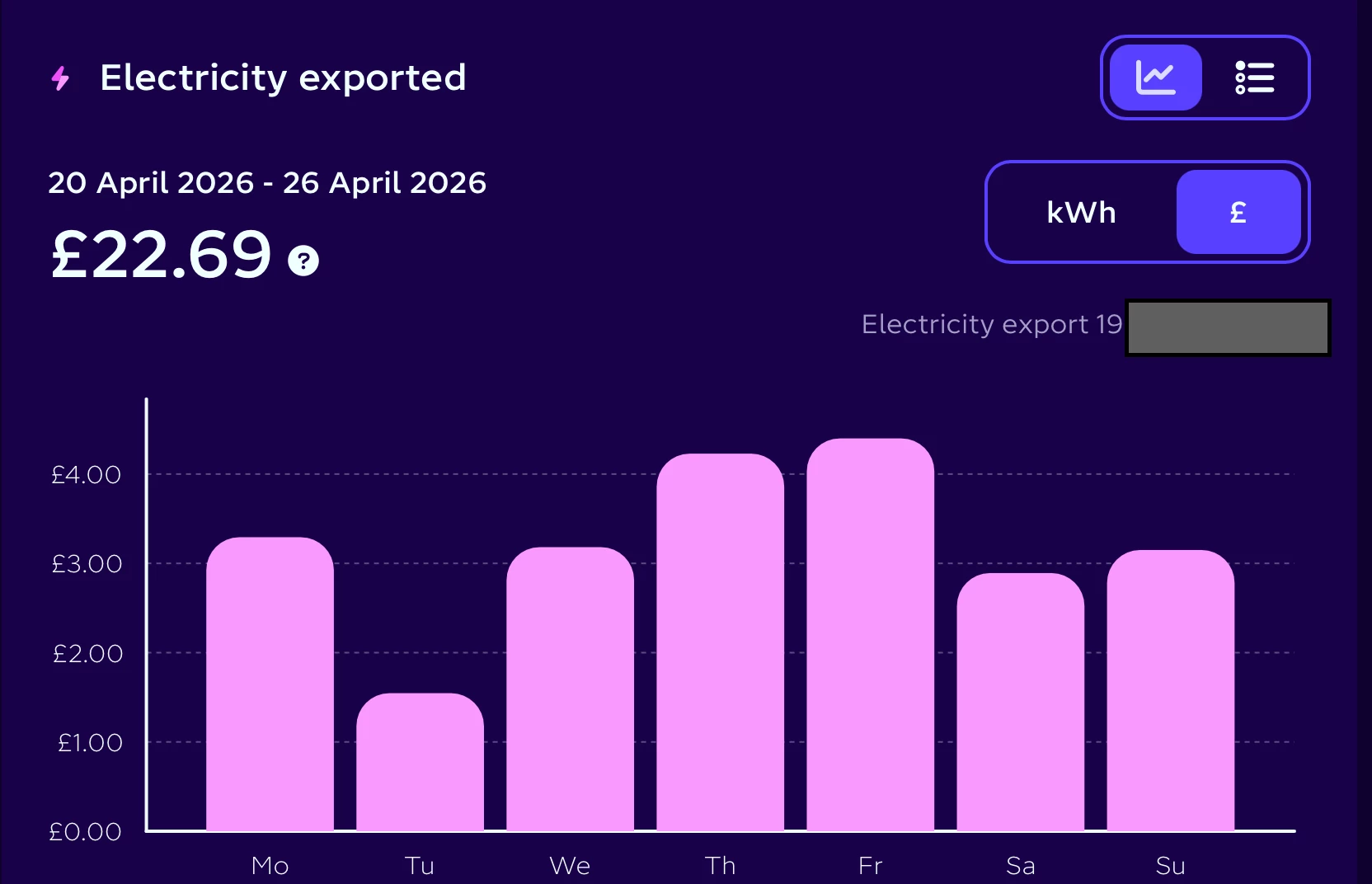
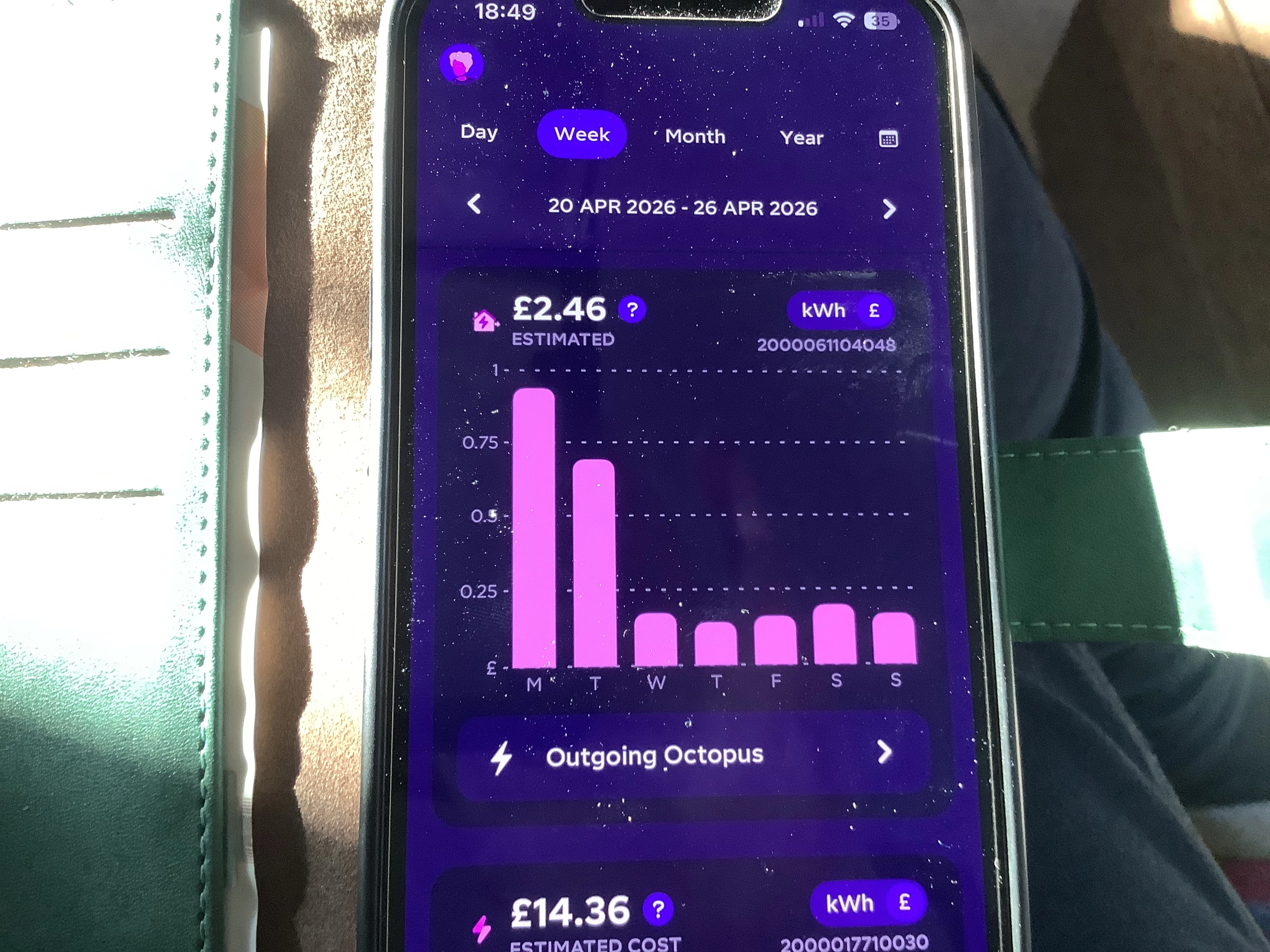
This is my export for last week, as you say we’ve had loads of sun. My panels are covered in pollen and/or dust as we’ve had no rain for days, and I imagine they’ve got very hot up there. 

I believe they’re less efficient when they’re hot but not so much as to make the difference you’re seeing. 


28 replies

BPLightlog
Super User
Super User
May 9, 2026

That’s quite correct ​@Peter E . The limit is based on levels issued by your local network operator (DNO).

It's generally based on calculations for your feed transformer which (if exceeded) could affect voltage levels - these are prescribed (for the UK) as 230v +10%/-6%
 

Bring me Sunshine ~ E&E {Solar PV, Battery Storage, Hybrid EV, ASHP and Home Assistant automation}
Ben_OVO
Community Manager
Community Manager
May 11, 2026

Thanks for this great insight ​@Peter E and ​@BPLightlog - much appreciated.

Powered by the Sun
Rank 6
May 30, 2026

I’ve only had my PV panels installed for the last couple of weeks or so, so still getting used to what is “normal”. Haven’t even managed to get the paperwork through yet to get an SEG account set up so all excess (not house load or battery charging) currently being “given away” to the grid/DNO as there is no means of being paid for it yet.

However, after the first few days the sun came out in earnest and I immediately saw an anomaly - my grid connection was dropping in and out, and occasionally for a few hours through the middle of the day. Looking at the data available from my system, I had the feeling that I was hitting a voltage limit as the local grid voltage was going up to 253.something, just about the limit of the 230+10% value. I contacted my installer to ask for advice and I am told that they tweaked something (don’t know what yet, but have asked) and today in bright and near-continuous sunshine there has been hardly a flicker and what dips I have seen could well have been due to occasional cloud. Overall total generated power is looking much better than a couple of days ago in similar weather. 

The moral of the story is that the whole end-to-end system is pretty complex and you do need good data at a fairly fine level of detail (my Sigen system gives me 5min data points) to try to see what is happening. I don’t even know yet exactly what my problem was but there seems to be a number of system parameters that may be outside our control but need someone else to manage.

And I don’t understand this “only export 60%” concept - a hard limit of 3.6kW or somesuch as permitted by the DNO makes sense, but not a percentage.

BPLightlog
Super User
Super User
May 30, 2026

There are max/min levels for all systems and as many (most) inverters are sold widely, UK level settings are important to protect the local infrastructure (network feeds, neighbourhood levels, transformers etc). If these weren’t adjusted, they would certainly cause issues.

Although typical, a 5 min data set is not normally good enough (in my opinion) and so I log locally at min 30 second intervals.

As far as export is concerned, your DNO would have a register of the inverter fitted on your system and therefore a 60% level would refer to that specific installation  - your import and export levels might be set as different limits for your local network.

Bring me Sunshine ~ E&E {Solar PV, Battery Storage, Hybrid EV, ASHP and Home Assistant automation}
Ben_OVO
Community Manager
Community Manager
June 1, 2026

Thanks for this info ​@Nealeb, and for your help here ​@BPLightlog. Having panels installed is a steep learning curb, and it’s lucky that this Forum exists as a great source of knowledge about all things Solar.


On that note ​@Nealeb, please could you let us know what the installer comes back with re what the issue on their side was?

Powered by the Sun
Rank 6
June 5, 2026

Looks like my on/off-grid switching problem has been fixed. Had a chance to talk to the installer’s chief techie this morning and it seems that when the system was installed, the inverter/control box was set to the wrong country. It’s a Sigen box and apparently has settings to match grid connections for the countries in which it is sold - but for some reason it was not set to “UK” when it was installed. It would ramp up the output, hit whatever limit it had been set to, go off-grid for “protection”, and the cycle would repeat. Now seeing consistent output that even peaks at higher than the nominal max power rating of the panels for short periods.

Chris_OVO
Community Manager
Community Manager
June 8, 2026

Hey ​@Nealeb,


Thank you for providing an update. It's surprising how a minor region setting has caused these issues for you. I’m happy to hear that you’re seeing more consistent results now.

Renewable energy jokes never get old.
Peter E
Super User
Super User
June 8, 2026

It does raise the point that some systems are so complicated that a setting buried deep in some menu can stop things working properly. I can't help thinking, in some cases, this is an own goal and that manufacturers should provide better information about diagnosing issues. 


Peter 

Reducing my yearly fossil fuel usage with an EV (-900 litres petrol), A2AHP (-8,700 kWh gas) and Timed Immersion heater (-1,500 kWh gas)