

Question

Quantum Dimplex Night Storage Heater Won't Charge at Max Rate

  • May 18, 2026
  • 16 replies
  • 98 views

Hi, I have been running a Dimplex Quantum QM050RF for a year or 2. I have an energy monitoring system attached to most circuits in the house (Emporia Vue) and note that the Quantum only charges up at 700W (max) on the offpeak supply. As I am with Octopus Intelligent Go tariff, I only get 6 hours of charging per day ie the Quantum only charges up to (700W x 6 hours =) 4.2kWh per day. This is corroborated by the Quantum's own historical stats (accessible via the display and controls).
How can I get around this issue as I am not getting sufficient heat from 4.2kWh during winter to adequately heat the room in question (a small kitchen)?

16 replies

Chris_OVO
Community Manager
Forum|alt.badge.img+4
  • Community Manager
  • May 18, 2026

Hey ​@martinwinlow,


I’m going to bring in ​@Firedog, who really knows their stuff when it comes to storage heaters. I wanted to ask, when you mention that your tariff only allows for 6 hours of charging each day, do the storage heaters recognize this and charge for the full 6 hours, or could you be missing out on some time? Is there a chance that there’s a setting that’s preventing the storage heaters from taking a full charge?


I took a look at the manual to see if I could find any other helpful tips about the charging limits. I’ve linked it below in case you or anyone else wants to check it out. It sounds like your storage heaters might not be set up quite right with your tariff. Usually, storage heaters work best with an economy tariff that gives you specific hours for off-peak charging. As far as I know, the Octopus Intelligent Go tariff is mainly aimed at EV charging, which might be causing the issues you’re seeing.


Dimplex mentions that the QM050RF can charge in about 5 to 6 hours, but it's really designed for at least a 7-hour window to ensure it charges fully, especially in colder weather when it needs to store more heat.


Firedog, what do you think about all this? Looking forward to your thoughts.


Dimplex QM050RF manual


  • Chris_OVO

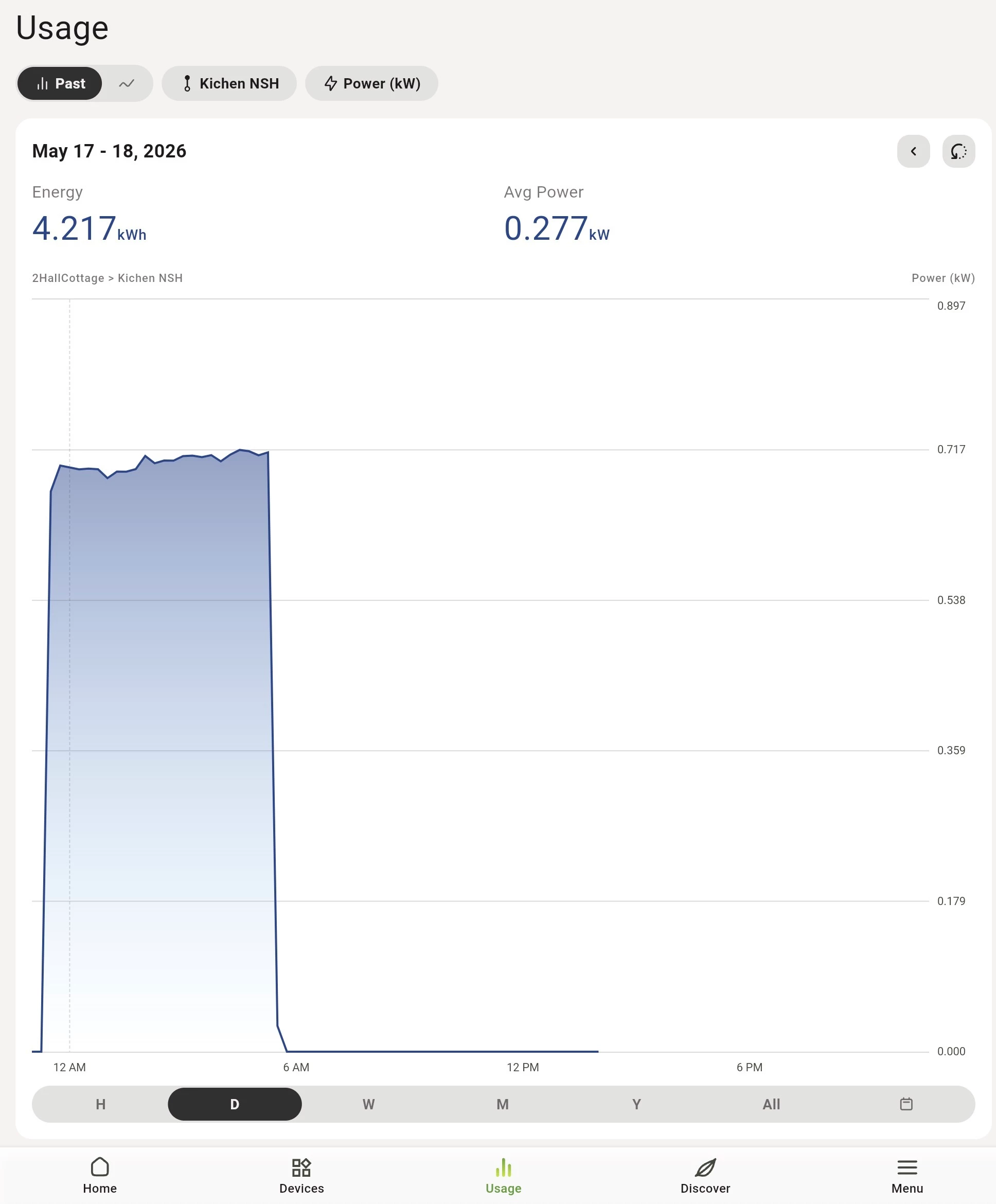
  • This is a screen shot from the Emporia Vue monitoring my Kitchen NSH (night storage heater - which is the Quantum in question)...

    I have a programmable ‘circuit breaker’ supplying this circuit (there is still the separate 24hr supply wired from a different consumer unit (CU) and thus supply).  This is set to turn on the NSH ‘charging’ circuit from 2330 - 0530 aligning electricity consumption with Intelligent Octopus Go (IOG) nighttime tariff. This is the only cheap period that is set in stone. As you say IOG has extra periods of low cost (7p/kWh) during the day but they vary according to the cost of electricity on the open market and thus these periods are out of scope for the purposes of programming my circuit breaker.

As you can see from the graph, the quantum turns on at 11:30 and turns off at 0530 it is programmed to do.
 
As I mentioned in my original post, the main problem from my perspective - and from what I can see  and understand from the quantum’s manual - is that the quantum will only consume a maximum of 700W when charging and not the 1kW (1020W according to the spec sheet) that it should consume. Obviously if it were consuming 30% more than I would be getting a lot closer to the ~7kWh maximum capacity of the quantum rather than somewhat more than half that as is currently the case.

Peter E
Super User
Forum|alt.badge.img+9
  • Super User
  • May 18, 2026

Hi ​@martinwinlow 


Trying not to tread on ​@Firedog’s toes the spec sheet is a tad confusing. It is basically a 500W storage heater with a 340W boost mode. I think the 1050W rating is the absolute power it could ever possibly take (with fans?) and maybe the rating you need to calculate the safe load for the circuit not the actual load.


Given your heating needs I think you need the higher energy storage units like the QM100RF. Perhaps Noel will have another take on that.


By the way, well done on getting the units right for power (kW) and energy (kWh) which confuses a lot of people. Exceptional!


Peter 


(“By the way, well done on getting the units right...”  I knew that 1980’s MSc in engineering would come in useful one day...)

Let’s see what Firedog has to say but this model Quantum with it’s 7.2kWh storage capacity, it makes sense that it would be designed with a 1kW heating element if it is intended to go from empty to full in one 7 hour (eco&7/off-peak) charging period…  So again, why am I only measuring 700W input, max?


BPLightlog
Super User
Forum|alt.badge.img+12
  • Super User
  • May 18, 2026

@martinwinlow , can I ask if you use any of the adaptive functions at all? Also what base voltage do you record on that circuit over a typical cycle?


adaptive functions:  Not that I’m aware of tho it is possible I set something up when I first installed it (other than basic on and off times).  Is there an easy way to find out - I’d rather not have to factory reset it as the timings are mildly complex and it isn’t the easiest thing to re-program…
 

Voltage here is generally relatively high - usually around 245VAC due (I quess) to the fact that we are right on the end of a very tortuous mains connection (via 2 under-sea linked islands before it gets to this one) and there is a 100kW wind turbine just up the hill from me…  Usually going like the clappers up here!


BPLightlog
Super User
Forum|alt.badge.img+12
  • Super User
  • May 18, 2026

There are several notes in the manual (linked earlier by Chris), some of which look at the menu functions and what is called a ‘set up wizard’. I guess you should be able to see set functions via the menu system.

I had originally assumed that the adaptive functions might modify power drawn but I’m now not sure that is the case.


BPLightlog
Super User
Forum|alt.badge.img+12
  • Super User
  • May 18, 2026

Actually I’ve just learned that the Quantum range uses “dynamic intelligent charge calculation” and will deliberately reduce overnight charging if it thinks less stored heat is needed - not sure how it calculates that.

Another possibility is a failed element perhaps


Firedog
Super User
Forum|alt.badge.img+7
  • Super User
  • May 18, 2026


Firedog, what do you think about all this? Looking forward to your thoughts.
 

Oh dear, I’m afraid I can’t match up to the hype in this case. My experience is with the more basic types of NSH, and in particular how they interact with smart meter ALCS control. One look at the schematic wiring diagram was enough to persuade me to bow out gracefully.

We know that ‘insufficient charge’ can with older NSHs indicate that a thermostat or one or more of the heating elements have failed; there should be on-board diagnostics to reveal that sort of fault. BP has mentioned ‘adaptive’ functions; I’ve noticed elsewhere that it can take several charge/release cycles (i.e. several days) for an intelligent control system to match input to desired output. It can be very tedious making a change - like desired temperature - and then having to wait days for the heater to work out how to deliver it. 

I’m told that Dimplex tech support is really helpful, so that may be a good source of advice. Better than me, at any rate ... 


  • Author
  • Rank 2
  • May 19, 2026

OK - thanks for your thoughts.  I’ll take it up with Dimplex.  I did try that route initially but got diverted down some annoying ‘pay-for’ rabbit hole which I found rather irritating and very disappointing… but I’ll try calling instead.


Chris_OVO
Community Manager
Forum|alt.badge.img+4
  • Community Manager
  • May 19, 2026

Hey ​@martinwinlow,


That's a great suggestion from BPLightlog. It sounds like the dynamic charging calculations might be a bit off, which could lead the heaters to think they don't need to charge as much. If adjusting things isn't straightforward, it might be worth trying a full reset. Dimplex will probably suggest that when you reach out to them. I know it can be a hassle to get everything set up again, but when you call Dimplex, you can let them know, "Here’s my issue and here’s what I’ve tried." 


We’d really love to hear what Dimplex suggests as a solution. Many Dimplex customers on our forum are looking for help and your experience might just guide someone else who’s facing the same situation. Thanks for keeping us in the loop!.


Thanks to ​@Peter E ​@BPLightlog & ​@Firedog for the support on the thread. 


Peter E
Super User
Forum|alt.badge.img+9
  • Super User
  • May 19, 2026

I'm still going with my original thought that the xx050xx in the number relates to the spec that says it has a 500W storage heating element. The xx100xx has a 1,000W element and so on up the range. I'm thinking that any power shown above 500W is additional, non-storage (immediate) heating. That heater is the smallest one in the range.


The reply from Dimplex will be interesting though.


Peter


Firedog
Super User
Forum|alt.badge.img+7
  • Super User
  • May 19, 2026

… the xx050xx in the number relates to the spec that says it has a 500W storage heating element.
 

I’m not sure I’d agree. The Dimplex Quantum brand has been around for quite some time, and I think the model designation has always included an indication of the nominal power output.
  

From 08_83324_0-3 QMRF Online G13 23-023.pdf

My own bog standard Dimplex QM150 allegedly delivers 1500W when it’s going full tilt. As a model designed for Economy 7, it takes 7 hours to charge up and 14 to release its maximum nominal capacity of ~21kWh. The heating element(s) tot up to about 3300W. 

It’s been normal practice for as long as I’ve noticed for electric heaters to be described by their heat output in kW - 1 bar = 1 unit:


Peter E
Super User
Forum|alt.badge.img+9
  • Super User
  • May 19, 2026

I was thinking that the input rating had to do with the maximum possible power it could take under the worst conditions for circuit loading calculations. That's not the same as what it's designed to store (it has a 500W storage element) which is a lot less. My best guess. Given that the user wants to store energy during the EV discount rate then I would say that this is the important factor. 


Firedog
Super User
Forum|alt.badge.img+7
  • Super User
  • May 19, 2026

I think we’re running into a spate of terminological inexactitude. This is my understanding:

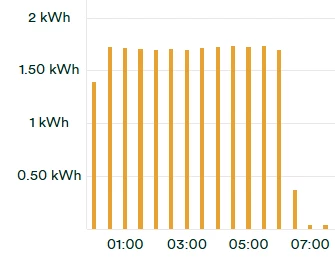
  • Input rating is the appliance’s maximum power draw, in this case 1020W. On a half-hourly usage chart, you’d expect to see bars up to 0.51kWh high for as long as the heater was charging (plus, of course, any background load).
      
    My QM150 being charged up. the first half-hour is ~20% shorter than the others because my meter has a switching delay of 6 minutes (= 20% of a half-hour) 


  • A heating element is a resistive load intended to convert electrical energy to heat. A 500W element would deliver 0.5kW of heat when connected to a 230V supply.
  • Storage here refers to the bricks that are heated up by the heating elements. The current euphemism for these bricks is ‘storage cells’, of which the QM050RF has 4 x 3. Each cell is thus apparently designed to store 0.6kWh when fully charged. 12 x 0.6 = 7.2kWh.  

Thus ‘A 500W storage element’ doesn’t make much sense to me, but then I am a bear of very little brain … 

… and the desire to get the most out of of cheaper electricity overnight is just as strong whether it’s used to charge storage heaters or EV batteries.


Peter E
Super User
Forum|alt.badge.img+9
  • Super User
  • May 19, 2026

I do agree with you. A QM150 heater (yours) will have storage heating elements of 1,500W and your chart shows that. A QM100 heater will have storage heating elements of 1,000W. A QM050RF will have 500W of storage heating elements although ​@martinwinlow’s chart is showing 717W of power consumption which I'm taking to be 500W of storage heating plus 217W of immediate (non-storage) heating (possibly) plus fan if one is fitted to the RF variant. A conversation with Dimplex may resolve that.


And you are right. 500W of storage heating doesn't make sense except for heating a very small room or as part of a much larger system with a number if such units distributed around the property of which we know very little about.