



Transparent
Rank 20
Rank 20
October 8, 2019
Tutorial

House insulation, electricity cables and fire risk: the good and the bad...
  • October 8, 2019
  • 17 replies
  • 42026 views
House insulation, electricity cables and fire risk: the good and the bad...

.How to combat Climate Change without setting fire to your house!


It's autumn and energy-conscious householders will be adding insulation to lower their heating bills. But beware... your home could be getting a lot warmer than you'd intended.

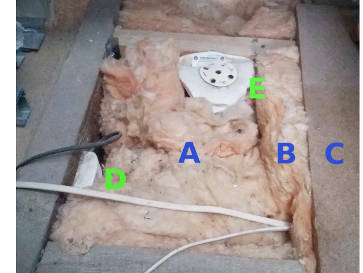
What's wrong in this picture from an attic?
 

b5e06d72-0a66-45a4-a06e-2ba93001a655.jpg


At first glance this looks good. The original insulation layer above the ceiling (A) was too thin, and a second layer (B) has been added above it. The area has then been boarded with chipboard (C).

There’s a low-voltage transformer (D) which has been properly screwed to a wooden beam and insulation pulled away to make sure it doesn't overheat.

A downlighter installed in the ceiling below has been fitted with an intumescent smoke hood (E) and its ventilation holes are also left uncovered by insulation. If there’s a fire below, the intumescent material will expand rapidly, filling the hood and preventing flames and smoke spreading through the attic.

The problem, however, is the two mains electrical wires running into the insulation layers at bottom right. This is a serious fire-risk.

All electrical cables will produce heat. The higher the current (in Amps) the more energy is lost as heat.

Adding insulation above a cable like this reduces its current-carrying capacity by 50%.

Thus a typical 10kW electric shower fed via a 6mm² twin&earth cable is able to carry 46 Amps in free air, but only 23A when surrounded by loft insulation. As 10kW requires 43A, the cable was already on its limits, and it is almost certain that electricians would now use a 10mm² cable for such a shower.

Even so, that 10mm² cable still must not be surrounded by insulation. Plastic covered cables are normally rated for a maximum 70ºC, and shouldn't ever be placed where their temperature will rise above 45ºC.

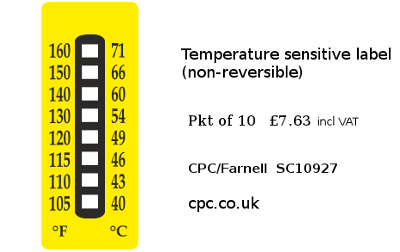
This can't be checked using test equipment carried by an electrician. If you want to know the actual temperature of a cable, then you need to stick a temperature-sensitive label to it. This will record the maximum value to which the temperature rises.
 

c13edcaf-2bae-49b6-a6b3-4318ce113c77.png


So what's the correct way to install loft insulation?

All electric cables need to be in free air above the insulation, and well clear of any flooring above.

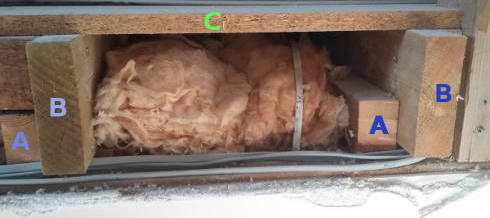
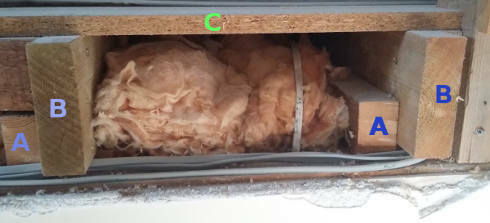
Here's a cross-section of an attic floor as it should be. The original ceiling joists (A) have additional floor joists (B) positioned between them. The chipboard floor panels (C) are screwed to those.
 

4b33fd2c-a0b8-4d95-8c8e-60beb37080cf.jpg


In the above photograph, the floor joists (B) have notches cut from them, allowing the grey cables to pass freely along without drilling holes.

The older, white cable is run on top of the insulation, permitting it to radiate heat into the air-space above. If the cable doesn't have enough slack to do this, then replace it. The risk of a fire isn't worthwhile saving the cost of new cable.

I am constantly surprised how often I find professionally installed loft insulation which has been installed on top of heavy-current cables. Even if you have a certificate declaring that your insulation has been laid to the correct standards, that is unlikely to include the electrical cabling which the installers encountered.

If you're unsure - check it!

17 replies

juliamc
Rank 20
Rank 20
January 29, 2023

@BPLightlog this is something I’ve worried about too. It’s really difficult to find a definitive answer to whether the wiring is safe. In my bungalow all the wiring goes up into the loft space. Mostly it’s clipped onto the joists which I’ve read is good to absorb some heat. Then I’ve read that lighting cables don’t really generate much heat so it doesn’t matter if insulation goes right up to them but it does matter for Power socket cables. Recent wiring I’ve had done is attached to the rafters (I mean the sloped ones, are they rafters?) so they’re well away from the insulation. Older armoured cables have just been laid flat near but not attached to the joists and are too tight to move. It’s a bit of a mess !! 
What’s wrong and what’s right??

ps. I used LoftZone legs and struts to fix my loft floor onto, the flooring ends up higher and you can get the full thickness of insulation plus an airspace btwn that and the boards for ventilation. It’s quite expensive but I (and the heating engineers who can be quite heavy!) need to walk across it to get access to my heat pump.

BPLightlog
Super User
Super User
January 29, 2023

Yes, I understand @juliamc . Nobody much bothered about this a few years ago but with the trends to insulate, it is more important that cables are allowed space. 
You are correct about lighting wiring, especially with so little current being used by modern lights but this is why there is the comment about power cabling in particular and trying to use the rafters (joists tend to be horizontal) to maintain a degree of air around them. 
There is a calculation that can be made about the cable size, type, load and max temperature for the cable, otherwise the cables insulation can degrade and perish, hence the potential for damage and failure. 
Much of the insulation applied in lofts I have seen is simply packed in with no regard to this


Incidentally there is a whole info piece on this, extra demand on cabling due to EV’s, Heat Pumps etc on the IET forum

https://electrical.theiet.org/wiring-matters/years/2021/86-july-2021/back-to-the-forum-thermal-effects/

Bring me Sunshine ~ E&E {Solar PV, Battery Storage, Hybrid EV, ASHP and Home Assistant automation}
juliamc
Rank 20
Rank 20
January 29, 2023

Is there a product like a mesh shield that can be fixed over cables to keep the insulation the correct distance away from them ? 
Thanks for that link, a bit of light reading for later!!

BPLightlog
Super User
Super User
January 29, 2023

I haven’t seen a mesh. There are spacers but these tend to be designed for point to point which doesn’t really help in this case. You can use a conduit of course as long as it’s not overfilled  


Bring me Sunshine ~ E&E {Solar PV, Battery Storage, Hybrid EV, ASHP and Home Assistant automation}
BPLightlog
Super User
Super User
January 29, 2023

Details here describe factors to consider with cabling and possible limitations to put in place 

https://the-regs.co.uk/blog/?p=718

Bring me Sunshine ~ E&E {Solar PV, Battery Storage, Hybrid EV, ASHP and Home Assistant automation}
Newcomer
March 24, 2024

To reinforce some of the above comments -

In my bungalow the bathroom has a extraction fan linked to the light. When I switch the light on, the fan starts, and stays on for a short time after switching off.

Now, after I had extra insulation installed, if I switch on, the fan comes on for a short time only, then goes into a ‘flapping’ mode. When I switch the light off, the fan comes full on again for a short time.

I am going to have to wait until one of my agile grandchildren appears to go up and free the cable from the insulation ( I am 80-y-o, and have never managed to get up there ).

I did get the insulation installer to ensure the cooker cable was free, but I didn’t think about the fan. 

Emmanuelle_OVO
Retired Moderator
Retired Moderator
March 25, 2024

Once one of your grandchildren has taken a look would be really interesting if you could pop back with your findings @PeterR2024, might be helpful for other community members with a similar issue. 

Renewable Energy? Big Fan.