Rank 1
January 3, 2024
Solved

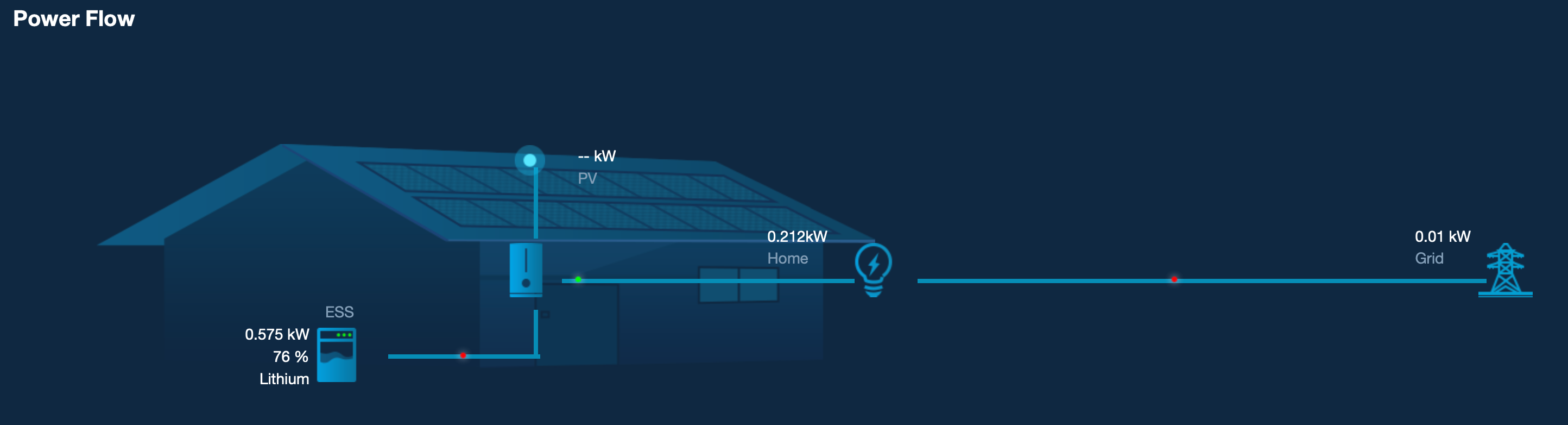
ESS Battery drawing more power than demand

  • January 3, 2024
  • 16 replies
  • 549 views

Hi, I recently installed a Livoltek ESS and I can constantly see the draw from the battery is nearly always double (low loads) to that of the demand (Home) is this normal or am I missing something obvious.


Best answer by waltyboy

Hi @WAC768, I’m afraid I’m not familiar with the Livoltek system…I just rely on my smaller inverter not exporting anything to the grid when its storage battery is discharging, mainly at night.  
 

I have noticed, though, that the “zero export” functionality of my little system goes a bit bananas if my house’s demand drops below around 20 Watts (for example during periods when the ‘fridge freezer and the chest freezer compressors aren’t running). For that reason, I’ve stopped going around at bedtime switching off router, neon switch for the cooker, doorbell transformer etc., as the inverter seems to “like” the household load never dropping below 20Watts or so. The “low loads” you mention, are they below this kind of minimal level?


As @BPLightlog says,  check your smart meter consumption to see what exact loads have been running, but I would also check the export kWh in your smart meter, I assume this should be a tiny or even a zero figure? Is it possible your system is exporting a small amount to the Grid, or is the Livoltek not grid tied in any way when it’s not charging?  I tried a hybrid ESS system for a few months, but I prefer the on-grid zero export type of setup now. 
 

On one occasion, but only once, I caught my small (battery-based) inverter fleetingly showing a mysterious and random 300W drain on the battery, but only for half a second or so, thankfully!  300 Watts is not unusual when everything clicks on at once, but I’m talking about a fleeting completely random 300 Watt demand, which I’ve only caught it doing that once. Goodness knows what it thinks is going on if and when it does that, perhaps it’s an internal check or something. It’s certainly not enough to register on my nighttime usage stats…your situation doesn’t sound similar though, I think?


You can get your own import/export meter very inexpensively: I hard-wired mine, but there are CT-based ones as well, although space may be limited in and around your consumer unit?  And you may glean enough information from your IHD and the smart meter itself, but I like to have my own kit as a “second opinion”!


Good luck with it, it’s a frustrating conundrum you’ve got there!  Is the Livoltek tech support any good?

16 replies

WAC768Author
Rank 1
January 4, 2024

Many thanks everyone for your help here it’s much appreciated and I will try your suggestions and will let you know how I get on.👍

Rank 7
January 4, 2024

We had a problem this autumn with our batteries. Different make to yours. We were charging from the grid overnight but only to 60% while there was still power coming from the solar panels. The batteries would start charging (very slowly) drawing power from the grid of their own accord during the day even when already above that 60% level and outside the time set.

It turned out after the installer referred to the manufacturer that for calibration they needed to hit 100% or 10%, which they weren't doing. They were calling for charge because they didn't know their state. They were replaced so the manufacturer could take them back to investigate, and now we've no sunshine we charge the new ones to 100% overnight so that they last all day.

3.99kW solar 2015, 12kWh batteries 2022, Tado.
juliamc
Rank 20
Rank 20
January 5, 2024

What is controlling that @EverythingNeedsAUserName ? Is it the inverter or a setting in the battery ? What make are they ? I’m hoping to get battery storage and haven’t had much info from the installer about this kind of detail. 

WAC768Author
Rank 1
January 5, 2024

Resolved maybe… After finally getting in touch with the head of Livoltek for the EU, who immediately got Dan from support on this (appears Livoltek has changed all their email addresses), who was brilliant, it appears that whilst the inverter had updated shortly after it was installed, many other updates that had not. It took around 1 hour for all these to be done and now typically the inverter load is around 100 - 150W higher than demand, which I think is about right (losses, DC/AC conversion, etc.)  


If anything changes I'll post again. Thanks for all your help on this topic.

Rank 7
January 5, 2024

What is controlling that @EverythingNeedsAUserName ? Is it the inverter or a setting in the battery ? What make are they ? I’m hoping to get battery storage and haven’t had much info from the installer about this kind of detail. 

It seems to just be the batteries. They've each some form of self control. AOBOET U Home LFP 2400. They're linked through a luxpowertek LXP Hybrid inverter. 

3.99kW solar 2015, 12kWh batteries 2022, Tado.
BPLightlog
Super User
Super User
January 6, 2024

What is controlling that @EverythingNeedsAUserName ? Is it the inverter or a setting in the battery ? What make are they ? I’m hoping to get battery storage and haven’t had much info from the installer about this kind of detail. 

It seems to just be the batteries. They've each some form of self control. AOBOET U Home LFP 2400. They're linked through a luxpowertek LXP Hybrid inverter. 

It might be because that battery model is not listed by LuxPower as being compatible.

https://luxpowertek.com/wp-content/uploads/2023/04/luxpower_compatible_list_20230408.pdf


Bring me Sunshine ~ E&E {Solar PV, Battery Storage, Hybrid EV, ASHP and Home Assistant automation}