Rank 2
April 2, 2023
Solved

Ecodan 'Coeffeciency of Performance', can I improve it?

  • April 2, 2023
  • 50 replies
  • 2394 views

Ecodan COP

Good morning 

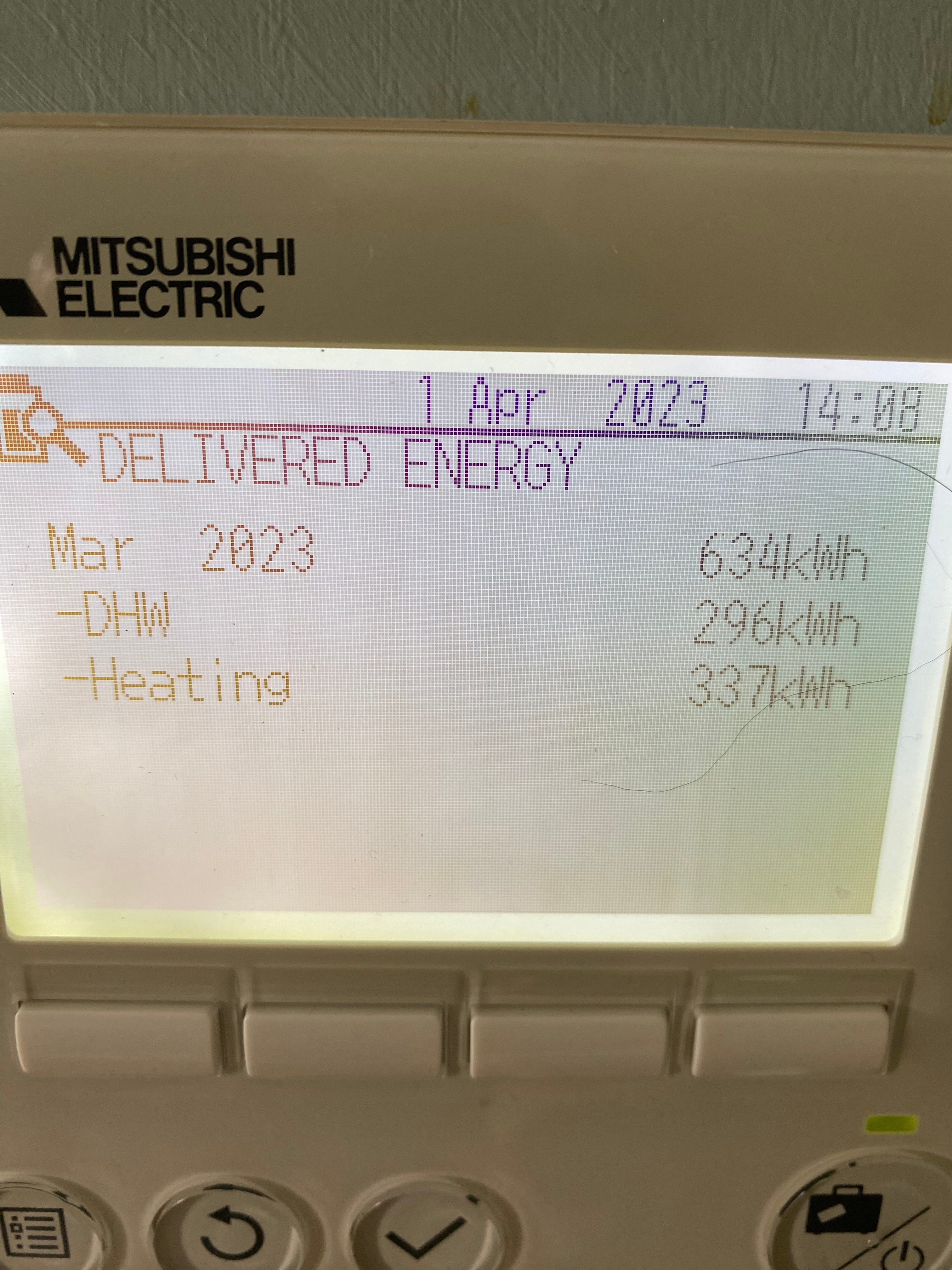
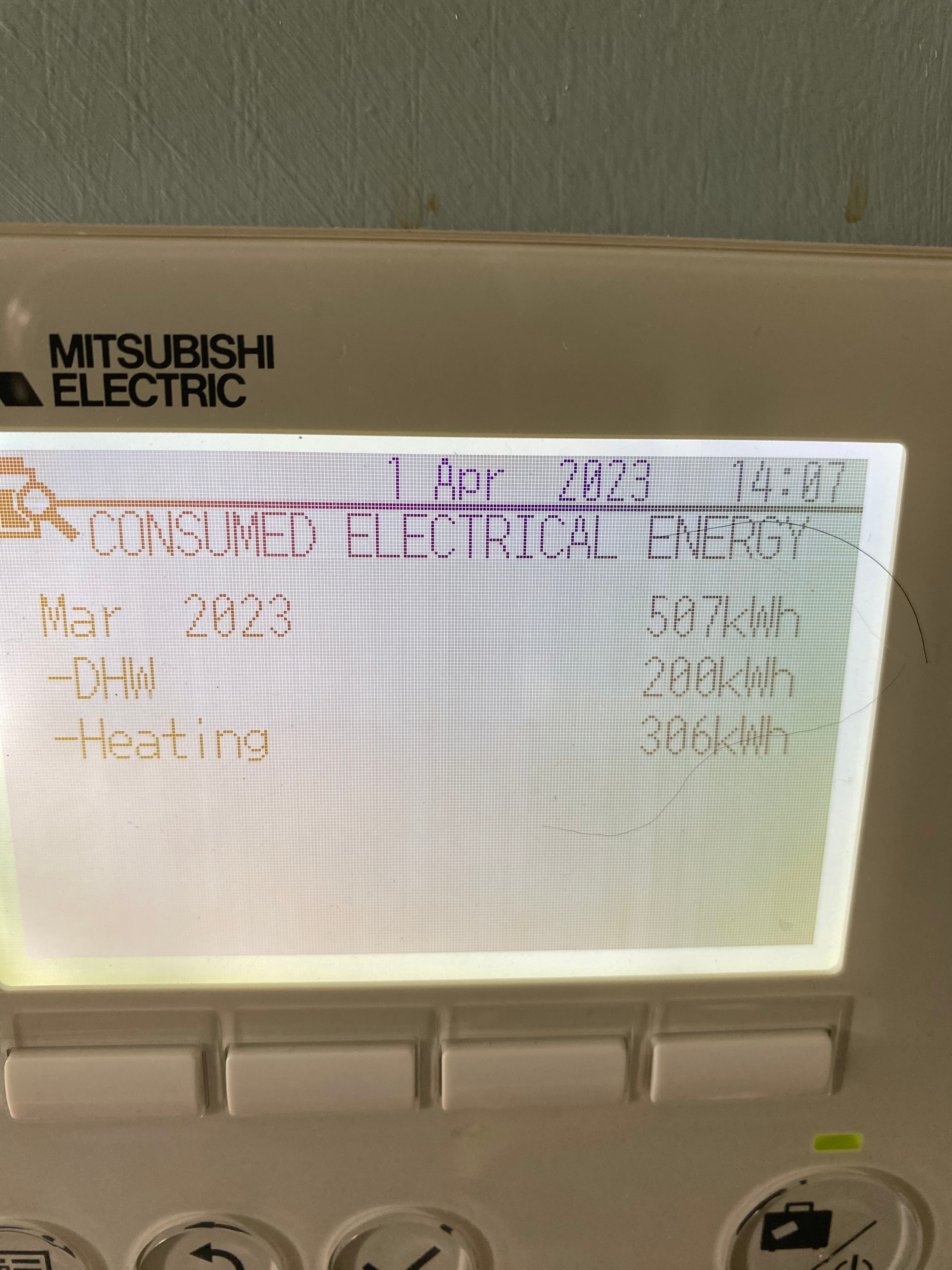
 , I have just looked at the COP for March and seems to be 1.25 , which I believe is poor. 1.48 DHW and 1.10 for heating . I have the heating on weather compensation mode and hot wat at 45c eco mode .  New system just in since end of January so new to all of this !!!  4 bed detached , no UFH , 20c downstairs and 18c upstairs . 10 PV solar panels 4kw. Anything I should do to improve COP?

Best answer by M.isterW

There are three ways to run an Ecodan heat pump 

1 - Fixed flow temperature. The system always produces water at the same temperature and you generally use a thermostat in the house to tell it when to turn on and off.

2 - Weather compensation. The system heats water to different temperatures depending on the outside temperature. It requires no internal thermostat because you set the compensation curve so it heats the house just enough and no more.

3 - Auto adaptation. This uses the wireless mitsubishi thermostat and manages the flow temperature to keep the house at your ideal temperature while trying to maximise efficiency.


I wonder if yours is set to weather compensation but the internal thermostat is stopping it performing correctly. Lots of people find that auto adaptation gives better, and more efficient, results so can I suggest you try that?

50 replies

juliamc
Rank 20
Rank 20
July 22, 2023

Hi @amanda1 it’s so typical to have zero information from the installers 🤦‍♀️ That’s one big failing of this heat pump industry I think.

When the system is heating your hot water to 50 deg it will always result in a lower COP because it’s got a larger temperature rise to reach than it would with your radiators, which may only need to be at eg 35 or 40 deg. So in the non-heating months the overall COP is less likely to get up to 3 or 4. If the heating’s on a bit over the ‘summer’  the average COP will improve a bit too.

Sounds like you have your hot water on ‘reheat’ so it only runs the pump when the tank temperature drops below 40. You could try scheduling instead, if you heat the hot water in the warmest part of the day (around 3pm) the temp uplift will be the least and the COP will be slightly higher. You could also try lowering the tank temp down a bit, eg 48 deg or lower.

Regarding running the heat pump 24/7 I wouldn’t worry about that till the cooler months when you want the heating on all the time. Basically you are balancing the heat loss from the property with the heat from your radiators. The heat pump will be at its most efficient when it’s running all the time rather than switching on and off. 

Rank 2
July 22, 2023

@juliamc that tallies with what I thought - re the water, the temperature is taking about fifteen hours to drop to 40, so only heating water twice in a 24 hour cycle, so effectively, it is scheduled. I have changed the legionella settings but that is all I have changed so far. I don’t use huge amounts of hot water. This of course partly accounts for the comparitive inefficiency. I am waiting to see how the system performs with these default settings when the winter comes. It’s a bit Game of Thrones up here in the Cairngorms….The system prioritizes the hot water. At the point in Autumn when the water needs to reheat more often,  50 degrees with a 40 degrees lowest temp will mean less frequent cycles, and therefore less time without heating, or 45 degrees with a 40 degrees temp, meaning more frequent cycles and more time without heating. I am used to living in a cold house with long stretches during the day when there is no heat coming from the storage heaters, and running out of hot water by midday. With ASHPs it all depends on what luxury you have or have not been used to!

juliamc
Rank 20
Rank 20
July 22, 2023

Yes they all prioritise hot water over heating. Some people have two heat pump installed, one for each function! In the coldest days down here in SE England (-7deg) we did notice the house cooling when the hot water was being heated, and of course the incoming mains water was very cold too so it had a lot of work to do and I think it took over an hour to run. 
The other time to have the hot water heating is of course when you’re in bed and won’t notice the heating going off, but that’s probably the coldest part of the night and you’ll get an even lower COP. We set the house temp back a degree at 9pm which in effect turns the pump off. Perhaps that would be the best time to heat the hot water 💡🤦‍♀️

Rank 2
July 22, 2023

@juliamc thanks - I might try setting up some timed settings later in the year. But that shortfall of heating while the water heats up isn’t going to bother me unless it happens often in winter. In winter the water may cool more quickly, given the location of the tank in my particular case. I think the COP will never be very good given our winter temperatures, and I expect to spend a lot of time clearing snow away from the front of the pump.

juliamc
Rank 20
Rank 20
July 22, 2023

Can you rig up any kind of screen or roof over the unit to stop snow drifting around it ? It’s the grille on the back that will freeze regardless of snow. The liquid in the pipes reverses to defrost the unit regularly so you’ll see the ice melt every so often. Did your installer have an opinion about snow ?? 

Rank 2
July 22, 2023

@juliamc I’m considering building a kind of canopy over the top, because while I can dig the snow away from the front of it, the snow falls off the roof eventually, and will land just in front of the ecodan, or worse still, on top of it. Tons of snow. The installers are based in Edinburgh and Glasgow, and I suspect they don’t actually know what real snow looks like, let alone have any opinions about it. They weren’t big on opinions, just on getting in and out of the North as fast as possible. They are fitting these ASHPs on a massive scale in Moray with council and government grants, and their attitude is “you’re getting it for nothing, so you are on a need to know basis”. What they have done, based on the experience of people up here who have gone through a winter with the ASHP, is set the Freeze Stat function to * (0 - effectively deactivating it), because it is set by default to kick in when the outside temperature reaches 5 degrees, but up here, it is 5 degrees or less most of the time in winter, and so people’s ASHPs were running 24/7. To do this you have to have sufficient glycol in the system. They have checked that the glycol in the system is sufficient. There is a separate anti-freeze function that kicks in anyway. I have been advised that if the coils freeze up it is OK to trickle warm water over them. This seems counter-intuitive, electricity and water and all that, but it worked for my neighbour last winter and she is still alive…..

M.isterW
Rank 6
Rank 6
July 22, 2023

@amanda1 The way auto adapt is designed to work is that is manages the flow temperature to keep your house at the selected temperature. By adjusting the thermostat up and down you’re interrupting the system’s attempts to run at maximum efficiency which results in a lower COP. The ideal way to run it is to set the main house thermostat to a single temperature (with a reduced temperature overnight, if that suits you) then leave it alone.

In cold weather it wouldn’t be unusual for the heat pump to run most of the time, particularly if you’re using auto adapt. It will run with a low flow temperature and provide just enough heat to keep the house at your chosen temperature. This is the most efficient way for it to run and will use less electricity than having it supplying a higher flow temperature and switching on and off.


Unfortunately installers are very bad at providing the sort of information and education that helps people run their heat pumps in the most efficient way. We’re all used to running heating systems that operate at a fixed efficiency (gas boilers, electric storage heaters etc) and heat pumps require a completely different mindset.

1992 4 bed detached house. Solar PV + battery, Zappi EV charger, Mitsubishi Ecodan ASHP and i-life2 fan assisted radiators.... No gas 😊

Rank 2
July 22, 2023

@M.isterW thanks for your clear info - that’s exactly what I try to do - the main house thermostat is set to a single temperature, 18, all the rad thermostats are fully open, and I reduce the set temperature overnight to 17.  Just lately however the room temperature on the main thermostat has been higher than my set temperature, but the house has been chilly - the room thermostat is in the hall and the hall is obviously quicker to heat up. Or maybe it’s just me….we have had a few nights with freezing temperatures lately also. To get the heater to actually come on, I have had to raise the single set temperature by a half a degree or so above the room temperature. This has been about once a day, for about half an hour or so. I don’t like doing this but it fascinates me to have heat on demand….you say, we are all used to running heating systems that operate at a fixed efficiency. But although storage heaters give 1kwh for every kwh consumed, to get them to heat the house sufficiently in winter they need to consume 60kwh a day - therefore despite their fixed efficiency they are expensive and useless. I have had 10 years of them, because we do not have mains gas - bills in excess of £2000 pa for almost all of those ten years, not just for the last year - in return for a cold house with damp walls; and I am still getting used to having a wrap around warmth almost instantaneously. I am not expecting the COP to be high, because I live in a cold area, and the house has been retrofitted with cavity wall insulation, but there is still some heat loss.  I will be interested to see if in winter the ASHP (Hirohito…) consumes 60kwh a day. It’s the kwh consumption per day that I am interested in, the raw cost, rather than the ratio of consumption to delivery.

juliamc
Rank 20
Rank 20
July 22, 2023

Do keep us posted on your system. You are in such an extreme location compared to me - our lowest nighttime temp has been about 13 deg recently.
To keep the damp out you’ll need to have some ventilation. Do you have double glazing with trickle vents ? That’s another game - for ‘ventilation’ read ’heat loss’ 🙄

Rank 2
July 22, 2023

@juliamc I do have double glazing with trickle vents. The damp is due to condensation. So the cavity wall insulation should make a difference. Since the cavity wall insulation was fitted last month, the damp smell has been less noticeable, and I think also that having pipes under the floor carrying heat some of the time has made a difference. But it is summer and we have been enjoying really hot weather in June - although this month has been wet and colder than average so far - so I really can’t tell at the moment how much difference all this new kit will make. These systems have been very common in Scandinavia for a long time, and in North America also, so I am assuming that the Ecodan will cope with the cold. They do sell it as being good in very cold conditions. I found some interesting Norwegian stats on COP  at cold temperatures. See graph