
Question

12 Panel Solar plus 5.2kWh battery plus 11kWh ASHP - off grid for 3 seasons?

  • April 1, 2026
  • 7 replies
  • 52 views

If I win the lottery and pay OVO £8700 for a 12 panel PV Solar array on my large 25 degree pitched south facing roof plus a 5.2kWh storage battery in my integral garage plus an estimated £5000 for an 11kWh ASHP (after £7500 govt grant) plus an estimated £5000 for new radiators and hot water cylinder, can I expect to be effectively self sufficient during 9 months of the year? 

7 replies

Ben_OVO
Community Manager
Forum|alt.badge.img+4
  • Community Manager
  • April 1, 2026

Out of interest I inputted your question into Google Gemini, which gave me this AI-generated answer:


To answer your question directly: No, you cannot realistically expect to be "effectively self-sufficient" for 9 months of the year. While you will be a powerhouse in the summer, the math for a UK home with an Air Source Heat Pump (ASHP) tells a different story for the "shoulder" months (March, April, October).


There was a load more info, facts and figures given in the answer, which I didn’t want to put on the Forum in case anything was incorrect. If you do use an AI tool you could try putting your question into it to see what answer you get.


Fingers crossed you do win the lottery! 😂🤞


BPLightlog
Super User
Forum|alt.badge.img+12
  • Super User
  • April 1, 2026

Just incidentally, we had our solar array installed in 2012 (it paid for itself in under 6 years and is still performing well).

We added batteries more recently and have added further capacity twice since then too.

Our heat pump (9kW) including radiators and hot water tank was installed for less than £3000 (with the grant).

So without a lottery win, piece by piece installs help to spread the investment cost.

I do know people who have complete systems which cost nothing to run but that relies on tou (time of use ) tariffs - including export which are not easy to follow for everyone and are a challenge during winter months.


  • Author
  • Rank 3
  • April 1, 2026

Out of interest I inputted your question into Google Gemini, which gave me this AI-generated answer:


To answer your question directly: No, you cannot realistically expect to be "effectively self-sufficient" for 9 months of the year. While you will be a powerhouse in the summer, the math for a UK home with an Air Source Heat Pump (ASHP) tells a different story for the "shoulder" months (March, April, October).


There was a load more info, facts and figures given in the answer, which I didn’t want to put on the Forum in case anything was incorrect. If you do use an AI tool you could try putting your question into it to see what answer you get.


Fingers crossed you do win the lottery! 😂🤞

Thank you Ben, I will certainly do what you suggest. I do use AI on a regular consultancy basis but did not think to do so on this occasion as the calculations are not trivial. I must admit that as I am somewhat new to all of this and it was already late in the night or early in the morning,  I did not want to make a whole load of assumptions and then estimate at what points and in which nominally ‘winter’months the system would be in net deficit, bearing in mind all the relevant data, so I just assumed that at least one dozen forum members would have already had first hand experience of this type of scenario.


Peter E
Super User
Forum|alt.badge.img+9
  • Super User
  • April 1, 2026

I think there are two questions in here. One explicit and perhaps one implied.


The explicit answer is as ​@Ben_OVO said above, you can’t be self sufficient but as you are not living off grid (I’m assuming) you don’t need to be.


The implied question, as prompted by ​@BPLightlog’s response is the return on investment, which with solar panels you certainly will. I’m thinking that BP’s panels come under the FIT payment (given the date of installation) which has a very good rate of return. If you have solar panels your excess production during the summer, sold as a SEG, will go a good way to paying back the panels over about 10 years (the SEG is less than the FIT so a longer payback time) and then everything you use and sell will see a good reduction on your energy bill. A significant lottery win will of course pay for the panels etc and you are home and dry from day one.


Summary: So whilst your winter production won’t cover your use the production over the year will be a great benefit to you. Of course, in the summer you have plenty of solar panel but no need for heating and the reverse is true in the winter. That’s where the SEG effectively averages out your gains and losses.


Peter


juliamc
Rank 20
Forum|alt.badge.img+8
  • Rank 20
  • April 1, 2026

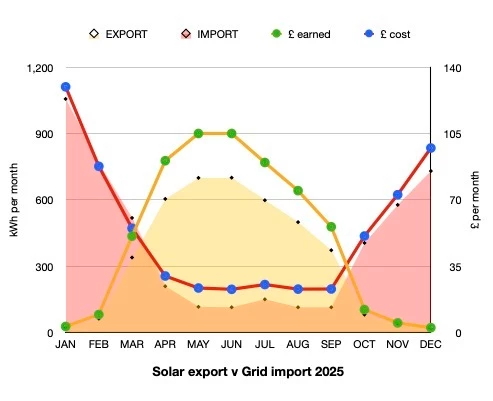
We have 18 solar panels, a 13.5 kW battery, an EV and a 8kW ASHP. I haven’t processed all the figures for the last 18 months since my solar panels were installed but for the last year I’ve been paying £30 a month for all our energy. That covers the EV (quite low mileage), ASHP (we have the house at 22 deg generally) plus the usual household appliances though we nearly always use the air fryer rather than the electric oven. We also have a gas hob. Our PV earned us £600 in 2025 and I charge the battery overnight from the grid. I’m on Octopus Intelligent Go so was getting 15p a unit for export (that’s now 12p) and buying during the night at 7p. 
I hope to get a graph together to show how much the PV got us through the shoulder months.


Peter E
Super User
Forum|alt.badge.img+9
  • Super User
  • April 2, 2026

Using ​@juliamc results above as an example a solar panel system costing, say, £6,000 and earning £600 per year would pay back in about 10 years.


The calculation for the battery would depend on the difference between the rate the electricity is bought at (7p) and the rate it would have been used at (the peak rate) times the amount used daily (up to 12kWh - allowing for losses).


Peter 


Ben_OVO
Community Manager
Forum|alt.badge.img+4
  • Community Manager
  • April 2, 2026

@Cloudliner79 you’ve sparked some good discussions recently that have unearthed some really interesting stuff. 


@juliamc ​@BPLightlog thanks for shedding light on the potential return of investment here - it’s nice to hear that these upgrades can start to pay for themselves after a few years.