




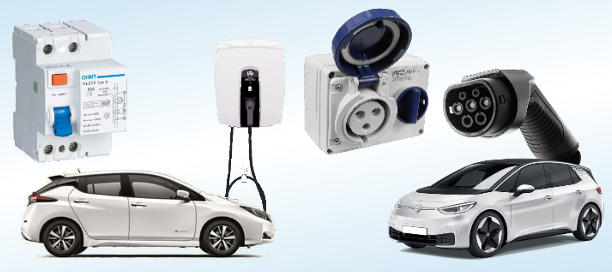
An electric vehicle (EV) charging point installed at home
Updated on 13/05/26 by Ben_OVO
Please be advised you must employ a qualified electrician to undertake the work outlined in this user-created guide. Given the cost/time requirements as well as the loss of smart charging benefits, OVO Energy would recommend a smart EV charger instead of a self-installed charger described below.
Want to find out more about OVO’s EV plan? Check out this topic:
.
As a new owner of an electric vehicle (VW ID3) I am well aware of the plethora of companies who wish to sell me a charger, such as OVO here. Each of them is apparently better than the previous one and comes with an array of bells and whistles . Most chargers are bundled into a package deal offering me cheaper rates and access to a thousand or more charging points across the country.
So I need a home charger too, right?
Wrong. Despite its name, the ‘charger’ really only performs two functions:
- It can reduce the current available to the EV if required
- It allows the configuration of charge time and duration
The actual charging electronics is built into the car… not the charger! Most EVs also allow the user to set up charging times, either using an internal touch screen, voice control or an App on your SmartPhone.
So until I know what sort of charger I want, all I actually require is an external socket capable of delivering the equivalent current to my car. Most home chargers are rated 7.5kW, which means they take 32 Amps.
Here is a switched 32A external socket. Initially a lead can be plugged in, and it can be changed to have a charger connected at a later date.
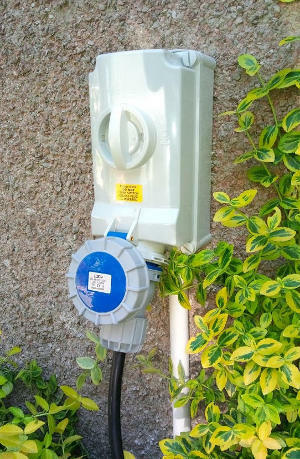
External sockets are marked with a code that defines how well sealed they are against water and dust. The socket above is rated IP67, which is as high as you’re ever likely to find. With the cap covering the downwards facing terminals, it can withstand a full-on attack with a pressure washer!
Even when a connecting cable is plugged in, the socket’s contacts still cannot be reached by the highest level of hurricane you’re likely to face without the house falling down anyway.
What are the benefits of using an external 32A (7.5kW) socket?
- Any qualified electrician can install it. They don’t need to be separately authorised to install charging equipment.
- A proportion of the installation work for a charging point is the running of the cable. The electrician will specify this. Its route may include moving furniture, lifting of carpets and floorboards. That really doesn’t warrant paying a charger-specialist to undertake.
- If your Consumer Unit needs extending/replacing to allow additional space for the EV protection components, then a local electrician is ideally suited to undertake that work, most of which involves the existing house electrics.
- A local electrician is well placed to make the LCT Application to your Distribution Network Operator (DNO). It requires undertaking a Load Survey of the house, excluding the LCT device(s) which the application is being made. The survey must find the peak-usage required by the house, possibly by having an energy monitor being left on site for a period.
That peak demand is added to the rated specification of the EV charger (and any other LCT devices) to arrive at the Maximum Demand (MD) for the property. - If you later decide on a charger, then the same cable can be used. The socket can be moved to allow a 2-way switch to be fitted. This can select between the EV charger and the 32A socket. Should the charger have a fault, you still have a wall socket from which to charge the car.
(Calculating the Max Demand for a house is described in the topic Energy demand, supply and flexibility)
So what do I need at the Consumer Unit end of the new cable run?
A suitably heavy-current cable connects the external socket back to the house Consumer Unit. If that cable is underground or clipped to the outside of the house, then it will usually be an armoured (SWA) construction.
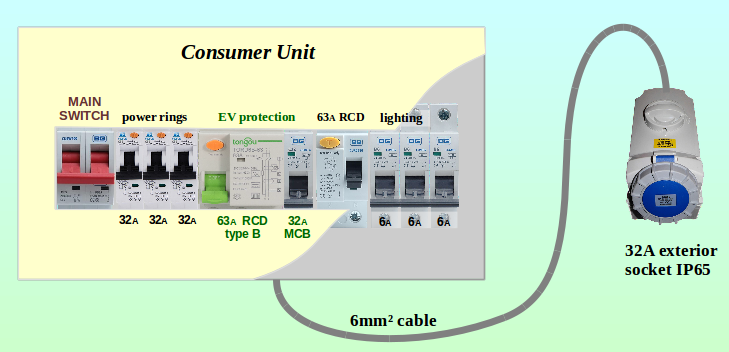
If you don’t understand this diagram, that’s because it’s intended to be shown to your electrician! Unqualified people are not permitted to work on mains electricity wiring in the UK, even if it’s your own house.
The method to provide the safety earth connection to an EV Charge Point is critical. The earthing rules must be adhered to whether you have a 32A charging socket like mine, or a full-blown EV Charger.
Earthing will differ according to the way in which the electricity feed is supplied to the house from the Distribution Grid.
The two most common methods are TN-C-S and TT which are shown below, but there are other arrangements. A qualified electrician will identify the type of supply and will test the earthing as part of the installation work.
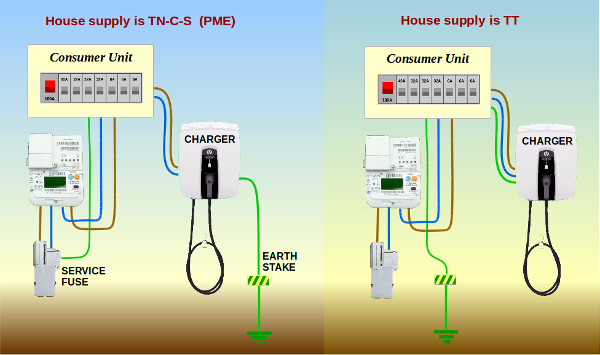
The reasoning behind the way in which the earth connection is provided is explored in greater detail later in this topic.
Your EV Charge Point requires an MCB (Miniature Circuit Breaker) rated at 32Amps to protect the cable between the Consumer Unit and the exterior socket. The MCB is normally chosen with a C-curve. This defines the trip-time when there is a fault.
Most household MCBs are chosen to have a B-curve. The C-curve is more tolerant of high-current surges at switch on/off. That’s what we usually need for charging our EV. We don’t want the MCB tripping every time the charge-cycle starts!
Supplying the power to that 32A MCB is a Residual Current Device (RCD). This provides operator safety and protection. An RCD measures the difference between the current on the live wire and the neutral/return. If they aren’t in balance then there must be a fault and the trip opens the contacts.
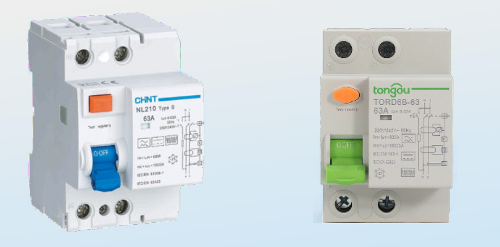
However, some electrical devices distort the 50Hz sine-wave used for UK mains power.
EV chargers fall into this category. They can induce higher-frequency ‘harmonics’, or shift the sine wave by adding in an element of DC (Direct Current). This can prevent the RCD from tripping out when it should, or needlessly tripping when there isn’t actually anything wrong.
Experience with this phenomenon was gained by OVO during the two years of their V2G charger Trial. It resulted in sites being fitted with Type-B RCDs which are specifically designed to cater for these anomalies.
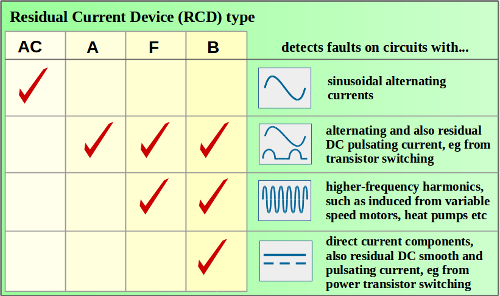
Type-B RCDs should not be confused with an MCB over-current device having a B-curve timing characteristic. These are two quite separate concepts.
An RCB with Type-B sensing is expensive… at least £200 at the time of writing. So if you’re paying less than that, then you’re probably not being offered what you need!
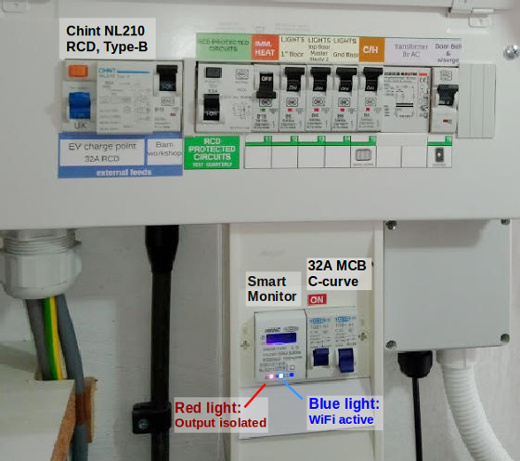
In the above photo there wasn’t enough space in the main Consumer Unit to fit an additional Smart Monitor module. This was therefore placed in a separate enclosure below, with the 32A MCB alongside it.
The Smart Monitor isn’t essential. It uses a WiFi connection to a SmartPhone App which displays the power used. The App also allows the external socket to be isolated, thereby preventing anyone else from using it.
How well does it work?
Let’s remember that this is an interim measure for me. Although I can preset charging-times using the car’s electronics, there are other automated features I’d like once I’m confident that a particular model of Smart Charger offers them.
My house already has the benefit of PV Solar Panels (5.1kW grid-connected) and a small Storage Battery (8kWh). I can use both of these to help maximise the quantity of free solar energy used to charge the car.
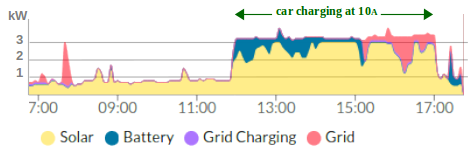
The above graph is from early June. It shows a household base-load of 0.8kW, almost all of which is being satisfied by solar power before 7am. At noon the PowerVault battery was over 50% full and there’s at least 2kW of solar available. That’s the point when I could start charging the car at 10Amps.
A higher charge rate than this would be needlessly taking electricity from the grid. But until 15:20 there’s enough energy from solar (yellow) plus what was already in the PowerVault battery (blue) to fulfil the 10A charge-rate I’d set. The Battery was then depleted, and any further deficit was taken from the grid (red) to keep the car charge at 10A.
By 17:10 the sun was no longer shining directly on the PV Panels, so I stopped charging the car. That low-current charge had added 12½kWh to its battery. Any surplus solar after then was used to restore energy back into the PowerVault battery.
Yes, it’s a very manual system, but if I keep watch on my solar generation and the weather forecast, then it serves well.
Hope this helps!