Answer

Is a Storage heater with single tariff allowed?

  • May 25, 2025
  • 20 replies
  • 385 views

I heard mention the other day that if you have a smart meter and are on an Economy 7 tariff and you want to change to a single rate tariff, that you need to have your storage heaters rewired, and you can’t just switch tariff’s like that, is this true ?

Best answer by Firedog

I heard mention the other day that if you have a smart meter and are on an Economy 7 tariff and you want to change to a single rate tariff, that you need to have your storage heaters rewired, and you can’t just switch tariff’s like that, is this true ?

No and yes.

If you have a smart meter with an internal switch (ALCS) that turns storage heaters on and off in accordance with the Economy 7 timings, then they will continue to switch on and off as before even though you change to a single-rate tariff. When OVO makes this change, all that happens is that the day and night tariff prices are set to the same figure; everything else stays the same. 

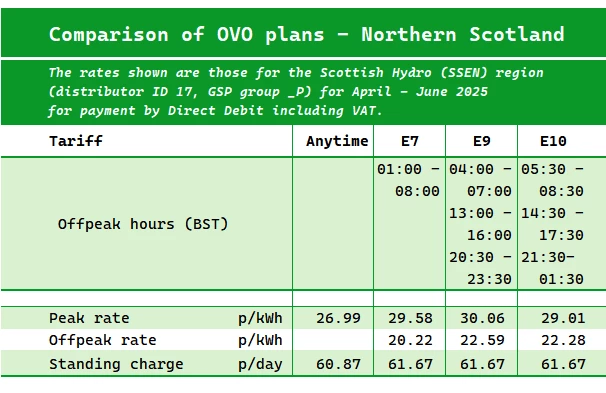
You might explain why you would want to change to single-rate if you have storage heaters. They are usually the biggest consumers of electricity in the household, so it usually makes sense to minimize the cost of charging them. I’m not sure whether the Northern Isles are covered by the same pricing regime as the Northern Scottish mainland, so I don’t know if these tables will be at all helpful:
  

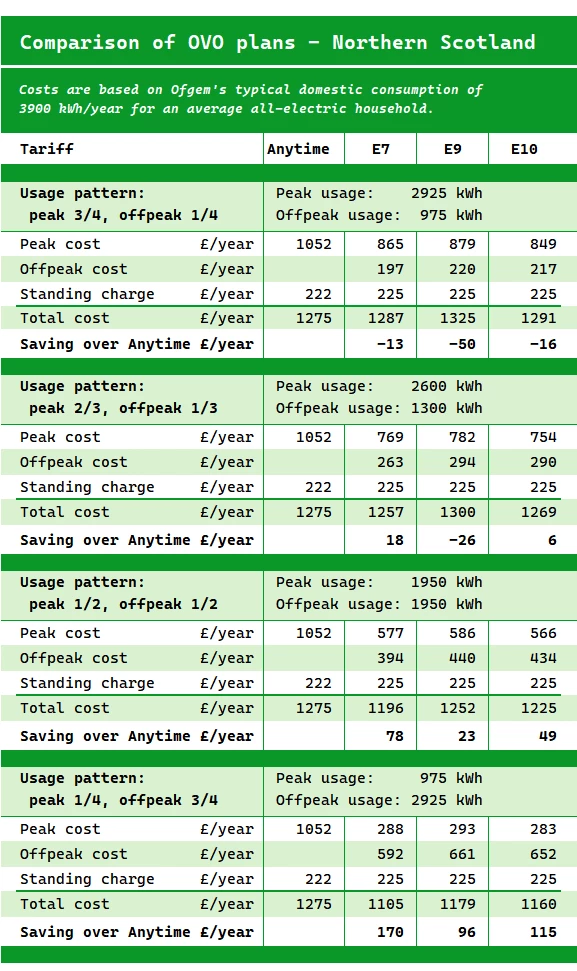
‘Anytime’ indicates the single-rate prices


You’ll see that so long as at least a third of consumption is during offpeak hours, Economy 7 will be less expensive than single rate. Many electrically-heated Scottish households see 75% of their annual consumption taking place offpeak.


20 replies

Blastoise186
Plan Zero Hero
Forum|alt.badge.img+1
  • Plan Zero Hero
  • May 25, 2025

Hi ​@shetland ,

If you have a Smart Meter, you can switch to Single Rate and have the heaters run 24/7 if you really want to, but it’s highly inadvisable because you’ll end up spending a fortune - and that’s not how such heaters work anyway.

They should never be allowed to run 24/7.


Firedog
Plan Zero Hero
Forum|alt.badge.img
  • Plan Zero Hero
  • Answer
  • May 25, 2025

I heard mention the other day that if you have a smart meter and are on an Economy 7 tariff and you want to change to a single rate tariff, that you need to have your storage heaters rewired, and you can’t just switch tariff’s like that, is this true ?

No and yes.

If you have a smart meter with an internal switch (ALCS) that turns storage heaters on and off in accordance with the Economy 7 timings, then they will continue to switch on and off as before even though you change to a single-rate tariff. When OVO makes this change, all that happens is that the day and night tariff prices are set to the same figure; everything else stays the same. 

You might explain why you would want to change to single-rate if you have storage heaters. They are usually the biggest consumers of electricity in the household, so it usually makes sense to minimize the cost of charging them. I’m not sure whether the Northern Isles are covered by the same pricing regime as the Northern Scottish mainland, so I don’t know if these tables will be at all helpful:
  

‘Anytime’ indicates the single-rate prices


You’ll see that so long as at least a third of consumption is during offpeak hours, Economy 7 will be less expensive than single rate. Many electrically-heated Scottish households see 75% of their annual consumption taking place offpeak.


  • Author
  • Carbon Catcher*
  • May 25, 2025

Roughly half our usage is off peak with storage heaters.

Since the E8 tariff we will be on is less than ideal for the times when the heaters come on, an alternatiave approach is either to leave the heaters on 24/7 but on a very low setting, or use something like a fingerbot to turn them on and off at the switch on the wall to a timed suquence of our choosing, rather than be stuck with the E8 times only.


But if changing to a single rate tariff means the storage heaters still are only going to come on at E8 times, that isn't what I'd ideally want !


I suspect the storage heaters could be rewired so as not to be connected to the smart meters E8 port so to speak, but was quoted £5,500 for that !


They said a new consumer unit had to be installed at the same time.


Firedog
Plan Zero Hero
Forum|alt.badge.img
  • Plan Zero Hero
  • May 25, 2025

By E8, do you mean the Domestic Economy tariff that gives offpeak rates for eight hours overnight (00:30-08:30 during summertime)? Why is this less than ideal for you? You would be charging the heaters up at 20.15 p/kWh instead of 26.99 p/kWh at current rates - that’s 34% more expensive. For an all-electric household consuming 3900 kWh a year, half of that would cost £526 at the single rate compared to £393 on Domestic Economy.

The heaters should deliver heat when you want them to, regardless of when they charge up. Older ones are not so good at that as newer ones, but they are usually designed to deliver heat for 14 hours a day. Some users find that they run out of steam towards evening, which is the time when you probably most need the heat. That’s why many Scottish customers have opted for Economy 9 or 10 plans, which each give two offpeak slots during the day; the earlier one can be used to boost flagging storage heaters, while the later one can be used to power direct heaters (radiators, convectors or IR, say) for late evening comfort at more affordable rates. It’s also easier to run other power-hungry appliances (electric shower, cooker, washing machine, dryer, hairdryer, iron, hoover ...) at the cheaper rate when you’re not actually in bed.

The bottom line (a personal view!): running storage heaters at single-rate prices is about as effective a way of keeping warm as burning £10 notes in the fireplace.  


  • Author
  • Carbon Catcher*
  • May 25, 2025

We consume 16,000 kWh a year, 8,000 of that with storage heaters, 8,000 of that with everything else.

Off peak rate is 24.61p a unit, peak is 28.77p a unit.

I heard of a company that their single rate 24/7 is something like 24p a unit, so if we changed to that, it would be cheaper, plus we might then be able to choose when our storage heaters come on and go off to better suite our lifestyle, than to be stuck to a specific E7/E8/E10 plan.


Blastoise186
Plan Zero Hero
Forum|alt.badge.img+1
  • Plan Zero Hero
  • May 25, 2025

Worth remembering though - it is unwise to try to run storage heaters 24/7 or outside of the E7/8/9/10 cycles that you’re moving to once you’re off of RTS...


  • Author
  • Carbon Catcher*
  • May 25, 2025

Why is it unwise to run a storage heater 24/7 when said storage heater has been working fine running E7 times for 50+ years ?

I would imagine it will last longer being on 24/7 than going on and off all the time, putting extra stress on components in the process.

How would running them on a 12 cycle be any different to a 10 cycle either ?


Blastoise186
Plan Zero Hero
Forum|alt.badge.img+1
  • Plan Zero Hero
  • May 25, 2025

Two main reasons tbh…

  1. It’d cost you a fortune - night storage heaters are not meant to charge up 24/7 and the idea is you charge them during the night when the rates are cheaper on a split-rate tariff
  2. You’ll potentially waste a load of energy for no benefit - those heaters can’t charge constantly anyway

Forum|alt.badge.img
  • Carbon Cutter*****
  • May 25, 2025

@shetland have you considered ditching the storage heaters and fitting an air to air heat pump heating system? After 50 yrs of storage heaters we did this last year, uses approx 33% of electric that storage heaters use, very responsive and quick to heat the house (ZE postcode). 


  • Author
  • Carbon Catcher*
  • May 25, 2025

I have considered heat pumps, but yet to be convinced by the maths that they are a saving long term.

I still explore that possibiliy, though at the moment, think that solar thermal might be a cheaper and more reliable long term solution.

Neither are a cheap capital investment though, whilst storage cheapers are dirt cheap, espeically when I already have some sitting in the garage doing nothing useful !

I’ve seen storage heaters charge constantly 24/7 on a low setting, so I know that is possible.

Whether they can handle such a thing or not long term I don’t know, but as it seems as they are a very simple heating design from 50 years ago I don’t see why not, unless someone can specifically tell me why that isn’t possible.

If I was to have a heat pump, I’d need at least 2, so when one fails, I can use the other to avoid freezing to death.

Same with hot water tanks, best to have two, so you don’t have to put up with kettles for everything until you get some spare parts.

I notice for my model, there was only 3 spare parts for it left in stock in the entire country and they don’t make them anymore ! which reminds me of my current storage heaters where they stopped making parts for them after 47 years, and they are 50 years old.

Which is why I have some spares i the garage from a neighbour throwing theirs away when they upgraded their heating system.

Currently testing out electric heated towel rails as a replacement, since they are cheap, especially second hand, and easy to find wall space for.



Forum|alt.badge.img
  • Carbon Cutter*****
  • May 25, 2025

I have considered heat pumps, but yet to be convinced by the maths that they are a saving long term.

I still explore that possibiliy, though at the moment, think that solar thermal might be a cheaper and more reliable long term solution.

Neither are a cheap capital investment though, whilst storage cheapers are dirt cheap, espeically when I already have some sitting in the garage doing nothing useful !

I’ve seen storage heaters charge constantly 24/7 on a low setting, so I know that is possible.

Whether they can handle such a thing or not long term I don’t know, but as it seems as they are a very simple heating design from 50 years ago I don’t see why not, unless someone can specifically tell me why that isn’t possible.

If I was to have a heat pump, I’d need at least 2, so when one fails, I can use the other to avoid freezing to death.

Same with hot water tanks, best to have two, so you don’t have to put up with kettles for everything until you get some spare parts.

I notice for my model, there was only 3 spare parts for it left in stock in the entire country and they don’t make them anymore ! which reminds me of my current storage heaters where they stopped making parts for them after 47 years, and they are 50 years old.

Which is why I have some spares i the garage from a neighbour throwing theirs away when they upgraded their heating system.

Currently testing out electric heated towel rails as a replacement, since they are cheap, especially second hand, and easy to find wall space for.

 

Here's actual data from our system, heating off overnight till 8 am, outside temp between 5 and 8 Deg C, target temp of 20 Deg C, system used 8 kWh. This is the total for the outside unit and 3 internal wall mounted units.

This is a big improvement over the storage heaters, we had 3, one of the small 2 element ones, a 3 element one and a 4 element one, the only one that worked any sense was the big 4 element one.

Heat pump system has a 7 year warranty. 

We have solar PV and a solar diverter to the hot water tank immersion.


  • Author
  • Carbon Catcher*
  • May 25, 2025

Thank you very much for that data / diagram.

Is 8 kWh the max the heat pump can use in 24 hours, if not, then what could the max be ?

Asking AI it reckons your COP from the above figures is around 3 to 4 would you say that is an accurate estimate ?


Chris_OVO
Community Manager
Forum|alt.badge.img
  • Community Manager
  • May 29, 2025

Hey ​@shetland & ​@Infiltrator,


Great to see you both working together it seems like the advice infiltrator is sharing has been really helpful so far. What’s your current thoughts on heat pumps Shetland have they grown in appeal or are you still very much in consideration phase? 


  • Author
  • Carbon Catcher*
  • May 29, 2025

Still considering phase.

I first heard about heat pumps in the 1980’s from the Mother Earth New magazines, and have followed them since, with interest.

It would be nice, when I eventually move to somplace with a few acres, to get off grid, to use something like that, since it would then reduce the amount of solar generated electricity needed to power the heating system.

So far, solar thermal is winning the race to provide the heating solution.

I want a good grasp of the economics involved, maintenance issues, and all that jaz, since ideally I don’t want to be up a ladder aged 100+ fixing it in the middle of winter. :-)


Chris_OVO
Community Manager
Forum|alt.badge.img
  • Community Manager
  • May 30, 2025

Hey ​@shetland,


It sounds like you've been following the heat pump journey for some time! One of our community members, ​@Peter E, has written two fantastic articles about his experience adopting greener technology and the associated costs. If you have a moment, they are well worth reading as they offer a fascinating insight.


What makes solar thermal more appealing over the alternatives? 


  • Author
  • Carbon Catcher*
  • May 30, 2025

Thanks for the links, will look at those.

From what I can gather, solar thermal will work every day of the year, is cheaper, takes up less space than solar PV, and simplier.

I want to be off grid, and be able to repair my own stuff as much as I can, and not freeze to death because I can’t get a spare part, or wait for an engineer to come and fix it for me, assuming I can actually afford one !

Mention is given of it in this video:


> Hasn't had a Heating Bill for 40 years.


  • Author
  • Carbon Catcher*
  • May 30, 2025

I also have several requirements that push the  boundaries:

I want to be prepared for a 6 month -50c winter.

I want to be able to grow all my own food if need be.

I want a 12v/24/36v DC wide system for the entire house electrics, so I can do them myself, and not need an electrican to do anything for me.

I haven’t yet decided, or found out which is best, 12v DC, 24v DC, 36v DC.  I was thinking of 48v DC too, but I hear there are regulations if the voltage ever goes over 50v, which it would do with a full charged battery in the system.

The lower the voltage the fatter the cables you need, which are more expensive, but it might be easier to go from 12v DC upwards to anything, than the other way around.

If I want to run something 230v AC, I can just plug in a cheap DC to AC converter, and when it goes wrong, plug in a spare from the spares shelf, where I would intend to have spare parts for everything.

I might go for a ground source heat pump, but it would take a while to dig a 300ft well for it !

Which reminds me, if I went for a shallow depth ground source heat pump, where does the majority of the heat come from, is it from below, or above fro mthe sun shining on the ground.  If above, don’t you need just grass there, rather than say a greenhouse to block the heat warming the ground up ?

I’ve a  million and one questions, still after forty years. :-)

Budget is tiny, so if I can start with something and build up, that would work well for me.

But it also needs to be something I can do myself, without need expensive professionals in, which I notice these days, are increasingly difficult to find even if you want one.

One reason I want to design and build my own EV car, since our new one spent the first 2 years of its life endlessly being repaired, or should I say, not being repaired correctly !

If I build it myself, I can repair it myself, and not have to wait 2 years without it most of the time !

I have an Ebike at the moment, and that now needs repair again, this time the brakes !

Well, I guess I’m going to learn how to fit new brakes then, assuming I can get any to fit, and I don’t have to spend ages hacksawing, using my new bench drill, and spending hours filing sitting on the sofa to make my own adapter.

Ah the joys of expensive made in China Ebikes !


Chris_OVO
Community Manager
Forum|alt.badge.img
  • Community Manager
  • June 2, 2025

Hey ​@shetland,


I hope you had a lovely weekend! 


It's incredible to hear about his closed-loop glycol system and how he controls the flow rate - Plus, his surroundings are stunning. This reminds me of Marques Brownlee, who hasn't paid for electricity in a couple of years. He documented his journey in a very interesting video, which I've linked here if you're curious: https://www.youtube.com/watch?v=UJeSWbR6W04


It's somewhat similar.


 You’ve thought through all the basics that you need and what you’re requirements will be. It’ll be a good project to tinker on over time! If you’ve ever got any questions you want some eyes on feel free to pop them on the Forum and you might find some amazing answers and out of the box thinking. 


  • Author
  • Carbon Catcher*
  • June 2, 2025

Solar tiles are a possibility, a half built new house the other day we was lookig at to buy, had a roof, but no tiles !

But last time I checked their costs, they was super super expensive.

But, could be worth if it the normal cost of tiles is quite expensive !

Metal sheets are quite common here, as once bolted down, they don’t blow away as easily as tiles do.

Cheaper I imagine too.

Though I hear expensive to repaint.

Pity there aren’t more earth sheltered homes for sale.

I wonder how much it costs to have solar tiles fitted, or will I need to learn how to use a ladder without falling off again !

This is why a bunaglow is so appealing, and some of your own scaffolding/towers with safety harnesses.


Emmanuelle_OVO
Community Manager

Hey ​@shetland,


I can’t find any topics on the forum specicifically about solar tiles. However we do have lots of helpful user guides like this one:


Our website also has some really helpful advice.

Keep us posted! 😊