Solved

How is data recorded on the online graphs and tables?

  • October 29, 2025
  • 51 replies
  • 630 views

Forum|alt.badge.img+1

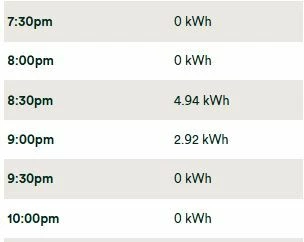
Here is an extract from the table showing my gas usage yesterday evening. As you can see, two values are recorded: 8.30pm and 9pm. If usage is recorded at 8.30pm, does this show what has been used between 8pm and 8.30pm or what has been used between 8.30pm and 9pm?

Best answer by Bendog

Today I have agreed to close the case I raised regarding the issue of missing data and the “data shift” issues. This is an extract from the reply I received from Dawn at OVO. 

Thank you for highlighting the "data shift" where your heating usage, which you observe coming on at 6:30 am, is recorded in the 6:00 am half-hourly slot. This is a known aspect of how smart meters and the data network report usage. The meter records consumption in a given half-hour period (e.g., 6:00:00 to 6:29:59) and then transmits that total. Depending on the exact timing of the meter reading and data processing, usage that begins at 6:30 am often falls into the total for the preceding 6:00 am slot. This inherent delay can indeed make precise real-time management of usage for specific initiatives challenging, and we appreciate your feedback on this.”

As you can see, OVO acknowledge this is a “known issue”. Knowing this, I wonder how and why it was decided to offer a “time of use” initiative for gas users. Earlier in the email, I was told that any missing data is a DCC issue. I still wonder why almost all of my missing data occurs at the same time. 

51 replies

Firedog
Super User
Forum|alt.badge.img+7
  • Super User
  • October 29, 2025

Only someone with a smart gas meter can tell you that, and I’m not. ​@Nukecad is, so I’m sure he’ll be along shortly.

I can say that for electricity, the meter operates on a bucket principle: it starts filling up, and then 30 minutes later it’s weighed. The weight (in fact the quantity of kWh used in that period) is stored along with the current time stamp, and a new bucket starts filling up. So an entry in the datastore labelled 20:30 indicates the amount recorded from 20:00 to 20:30. OVO then choose to manipulate these figures, labelling and reporting that same entry’s quantity with a time stamp 30 minutes earlier than that recorded.

@Nukecad will be able to confirm or refute whether a quantity of gas displayed with a time stamp of 20:30 passed through the gas meter in the period 20:00-20:30 or 20:30-21:00. You could also do your own experiments to find out, by taking meter readings at the beginning and end of a 30-minute period and consuming a ~known large volume of gas during that period. 


Forum|alt.badge.img+1
  • Author
  • Rank 8
  • October 29, 2025

The reason that I am asking is to try to work out when I should heat up my hot water tank in order to take advantage ot the 9pm to 11pm slot I have booked for next week for the “winter free heating help initiative”. Last night, we set the gas to heat up the boiler from 9pm to 10pm and these are the values that were recorded. So which values will OVO use to record my usage during the time slot? I am SO confused!!


Nukecad
Super User
Forum|alt.badge.img+4
  • Super User
  • October 29, 2025

The time is the Start of the half hour period.

For example my gas boiler timer is set to be off all night and fire up at 7 in the morning so I see this as it starts burning gas at 7:00am:


Nukecad
Super User
Forum|alt.badge.img+4
  • Super User
  • October 29, 2025

The reason that I am asking is to try to work out when I should heat up my hot water tank in order to take advantage ot the 9pm to 11pm slot I have booked for next week for the “winter free heating help initiative”. 

Ah, i see.

It is free gas during the two hours that you have booked (up to 5kWh free in each of the 2-hours) - So to take advantage you have to use the gas during those hours.

Which in your case would be to heat the water tank on that day between the 9pm to 11pm that you have booked.

Using gas at any other time than the 2-hours that you have booked will be charged as normal.


Forum|alt.badge.img+1
  • Author
  • Rank 8
  • October 29, 2025

The reason that I am asking is to try to work out when I should heat up my hot water tank in order to take advantage ot the 9pm to 11pm slot I have booked for next week for the “winter free heating help initiative”. 

Ah, i see.

It is free gas during the two hours that you have booked (up to 5kWh free in each of the 2-hours) - So to take advantage you have to use the gas during those hours.

Which in your case would be to heat the water tank on that day between the 9pm to 11pm that you have booked.

Using gas at any other time than the 2-hours that you have booked will be charged as normal.

Last night that is exactly what I did to test out what would happen. I set the water to heat from 9pm to 10pm, but the daily data table records it as having been done between 8.30pm and 9.30pm.  No usage was recorded for any time outside of those two periods. That is the basis for my confusion. Nothing else was using gas at the same time as the heating was switched off in order to make this a “fair test”.


Firedog
Super User
Forum|alt.badge.img+7
  • Super User
  • October 29, 2025

Last night that is exactly what I did to test out what would happen. I set the water to heat from 9pm to 10pm, 
 

Where do you select these times (I know nothing about gas boilers)? Are you sure that the timing device you’re using has migrated from BST to UTC? [It wasn’t until this evening that the MSF radio-controlled clock in my kitchen finally decided to relinquish  summertime until next Spring.]

If that’s all in order, it might be worth doing a couple more similar experiments, varying the start time by 10 or 15 minutes either way. I know it’s tedious having to wait so long for the results, but you may learn something valuable by doing it. 


Nukecad
Super User
Forum|alt.badge.img+4
  • Super User
  • October 30, 2025

 I set the water to heat from 9pm to 10pm, but the daily data table records it as having been done between 8.30pm and 9.30pm.  

THIS HAS BEEN EDITED TO HALF-HOURLY DATA PACKAGES - so some sections quoted in later posts no longer match.

 I do know the cause of that one - because I saw the same thing when I first looked at mine.

I looked into it and decided that it’s to do with the gas meter only sending packages of data at 30 minute intervals.

However that 30 minutes of data doesn’t line up exactly with ‘clock time’.
I believe that it depends on exactly what time the meter was commissioned/ connected to the HAN.

Depending on just what time that was you could get up to 29 minutes of gas usage showing in the previous ½ hour clock period.

So for example if you meter was commissioned/connected at a time such as 13:19 the first packet of data would be sent at 13:49.
The next packet of data will be sent at 14.19, however becauses it started at 13:49 will be shown in the 13:30-14:00 time slot, - even though most of it was actually used after 14:00

When I had my gas heating set to come on at exactly 7:00 i would get a small ‘mysterious’ usage recorded in the 6:30 period. That’s when I went looking for the answer.
 

Changing the boiler start times (mine is a manual timer, but although the on-off is at 15 min intervals I could still set the time in 1 minute intervals) and watching what happened with the ‘6.30’ usage I found a discrepancy of around 6 minutes in ‘boiler time’ to ‘meter data time’.

So let's say that my meter was commissioned at 6 minutes past the half hour.
That would give a 6 minute discrepancy between the meter 1/2 hour data periods and the clock half hour.

Meaning a data period starting at 06:36 would run until 07:06 but would all be reported as being in the 06:30 to O7:00 timeslot.

So when my boiler fired up at 07:00 the first 6 minutes of gas usage were reported as being in the 06:30 to 07:00 timeslot.

(Then when I changed it so that the boiler fired up at 07:15 nothing was reported in the 06:30 to 07:00 timeslot).

As the gas tariff is the same then it isn’t usually a problem exactly when the gas was used.
However with something like the Free Gas offer it becomes a smal thing to factor in.

One thing I would add is that 4.94 kWh for up to 10 minutes of gas usage seems a lot, but I suppose that depends on your meter data to actual clock time offset.


Forum|alt.badge.img+1
  • Author
  • Rank 8
  • October 30, 2025

 I set the water to heat from 9pm to 10pm, but the daily data table records it as having been done between 8.30pm and 9.30pm.  

One thing I would add is that 4.94 kWh for up to 10 minutes of gas usage seems a lot, but I suppose that depends on your boiler.
Which makes me wonder if for some reason your particular gas meter is set to only send packets ever half Hour?

Your explanation makes sense as we have noticed our heating being shown as on in the 6am slot when it is actually set to come on at 6.30am. The boiler is in our garage, so we often cannot hear it in the house.

How can I find out if the meter is set to only send every half hour? I am not sure if the picture of the meter helps.


Firedog
Super User
Forum|alt.badge.img+7
  • Super User
  • October 30, 2025

@Nukecad Thanks for chipping in 🙂
    

I looked into it and decided that it’s to do with the gas meter only sending packages of data at 10 minute intervals.
  

I rather though that routine data transmission was at 30 minute intervals, to prolong battery life. Where did you learn that it’s in fact at 10 minute intervals?

SMETS2 says:

4.5.1 Gas Proxy Function information provision

GSME shall be capable, immediately upon establishment of a Communications Link with a Gas Proxy Function (as set out in Section 4.4.2.3), of providing the Constant  and Operational Data (set out in Sections 4.6.1 and 4.6.5) to that Gas Proxy Function (and with the exception of the Cumulative and Historical Value Store(4.6.5.5) and the Profile Data Log(4.6.5.15), updates of any changes in that data every 30 minutes thereafter).


Nukecad
Super User
Forum|alt.badge.img+4
  • Super User
  • October 30, 2025

@Nukecad Thanks for chipping in 🙂
    

I rather though that routine data transmission was at 30 minute intervals, to prolong battery life. Where did you learn that it’s in fact at 10 minute intervals?

Good question which I don’t have an answer for, so I don’t know why I said 10 minutes.

(However I still have a niggling idea I’ve seen something about the gas meter recording data internally at 10 min intervals but only transmitting that data to the comms hub every 30 mins. Maybe it was an article on ToU tariffs and data granularity??)

I don’t think it changes my (unproven) theory about the meter commisioning time though, it would just mean larger possible offsets/discrepancies, such as that 4.49 kWh.

eg if the meters data ½ hour started at 08:58 then the gas used between 08:58 and 09:28 all get reported as being used in the 08:30-09:00 timeslot on the chart?
I believe that it does work like that.

Lets face it unless the meter fitters are going to stand around waiting to commision meters exactly on the clock half-hour then there will always be variation.
So it’s then a question of allocating the meters half-hour data, to a clock half-hour shown on the charts.

Like I say above normally it’s just technical detail that would make no difference to billing, but for something like the 2-hours Free Gas then it becomes more important to know just what your own gas meter varience/uffset is.

I’ll have to think about it a bit more, but as I’m currently running a fever of over 38 C I’ve not been on top form for a couple of days. (Flu, I had the jab last month so it must be a new strain since they formulated the vaccine).

Edit.
I have thought it through and edited my post above,
However it does not make any difference to my theory about gas meter data offsets to actual clocK time.
It looks as if the Beyond team responsible for the free gas offer may not have considered it either.


Ben_OVO
Community Manager
Forum|alt.badge.img+4
  • Community Manager
  • October 31, 2025

Sorry to hear you’re ill ​@Nukecad, I really hope you start feeling better today and over the weekend.


I have requested an official answer internally to this and will get back to you as soon as I get an answer.


Firedog
Super User
Forum|alt.badge.img+7
  • Super User
  • October 31, 2025


… if the meters data ½ hour started at 08:58 then the gas used between 08:58 and 09:28 all get reported as being used in the 08:30-09:00 timeslot on the chart?
 

I’d be surprised if this were the case.

I know we all have ideas picked up along the way, ready to be trotted out when they seem appropriate, with no clear memory of where they came from and indeed not really knowing whether they’re even correct. One of mine is the notion that when smart electricity meters record usage data, they weigh the bucket at the end of each half-hour to see how much it’s captured. That quantity in kWh (or perhaps Wh) is then salted away along with the time-stamp (mS or even μS since 1 January 1970) at the time of recording. Those retrieving the data then make their own modifications to them before presenting them, e.g. by subtracting 30 minutes from the time-stamp or reducing the kWh figures to one or two places of decimals. 

If this idea is anything like accurate, then I can’t imagine that a smart gas meter would behave differently. It can’t possibly know what volume of gas has passed through it in any half-hour period until that period is over, so it would be to some minds illogical to assign a time-stamp to that volume different from the actual time of recording. 

There are standards laid down in SMETS2 that dictate the precision of clocks within meters and how far they may be allowed to deviate from the one in the comms hub. I think it’s 10 seconds, although if the deviation reaches that, all that happens is that an entry is made in the event log, waiting for some curious tech back at the mothership to notice it.

We really need a metering expert to answer these pressing questions. Let’s hope Ben reaches one.


Sorry to hear you’re not well. It’s probably just Covid, so get well soon 🍇


Forum|alt.badge.img+1
  • Author
  • Rank 8
  • October 31, 2025


eg if the meters data ½ hour started at 08:58 then the gas used between 08:58 and 09:28 all get reported as being used in the 08:30-09:00 timeslot on the chart?
I believe that it does work like that.

I do hope that you will soon feel better.

However, my 3 day experiment appears to support your theory regarding data transmission of gas (See image attached showing screen shots for three successive days and how I changed the set up for boiler usage each day.)

When a similar “Free energy” initiative was offered for electricity, it made sense to ask customers to pick slots that were specifically chosen to be outside of “peak usage” times.

Is that really necessary for gas? The cost if gas to customers does not vary throughout the day. Perhaps picking a day rather than a slot when you will be credited for the cost of 10 kWh of gas would be simpler to administer?

In common with the electricity initiative, it appears that one day is during the week while the other is at the weekend (I suspect Sunday will be the norm) will be the choices to allow those who use more energy at weekend than during the week to benefit most easily.

For a MAXIMUM saving of 63p per week per customer, it seems a rather cumbersome vehicle. Doing it this way will also stop data nerds like me (I have recorded every single day of my electricity and gas usage since my meters were installed in September 2023) from being “rather angry” when my meter fails to send data in specific slots. OVO probably has numerous diagrams that I have sent them over the years regarding problems about this. 


Nukecad
Super User
Forum|alt.badge.img+4
  • Super User
  • November 1, 2025


….,  It can’t possibly know what volume of gas has passed through it in any half-hour period until that period is over, so it would be to some minds illogical to assign a time-stamp to that volume different from the actual time of recording. 

Whilst I agree that the data cannot be available until the end of the period, you do have to remember that we are talking about the presenting of the data to customers.
In which case “This is what you used between ##.00 and ##.30” is the most logical way of presenting it.

It doesn’t alter the fact that there is an offset berween the meters half-hour ‘data-periods’ and the half-hour clock time.

(I’m trying to be careful with terminology and distinguish betweed ‘data-periods’ and ‘clock time’).

So the data recorded at the end of a period is attributed to the clock timeslot at the start of that period.

It happens because with gas smart metering there is a 30 minute granularity of data transmission to the comms hub.
(With electricity smart metering the granularity is 10-15 seconds, so not that significant).

The testing that ​@Bendog has done clearly supports/shows that some gas usage goes indeed get recorded in the previous timeslot to when it was used.

How much will depend on just how much your particular meter’s data-period is offset to the clock half hour.
Each meter will have a different offset, which I believe is set by the time it was comissioned in relation to the clock half-hour.
My own gas meter has about a 6 minute offset, Bendog’s gas meter’s offset is obviously much larger.

PS. It would be nice to come up with a quick, simple way of determining the exact offset for each meter, but with the 30 minute granularity any reasonablr test I can currently think of is going to take hours if not days.


Nukecad
Super User
Forum|alt.badge.img+4
  • Super User
  • November 1, 2025

When a similar “Free energy” initiative was offered for electricity, it made sense to ask customers to pick slots that were specifically chosen to be outside of “peak usage” times.

Is that really necessary for gas? The cost if gas to customers does not vary throughout the day. Perhaps picking a day rather than a slot when you will be credited for the cost of 10 kWh of gas would be simpler to administer?

In common with the electricity initiative, it appears that one day is during the week while the other is at the weekend (I suspect Sunday will be the norm) will be the choices to allow those who use more energy at weekend than during the week to benefit most easily.

For a MAXIMUM saving of 63p per week per customer, it seems a rather cumbersome vehicle. Doing it this way will also stop data nerds like me (I have recorded every single day of my electricity and gas usage since my meters were installed in September 2023) from being “rather angry” when my meter fails to send data in specific slots. OVO probably has numerous diagrams that I have sent them over the years regarding problems about this. 


That mirrors my own thinking.

Gas is the same price all day, there are no Peak or Off-peak timings for gas.

So having a scheme/promotion for free gas use in Off-peak periods is somewhat of an odd notion.

In my opinion it shows two things:

  1. Firstly it shows that the Beyond team have not thought things through and just tried to jigger the free electricity offer to gas without realy understanding the differences in tariffs and metering. (OK the metering offset isn’t that well known, but still).
    Probably because:
  2. Supplying gas is a secondary consideration at OVO. (Fair play though, it was considered for this new offer).

PS. This potentially large problem for the “A little help’ scheme, that is the metering offset issue, has been raised with the responsible team at Beyond and we are awaiting their reply.
As it’s now weekend we probably wont hear from them until Monday/Tuesday at least.

I do have an easily implemented and workable solution for them that would suit everybody.
Again Bendog has seen the same solution and touched on it above.


OK it would leave some embarassed faces at Beyond, however as the issue has already been noticed and raised then I expect there is growing embarassment there already.
Better to come clean, than trying to fudge now and probably make things worse.

The Solution:
Simply treat everyone who has signed up the same as electricity only customers, in other words:-
Give everyone who chooses a weekly timeslot the maximum 63p for that timeslot regardless of their actual gas usage.

TBH that was another flaw of the scheme, one that again shows gas being second fiddle at OVO.
Although ostensibly aimed at helping gas customers they would struggle to reach their maximum reward, and of on a fixed tariff would get less than 63p even if they did meet mayimum.
By contrast electricity only custoners automatically get the maximum 63p for simply tapping a couple of buttons.


Nukecad
Super User
Forum|alt.badge.img+4
  • Super User
  • November 1, 2025

@Bendog 

If you havent already then I suggest that you now narrow down your testing by starting the heating at 9.20 and 9.25.
The idea being to see at what point usage stops being recorded in the 8.30-9.00 timeslot.

Once you have narrowed it to 5 minutes then you can take it further and do minute by minute.
From your numbers posted I would expect it to be 9.23 or 9.24.
I’m sure you can follow this (4.94-1.85) / 15 = 0.206 per min and then 4.94 / 0.206 = 23.98 mins

If like me you have a manual flip-the-arm timer that can only be set in 15 minute steps then you can still set the clock itself in 1-minute intervals to achieve the same effect.
eg setting an 'on' time of 9.00 but setting the timer clock a minute slow will mean that the actual time the gas comes on will be 9.01, and so on.


PS Why your chart is showing dashes in the 10:30 pm and 11:00 pm timeslots I have no idea.
I assume that you have looked back to see when it started?


Forum|alt.badge.img+1
  • Author
  • Rank 8
  • November 1, 2025


The Solution:
Simply treat everyone who has signed up the same as electricity only customers, in other words:-
Give everyone who chooses a weekly timeslot the maximum 63p for that timeslot regardless of their actual gas usage.

TBH that was another flaw of the scheme, one that again shows gas being second fiddle at OVO.
Although ostensibly aimed at helping gas customers they would struggle to reach their maximum reward, and of on a dixed tariff would get less than 63p even if they did meet mayimum.
By contrast electricity only custoners automatically hot the maximum 63p for simply tapping a couple of buttons.

Is it really necessary to pick a time slot? The wonderful get-out clause about not getting any credit if the meter fails to send data could also be avoided. As you can see from my experimental data, on two out of three days, it appears that my meter failed to send data in the 10.30pm and 11pm slots. That is, I feel, a little worrying.

The actual description of this initiative reads like it was done by just replacing the word “electricity” with “gas” from the same electricity one. It could even have been produced by AI. 

Unfortunately, this initiative is supposed to start soon. I hope OVO can be persuaded to take on board the problems that I have experienced and react to them.


Nukecad
Super User
Forum|alt.badge.img+4
  • Super User
  • November 1, 2025

Is it really necessary to pick a time slot? 

I don’t see them going for just “Sign up and we’ll give you a 63p credit each week”.

You have to pick/do something otherwise they might just as well give an immedate £6.30 credit to anyone who signs up.

Of course there is also a plan ‘C’.
As there have been no actual timeslots yet they could Cancel the promotion, giving anyone who already picked a slot a 63p credit for it, and think about a different promotion.


Forum|alt.badge.img+1
  • Author
  • Rank 8
  • November 1, 2025

Is it really necessary to pick a time slot? 

I don’t see them going for just “Sign up and we’ll give you a 63p credit each week”.

You have to pick/do something otherwise they might just as well give an immedate £6.30 credit to anyone who signs up.

Of course there is also a plan ‘C’.
As there have been no actual timeslots yet they could Cancel the promotion, giving anyone who already picked a slot a 63p credit for it, and think about a different promotion.

That is why I suggested that picking a day rather than a time slot would work. For instance, the first slot I have signed up to is Wednesday 5th November between 9pm and 11pm. In reality, any time on Wednesday would be OK. 

We are using Hive to control our heating and hot water and I am not sure that we have anything other than being able to pick 15 minute time slots. The missing data does not happen every day. However, I am going to look back to see how often and when it does happen.


Forum|alt.badge.img+1
  • Author
  • Rank 8
  • November 1, 2025

Regarding my missing data slots for my gas usage. I have not bothered to record them in the same way as I have my electricity usage (i.e. every slot for every day since our meters were installed) because I have an electric kiln that I use for firing glass and needed to know how much each different firing program costs. However, I have just looked at what data is being sent (and not sent) from October 1st - 30th as the data for yesterday is not available until much later in the day. As you can see, it is pretty inconsistent and on some days no half hour data is available although total usage and cost is available for those days on the Month tab.


Nukecad
Super User
Forum|alt.badge.img+4
  • Super User
  • November 1, 2025

Mmmm, If the red is the missing data then that’s oddly consistent. It looks too consistent to be coincidental.

Putting it into 24 hour notation those red periods are 23.00 one day and the following half hour,  00.00 the next day.

PS. I’m discounting the readings after the 25th because the change from BST-UTC always screws things up for a while.

It almost looks like something switching on at around midnight and generating a signal/field strong enough to swamp the meters Zigbee signal for a while?
(Your seemingly large 24 min or so meter-data to clock time discrepency may mean it’s happening at exactly midnight?)

Would something switching on around midnight like that make any sense to you?

(Could the glass kiln even be the culprit? It may seem an odd time but I know nothing about how glass may be tempered or annealed so perhaps a midnight heat cycle may be called for).


Forum|alt.badge.img+1
  • Author
  • Rank 8
  • November 1, 2025

Our gas usage via Hive is as follows: Heating (set at various temperatures, dependent on room/area) is on from 6.30am until 11pm each day. We now put the water on when we are about to use it. We discovered that, although the tank appears to be well-lagged, when we had it set to heat up for 30 minutes each day, on days when we were not actually here to use it the cost for doing this was the same as if we had used it. A 30 minute boost allows us to both have a shower with enough left to wash stuff that cannot go in the dishwasher.

On the days when no data was recorded on the Day tab, the Month tab shows that we used 0 kWh of gas. (We were not here to use it). It seems that the system cannot cope with zero usage.

I have not used my electric kiln in the last month. After around 10pm each evening, the only things using power are the tropical fish tank (just filter pump and thermostatically controlled heater, no lights), fridge freezer, my PC and monitor,  one light in the dining room and one in the hallway (both LED). In addition, there may be a phone or my Kindle on charge. At midnight, our electricity usage is around 0.15 kWh on average. 

I intend to start today recording the half hourly data as reported by the Day tab for gas in the same way as I have been doing for electricity. That may give me some clues. Our gas meter is actually in the ground at the front of the house while the electricity meter is on the side of the house. A couple of times in the past, it does not send readings (this has not happened for a while) but they resume if we, physically, wake it up! In order for the meter fitter to install the gas meter, he had to completely reconfigure the piping. He was here for about 4 hours!!


Ben_OVO
Community Manager
Forum|alt.badge.img+4
  • Community Manager
  • November 19, 2025

Afternoon ​@Bendog and sorry this has taken a while.


I’ve had it confirmed that, for example, the half-hourly usage interval labelled 6:30am is the 6:30-7:00 interval.


Hope this helps!


Forum|alt.badge.img+1
  • Author
  • Rank 8
  • November 20, 2025

Afternoon ​@Bendog and sorry this has taken a while.


I’ve had it confirmed that, for example, the half-hourly usage interval labelled 6:30am is the 6:30-7:00 interval.


Hope this helps!

So, when my boiler fires up at 6.30am, any gas usage should be recorded in the 6.30-7.00 interval. This is not what is happening. Our gas is controlled by Hive and is set for heating, when the thermostat or individual room TRVs require it, between 6.30am and 11pm each day. This is an image of an extract of the data recorded on 18th November. 

As you can see, there is usage shown for the 6-6.30am slot. The same thing happened on 16th November.

Slots with no recorded data, not even 0 kWh continue to occur in the same two slots on a random basis.

 The most recent of these were the 10.30 and 11.00 pm slots on November 18th. The previous date this happened was November 15th. As a result of this, it would be impossible for us to choose a 9pm-11pm slot for the new “help with heating initiative” as we could never be certain when the usage was a) going to be recorded at all or b) going to be recorded in the correct slot. This is not what smart meters are advertised as being able to do. They are “sold” to us as making things easier, not as something that customers are expected to have a maths degree to understand (tick) or be willing to gamble on whether, on a particular day, accurate data will actually be recorded. Don’t get me wrong, I would still rather have a smart meter than the old meters it replaced. At the ages of 70 and nearly 74, not having to kneel down on frozen ground to read the old meter each month is wonderful. While the missing slots should not impact the actual cost of our usage, it would be nice to be able to see exactly when our gas usage happens and try to tie this up with what we might be doing at that time. 


Nukecad
Super User
Forum|alt.badge.img+4
  • Super User
  • November 20, 2025

That answer given yesterday by Ben was the answer to your original question in you opening post of this thread:

As you can see, two values are recorded: 8.30pm and 9pm. If usage is recorded at 8.30pm, does this show what has been used between 8pm and 8.30pm or what has been used between 8.30pm and 9pm?


Whilst it is correct as far as it goes, it is not the full story - particularly when it comes to gas metering.

Our discussion has moved on and we have got into discussing the difference in alignment between the meters 30-minute periods and the clock half hour.

Of course you don’t see that on electricty meter the report usage to the coms hub within seconds, only with gas meters that report in 30-minute packages.
30-minute packages that are not exactly aligned with the clock half hour.

@Bendog did you do any testing yet to pin down just how many minutes your gas meter offset is?


Feedback 💬