



I have just read this passage about FACs in another thread: “… my own experience shows that [the future annual consumption figure] is being based on, (or at least being adjusted based on) actual meter readings. I could see my FAC for gas changing (reducing by large amounts) within minutes of submitting a new meter reading.”
This is what is supposed to happen, if I understand the wording here: Usage projection is a figure produced by our billing system, that uses smart meter readings (if available) to project the usage for you over the next year.
We clearly have a two-tier system: an ineffectual one for smart meter customers, and another better one for everyone else. Those who submit manual readings 'see their FAC changing within minutes.' Those of us with smart meters are apparently subject to a system which can take months to adjust the FAC to actual usage, despite having meter readings recorded automatically every day.
My own (electricity only) FAC got stuck last year after a meter adjustment. I was told last year, as was the Ombudsman, that it would all come right after a meter exchange, which happened in September. There was no change to my FAC until mid-November, when it suddenly started falling from its figure of 2.35 times the actual annual usage. This is how it has progressed, from its stubbornly-maintained figure of 2902.9 where it had been since the previous April:
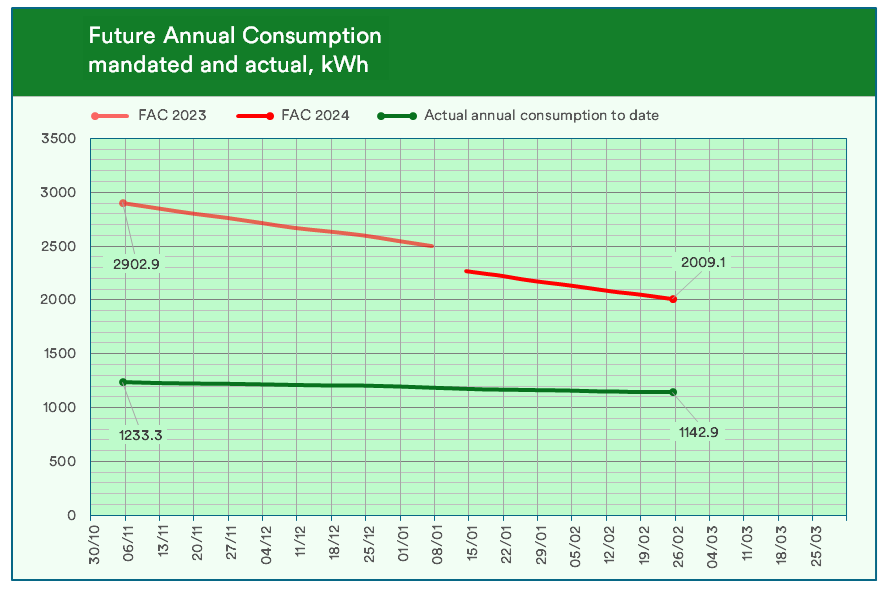
I can't explain the hiatus in early January, unless there was some manual intervention. The figures are updated every Sunday, and occasionally midweek: there have been 16 updates since 5 November. If manual intervention is possible, then there’s no need to rely solely on this clearly flawed system.
I suppose I should be grateful that my FAC is now only 76% higher than my actual consumption for the past year. Excel tells me that if both curves proceed at the same rate, they will eventually meet on 8 August next, just one year after OVO assured the Ombudsman and me that a meter exchange would soon solve the problem.
For those of us with multi-rate tariffs (e.g. Economy 7), there have to be FAC figures for peak and offpeak usage. It’s the ratio between these that determines how economical the tariff is, so it’s also important that this ratio is also accurate. It’s not, for me. Not only is any Direct Debit calculation worthless, but so are projected costs when trying to compare tariffs.
There is something seriously wrong with the FAC determination if it can't adapt more quickly to actual, readily-available meter-confirmed data as Ofgem mandates and as Tim maintains it should.
Best answer by Firedog
Updated on 15/08/25 by Emmanuelle_OVO:
I’ve now (courtesy of @ChristopherS_OVO - thanks!) had some actual figures for the calculation of my FAC, and they’re as clear as an early-morning midstream sample. I learnt a few things, though:
The EAC is indeed allegedly updated to reflect data shared by the supplier. If that sharing fails for some reason - and it clearly did in my case - the EAC reverts to a default value, subsequently adjusted for whatever data have been successfully shared since the fault.
I can’t for the life of me work out where these default values come from. I’m told they are for a ‘typical E7 user’. So no attempt at all to take into account the factors that Uswitch and comparethemarket say are used to match the EAC to the user’s household [“central industry sources including the Retail Energy Code Company … estimate your consumption over the next 12 months based on a number of factors about your property and based on your property’s historical consumption.Your usage comparison is based on your energy usage compared to other households in your postcode region. Your usage will be affected by a number of factors including the size of your home and the number of people who live there.”]
Meter readings are thus used to adjust the EAC from its initial default value, but this can only happen of course if OVO successfully submit readings. This seems to be where the fault is in my case.
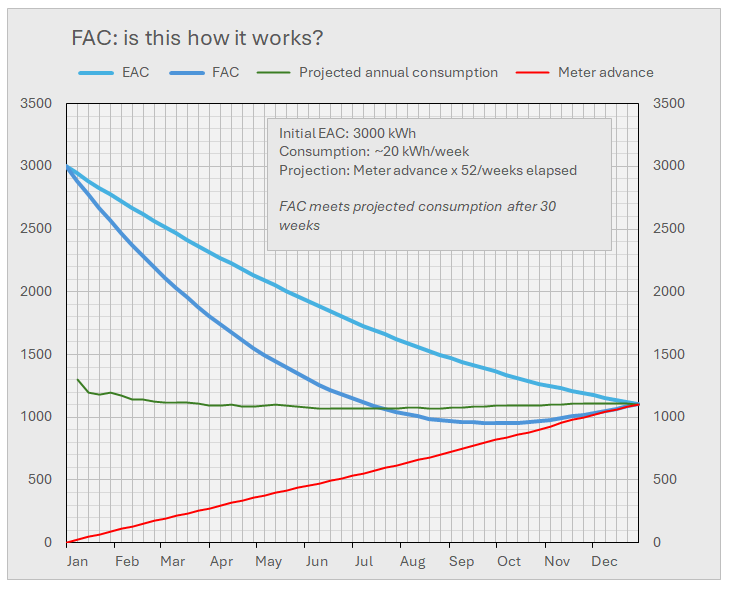
OVO then generates an FAC from the current reading and the current EAC, the proportions of each depending on the time elapsed since Week 0. By Week 52, the EAC proportion will be 0 and the meter advance 100%.
It’s impossible for me to work out how the EAC is adjusted when a reading is submitted, but I suspect it’s a similar arrangement.* This being the case, the FAC should approach parity with the meter advance before the year is up. How long before is a mystery, but it’s not likely to be nine months before.
I can see no reason why OVO can’t generate a more accurate FAC if it’s clear that the EAC is wrong. OK, this would involve manual intervention, which they understandably try to avoid. However, I’m sure it would have taken much less effort on their part just to do this rather than involve at least five different employees in trying (and failing) to explain why it went wrong for me in the first place.
[I just realized after reading this through, though, that this was the sort of approach Fujitsu took when faults appeared in bits of their Post Office Horizon system. I won’t draw any more parallels ...]
* If it were a similar arrangement (the EAC value changing pro rata with the meter advance over a fixed period), then we’d end up with a second-order function which would give a parabolic curve if the actual consumption was lower than expected. Something like this (I know how you all love my pretty charts 🙂):
I have always found OVO very receptive to listening when I have explained my strategy for managing my account. Using the Future Annual Consumption estimates as show on “My Plan”, I usually present my argument in the form of a table. (See image). This has usually been enough. In fact, I have had more difficulty in persuading them that I choose to pay £100 per month rather than the minimum monthly payment suggested in the annoying little box because I want to be able to choose to be warm in the winter!! I will be 70 in 12 days time and my husband will be 74 in December. We are at home, usually, 24/7. Over the past few years, knowing that we have a fixed income, we have done our best to try to minimise our energy usage in a number of ways. I have been paying £100 per month since January 2024, despite having received a refund of £300 in February 2024 and a further refund of £200 in April 2024.
My estimate was set at £892 a month! I have taken it to the ombudsman.
That sounds painful, especially for someone whose monthly bill usually amounts to £100. What does the Direct Debit calculator give under “Check your monthly minimum payment calculation”? Does this tally with the Future Annual Consumption figures on the Plan page and the current balance? If so, which of these underlying figures is wrong: the FAC or the current balance?
The ombudsman are dealing with our complaint as they were charging us £450, £740 etc a monthly last year. We complained constantly and they finally fitted a smart meter and we use around £100 a month and they say are bills last year were correct, don’t figure!
The ombudsman advised us not to accept any offer from
them as it needs investigating thoroughly. It was going on for 2 years and whenever we put a reading through it would just go back to the a really high price the following month, like our readings were been ignored.
The customer service has been awful and they have threatened to hand our debt to a collection agency even though the ombudsman have advised them they are investigating.
Just used the direct debit calculator and it now saying our minimum payment is £973 a month, so £11800 worth of utilities in a year for a 3 bed house, why are these ridiculous costs not flagged as we use £100 a month and that has been consistent since they fitted the smart meter.
When you log into your OVO account, what do you see for your usage for the year, so far? This is what mine looks like at the moment. As you can see, it shows the cost for electricity and gas and also the kWh use for each fuel. What does yours show?
That is the amount they charged us after our discount as our son has Ulcerative Colitis. We are also out of the house from 7.30 am to 4.30pm daily but on this occasion we were in the US.
@Elwell1624 It’s always best when trying to find out why billing has gone wrong to concentrate on the usage figures - the kWh - rather than the costs - the £. It’s the meter readings that form the basis for all billing, but costs and billed amounts can change for all sorts of reasons - different unit prices, discounts, fines or goodwill payments, for example.
If the DD calculator thinks the account is in debit, the recommended monthly amount will be inflated by 1/6 of the current debt + 1/12 of the annual cost of fuel. We can’t tell whether this is the cause of the ridiculously high DD until you give us some figures to work from.
It rather sounds as if there is a long-standing error, perhaps with a meter reading wrongly recorded or submitted two or three years ago, which led to underestimated charges that are coming back to bite you. So long as your online account shows meter readings from before 2023 and up to now, it should be possible to spot where any error crept in.
……….they have threatened to hand our debt to a collection agency even though the ombudsman have advised them they are investigating.
That’s most likely just standard wording (basically empty threats to make you sit up).
However if it should happen that you do get a letter or letters from Debt Collectors then refer to this article, read and take onboard the information in the first post, particuarly the ‘2 Important Facts’ Then you’ll want link #5 “Letter to you about a debt but you are already disputing that debt with the supplier”
The screenshots you’ve shared show that there was previously a large debt balance, which would have generated the large suggested increase to the Direct Debit, as the aim would have been to clear the debt and get you back into credit, whilst still paying for your usage.
If you’re speaking to OVO about this they should be able to explain to you what happened previously and, as @Firedog has mentioned, whether there was any sort of issue on our side that caused errors in the billing that were rectified down the line.
Let us know when you’ve heard back from our Complaints team about it.