




Answer

Ideal OS2 Weather Sensor Installation

  • August 28, 2025
  • 8 replies
  • 165 views

George
Carbon Cutter***


Boiler new Aug 2022. Ideal Logic+ Combi C

Thermostat / programmer fitted May 2023. Ideal Halo RF, not wifi connected.

August 2025 weather compensation fitted. Ideal OS2.


Straight forward to install the sensor and two core cable connected and run into the house for connection to the boiler. Cable run approximately 5m. Terminal on the sensor are not marked and the boiler weather compensation terminals likewise not marked. All connections made as per the Ideal instructions sheet.

Boiler switched on and nothing untoward. The instructions state that the house temperature is now controlled using the boiler flow temperature dial. Turn it clockwise to raise the house temp and anticlockwise to lower the house temp. The screen should indicate a range of 5℃ minimum and 30℃ maximum.

When I move the dial it performs as it always did and shows a temperature of the water  flow. Minimum 30℃ and maximum set by myself of 64℃. Previously the minimum flow temperature was 40°C.

Checked my connections and all OK. However there was a link between the opentherm terminals. I believe this was fitted by the manufacturers. I removed this link.

Time to trail the system but first I set the weather compensation curve to 15. These seem to be arbitary numbers between 0 and 40. It was 18.

The stat was reading 21℃ and the set point increased to fire the boiler. The flow was set at 45℃ and the pump speed was switched to 100%. As the water temp increased it stabilised at 34℃ and sat there. The boiler had modulated down. The one thing I should have checked was the fan speed giving me an idea of the fire rate.

Previous experience was when trying to run the boiler at a flow of 40℃ the flame/fan speed would not reduce less than 25% and the flow would reach the set point and shut off the flame. On this occasion the flow and return would sit there at 34/25℃. No doubt if I let it run longer it would have shut down.

It looks to me that the boiler is being controlled by the weather sensor by modulating down more than I would normally see. What I normally see is the opentherm modulating down to a fan speed of 25% and the pump speed slow to 70% and the stat shut down the boiler at about 0.3℃ above the set point.

The house is a three bed Edwardian Terrace. The loft is well insulated and the windows double glazed sash type. These are pretty airtight. I’ve always tolerated a few draughts to allow the house to breathe.

My question is has anyone come across this before? The situation is the boiler is working fine but not as described in the instructions that came with the sensor or what I’ve read on line. As said above I removed the Opentherm link but there’s no mention of this in the instructions. Everything I’ve read says that the sensor will control the boiler but the thermostat still has control.

Best answer by George

Thanks all.

I’ll copy and paste my notes after this. For years I’d been running the boiler at very near the boiler max. I should have know better as for years I was responsable for the ships fuel consumption. When my previous boiler was serviced in 2021 the engineer said it would heat the house no problem at 69º. This started me on my quest to discover more. Cut a story short I have totally changed the heating system radiators. I renewed them all in 1997 when I bought the house so they had served me well. 

Here’s my notes of today.


29th August 2025

On a second attempt to find out what was happening I discovered the following.

The boiler flow was still at 45℃ and the pump modulation off. The Halo stat was used to start the boiler and fired it up with a 2º load. Once started the boiler was modulating down and the flow settled again around the 34º mark and the fan speed was 25% which is the minimum. This was OK but again not as described in the instructions.

Decided to change the Halo for the original mechanical clock supplied with the boiler. My thinking was to take the Halo out the game so the weather comp sensor would be the sole method of achieving the correct house temperature.

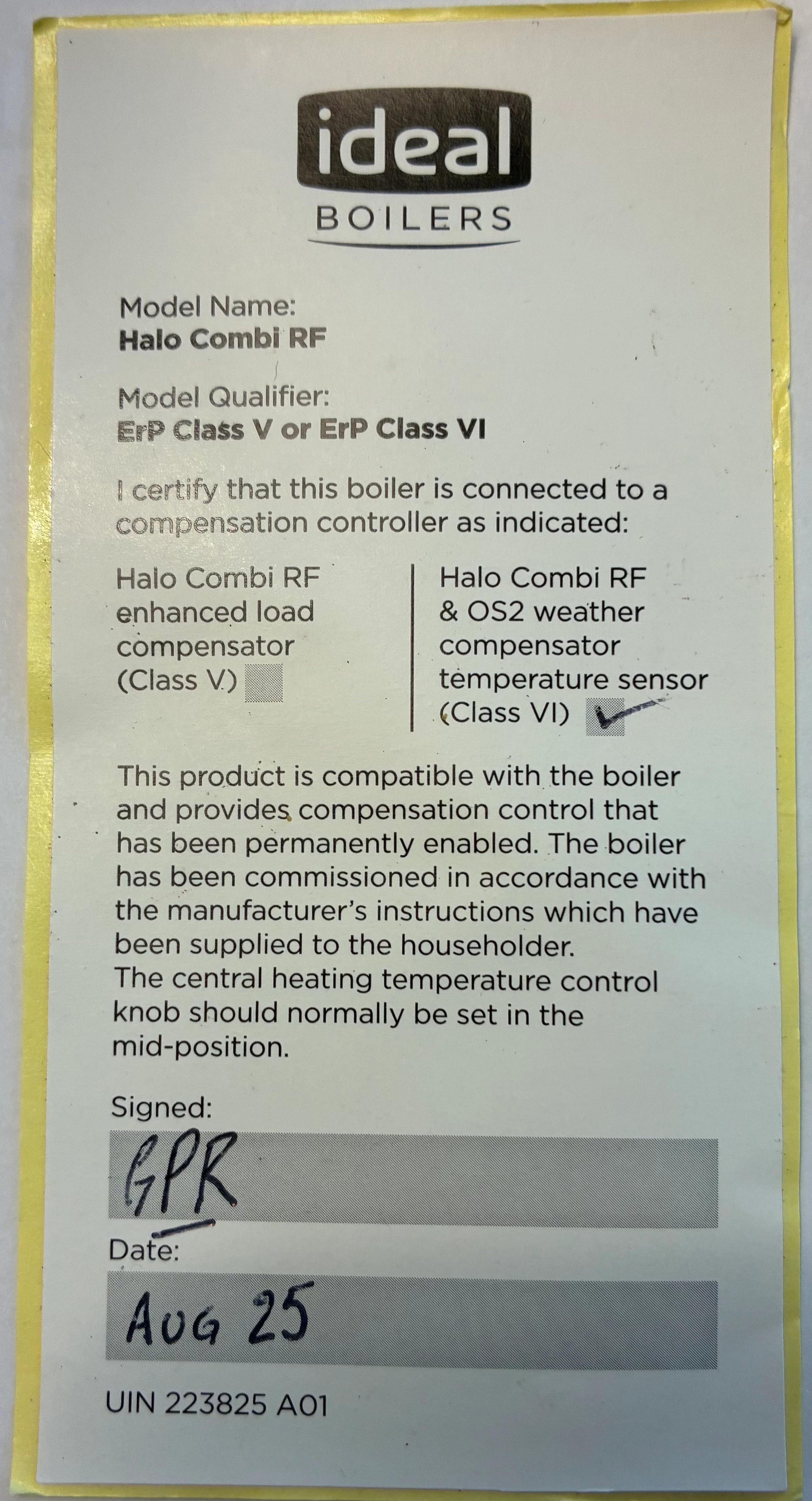
In the retained Halo box containing the mechanical clock was a label that I should have stuck to the boiler when the Halo was fitted. Not fitted as I’m not a registered installer. The label had two tick boxes for the installer to indicate the set up. One option was for the Halo alone and I assume the mechanical clock. The second was the Halo fitted plus an OS2 weather compensation sensor. The instruction for this scenario was to position the boiler flow dial indicator in mid position. The maximum boiler temperature was set to 80º and the mid point on the screen indicated 51º.

It also said the boiler was permanently wired for load compensation.

There’s an image after this.


Next steps. Return the weather compensation link to the boiler terminals and try again. When I’m happy with the set up I think I will reduce the maximum temperature to 70º. Even in the coldest ambient temperature last winter the highest flow temperature I set manually was 62º.


Link has been fitted.

Maximum boiler flow temperature set to 70º and the dial set to mid position and reads 50º on the screen.

Pump modulation switched to on although may need to set to 100% at lower flow temperature to prevent the boiler short cycling.  We’ll see.

All that needs to be done now is to set the weather curve later in the year one the temperature drops. At present its quite low.


I now feel confident this arrangement is as intended by Ideal Boilers.


8 replies

Chris_OVO
Community Manager
Forum|alt.badge.img
  • Community Manager
  • August 29, 2025

Hey ​@George,


Thank you for your great question! I must admit that it’s not a topic I’m entirely familiar with, but I'll do my best to help by providing some resources and tagging a few members who may have valuable insights.


I found a video during my research that covers both the installation and operation of the boiler and the weather compensation kit. I believe it could be quite informative.


Additionally, I previously spoke with ​@hotfigs, who was asking about Tado and Opentherm. They might have some relevant advice to share as well.


Lastly, I’ll tag ​@Peter E and ​@BPLightlog, who have extensive knowledge of the forum and are much more knowledgeable than I am. I hope they can provide some useful insights!


I hope this information helps you find the answers you need!


BPLightlog
Plan Zero Hero
Forum|alt.badge.img+5
  • Plan Zero Hero
  • August 29, 2025

Although I’m not familiar with the boiler you mention, I do know that you can set ‘pure’ weather compensation or WC plus thermostat control. 
Without looking into how you’re set up, I’m not sure how the connections and links alter this.

I'm also not familiar with the sensor you mention but given your description, I presume there’s an outdoor device which feeds back to the boiler - I say this because some WC setups rely on an internet weather feed.

Peter might have some more insight on this


George
Carbon Cutter***
  • Author
  • Carbon Cutter***
  • August 29, 2025

@Chris_OVO 

Thanks for getting back. I’m pretty sure I’ve got it sussed. With forty years engineering at sea I’ve often been in the position of fixing it or calling a tug! Never had to call a tug!

When I’m sorted I’ll post my findings, probably later today, but as ​@BPLightlog says there are set ups where a system has WC that is controlled by a stat. I think this is one such setup as I could see the WC setting the flow temperature but I was starting and stopping the boiler with the stat.


Peter E
Plan Zero Hero
Forum|alt.badge.img+1
  • Plan Zero Hero
  • August 29, 2025

Unfortunately I’m completely out of my depth on this one but I’ll hang around to see if I can add anything to the query and I’ll do a trawl to see if anything pops up. Hopefully not a sea mine.


Peter


Chris_OVO
Community Manager
Forum|alt.badge.img
  • Community Manager
  • August 29, 2025

Hey ​@George,


The never calling a tug trend continues! 


If you could post your finding, that would be really helpful. We don’t have much content about your setup, and it could be helpful to others in a similar position. 


Peter E
Plan Zero Hero
Forum|alt.badge.img+1
  • Plan Zero Hero
  • August 29, 2025

Although I’m not familiar with the boiler you mention, I do know that you can set ‘pure’ weather compensation or WC plus thermostat control. 
Without looking into how you’re set up, I’m not sure how the connections and links alter this.

I'm also not familiar with the sensor you mention but given your description, I presume there’s an outdoor device which feeds back to the boiler - I say this because some WC setups rely on an internet weather feed.

Peter might have some more insight on this

My take would be the you seem to be a pretty much switched on guy in terms of dealing with these things so my recommendation is to let it settle down and see what it does. One of the problems of trying to fix heating systems is that the weather at the moment is not going to give you any realistic conditions to test it against. When we get the colder weather (please - not yet!) then you can see how it reacts to that. Weather compensation should pretty much control the temperature of the house independent of the thermostat because the rate the house loses heat is dependent on temperature so as it gets colder outside (assuming your weather compensation is not in sunlight at any point) then it should be able to adjust the boiler to get the heat output to the correct level even before the thermostat has to exert any control.


The other thing is that modern boilers come with the intelligence to learn. My new Vaillant boiler (no weather compensation) has learnt how quickly the house cools down so it comes in just a smidge at the right time to head off a decrease so there are no wild swings in temperature like we had with the old boilers. My boiler is also clever in that as the temperature edges down towards the thermostat set point it runs the radiator pump (with no gas) to sample the average return temperature from all the radiators and then makes a decision to head off the temperature decrease at some point. So, you need to give the intelligence a bit of time to work out what is going on. After that you can tweak the settings slowly to see if that is better or worse. I bit like being at the opticians.


Wait for some colder weather and let it settle down. Change things slowly.


Peter


George
Carbon Cutter***
  • Author
  • Carbon Cutter***
  • Answer
  • August 29, 2025

Thanks all.

I’ll copy and paste my notes after this. For years I’d been running the boiler at very near the boiler max. I should have know better as for years I was responsable for the ships fuel consumption. When my previous boiler was serviced in 2021 the engineer said it would heat the house no problem at 69º. This started me on my quest to discover more. Cut a story short I have totally changed the heating system radiators. I renewed them all in 1997 when I bought the house so they had served me well. 

Here’s my notes of today.


29th August 2025

On a second attempt to find out what was happening I discovered the following.

The boiler flow was still at 45℃ and the pump modulation off. The Halo stat was used to start the boiler and fired it up with a 2º load. Once started the boiler was modulating down and the flow settled again around the 34º mark and the fan speed was 25% which is the minimum. This was OK but again not as described in the instructions.

Decided to change the Halo for the original mechanical clock supplied with the boiler. My thinking was to take the Halo out the game so the weather comp sensor would be the sole method of achieving the correct house temperature.

In the retained Halo box containing the mechanical clock was a label that I should have stuck to the boiler when the Halo was fitted. Not fitted as I’m not a registered installer. The label had two tick boxes for the installer to indicate the set up. One option was for the Halo alone and I assume the mechanical clock. The second was the Halo fitted plus an OS2 weather compensation sensor. The instruction for this scenario was to position the boiler flow dial indicator in mid position. The maximum boiler temperature was set to 80º and the mid point on the screen indicated 51º.

It also said the boiler was permanently wired for load compensation.

There’s an image after this.


Next steps. Return the weather compensation link to the boiler terminals and try again. When I’m happy with the set up I think I will reduce the maximum temperature to 70º. Even in the coldest ambient temperature last winter the highest flow temperature I set manually was 62º.


Link has been fitted.

Maximum boiler flow temperature set to 70º and the dial set to mid position and reads 50º on the screen.

Pump modulation switched to on although may need to set to 100% at lower flow temperature to prevent the boiler short cycling.  We’ll see.

All that needs to be done now is to set the weather curve later in the year one the temperature drops. At present its quite low.


I now feel confident this arrangement is as intended by Ideal Boilers.


Chris_OVO
Community Manager
Forum|alt.badge.img
  • Community Manager
  • August 29, 2025

Hey ​@George,


Thanks again for sharing this with us it’s really helpful. Glad that you’ve managed to find a solution to things and hopefully the advice from the community helped. 


I’ve marked your response as the best answer for now let’s others know at a glance that there’s a solution or what the best advice is. 


Have a great weekend!