

A recent MCS survey on my property - by a reputable installer - came out with the figure of 22kw needed for our heat pump installation. (Our home is a large Edwardian semi-detached and about 350msq.) It’s such a large figure that they have suggested 2 heat pumps of 11kw each working in tandem. I suspect this is excessive and my own data from recorded gas usage would suggest much lower. We use consistently between 31000 and 33000 kWh of gas per year. Using the ‘rule of thumb’ guide and dividing that figure by 2900 would suggest closer to 12kw. I also have data from the coldest day we have had in the house - 15 December 22 when the temperature dropped to -7 all day in a cold snap. On that day we used 375 kWh of gas which divided by 24 hours would still come in under 16kw. We usually keep our house at a comfortable 19C which is fine for us but I know the survey factors in warmer temperatures. Nevertheless the discrepancy seems considerable. Am I missing something? Would welcome comments from those that have experienced a similar issue.

- Forum
- Green tech & greener living
- Home and heating
- Do MCS surveys for heatpumps over estimate your requirements?

Do MCS surveys for heatpumps over estimate your requirements?

- March 26, 2026
- 14 replies
- 135 views
14 replies
- Newcomer
- March 27, 2026
Hi,
I live in a 1950 airey house and it's around 900 square feet in size and also have my house temperature around 19 degrees, I had a survey done by a green home grants appointed surveyor back in 2021 and had a Vaillant aroTHERM Plus 10kW VWL 105/6 fitted, a must for me and the boss (the wife) was to have enough water storage for a full bath tub of hot water, before getting the A.S.H.P I had my house cladded, fitted new windows and doors, as well as having on a new roof, in 2024 I got a grant to have solar panels fitted (6) and my loft boarded out, my house is electric only, saves on gas standing charge, and with all the improvements my house has a "B" EPC rating and my annual electricity consumption is 3885 kwr per year 😊
I would ask for more quotes to see if they agree with your calculations.
I hope you sort it.
- Community Manager
- March 27, 2026
Hey
Welcome to the community! It’s fantastic to see you diving in and reaching out for advice and support. To help you connect better, I’ll tag some of our friendly heatpump members who've been active recently; you can spot them by their heatpump badge, like Johnr64's above! I've also moved your question to our Home and Heating category to make it easier for you to find. Enjoy exploring!
- Super User
- March 27, 2026
Hi
One thing that is often said by the surveyor or installation company is that they need to consider heating requirements for the property and not the individual/current owner. This appears to be something in the terms from the government grant such that any future ownership would not suggest that the heating system is inadequate. While this might have some truth to it, it does not help with the impression of over specification. This is also why they often won’t consider your submission of historic heat energy as covering the needs of the property.
It is a difficult situation as an over specified system can be inefficient .. something you definitely do not want for a heat pump.
Many get different surveys which can offer significant different results and this is a path often chosen in this situation, until you are more comfortable with the design and specification.
- Super User
- March 27, 2026
I completely agree with the oversizing issue but it's the rules. When Heat Geeks arrived to do a survey the guy looked at the property and said this looks to be a 5kW heat pump from everything I can see. However, after doing the survey he said it is just over 5kW so under the rules I have to fit the next size up at 7kW. There are several problems with that. With a 7kW HP he had to add additional pipes to get the volume flow which added (I guess) about £2k to the costs, including scrapping all my new radiators which worked fine with gas. Another problem is that the now oversized HP would cycle more (and lower the COP) because it's more powerful than it needs to be, even for the very lowest temperatures (-2C) that it was specified to work at. And winter temperatures are not as low as they used to be and getting warmer. With a £16k price tag I said no even though I qualified for the BUS grant of £7.5k.
I replaced my gas boiler for £3k and DIY fitted an A2AHP for £800. This year the HP replaced 88% of the gas I would have used so I cut my gas use almost as much as I would have done if I had spent £8,500 on an ASHP. Hot water is from an immersion heater.
For a more practical A2AHP consider a split unit that feeds heat into the upstairs and downstairs parts of the house. Open Plan works better than small rooms.
Peter
Adding: My house is four bedroom detached with a C rating and in the last 12 months I've used 1,500kWh for the HP (4,800 kWh heat) and 500kWh for gas. The A2AHP is currently running at 300W (960W) where a 7kW HP would probably be cycling on and off.
- Super User
- March 27, 2026
If you have a little time to spare, and a tape measure, you can do your own assessment of your house's heat loss using a free account at Heat Punk. This is useful in highlighting problems, but it can also help in indicating where heat is being lost, and also for assessing potential home insulation improvements and their impact on the final design.
As
One of the reasons I have not progressed with a heat pump installation is this apparent rigid requirement to design for the property and the environment and not for the occupiers. As an example we currently have a 160l hot water tank, however guidelines suggest at least 250l, or even 300l. However only a few of the 200l tanks would fit in the available space. none of the larger ones would fit. We have operated the existing tank at below 50°C for the last 3 years, heating for just 30 minutes morning and evening from our gas boiler and have never run out of hot water. I have also operated the heating in what can best be described as "manual weather compensation". I manually set the boiler flow temperature based on the outside temperature (20°C - outside)* 2.5. MCS calculations indicate that at least three of the rooms won't reach temperature; in reality they all have.
Another issue is the environment/weather factors. Take the degree day data used to calculate annual energy usage:-
EGNX (East Midlands 2015-20) 2174
Nottingham 1981-2000 2263
Nottingham 2001-2020 2067
Nottingham +1.5°C warming 1965
My Local Data (15.5°C) 1826
So my measured data is around 20% less than the "agreed" data. Given that data seems to suggest we are already close to 1.5°C of global warming why not use more relaxed data?
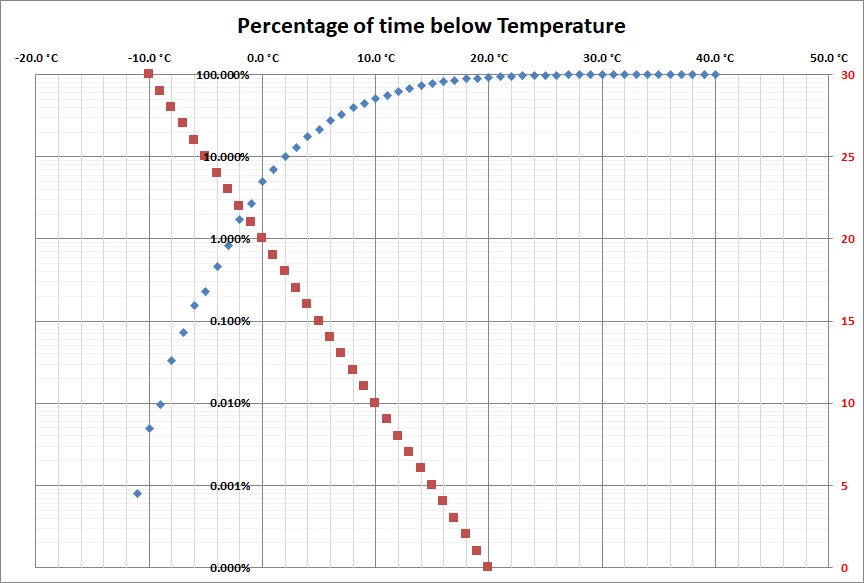
Systems are also designed for a nominal minimum outside temperature, usually around -3°C. My home data suggests around 0.8% of the year will be below -3°C, 0.5% below -4°C, and 0.2% below -6°C. So a system designed for -3°C will still have times when it would not cope, so why not accept that some form of supplementary heating may be required? As an aside fitting a larger water tank also results in a longer period when heating is off-line while the water re-heats.
Bit of a rant but I just have this feeling that the standards don't best match the requirements of the home owner.
- Super User
- March 27, 2026
I don't know what the answer is.
Peter
- Author
- Rank 1
- March 27, 2026
Thank you all for the above comments - good to know at least that I wasn’t getting it wrong. I do see the logic in future proofing the property in case another owner wants it warmer, hence the generous, or at least cautious, power calculations. My concerns going forward are two fold: firstly I would have to pay for two heat pumps and greater maintenance charges in future. Secondly, I am insure how efficiently our system would run if it is short-cycling and shutting down too frequently due to being over-powered….
- Super User
- March 28, 2026
My view is that you change a property to suit yourself for the time that you are there. You are it's current caretaker. Not the owner for the whole time that the property exists. Therefore my suggestion is change a property if you have to, to suit you and not what you think a future owner might want. There are two points.
ASHPs are an evolving technology. They are relatively new having been around for only 30 or perhaps 40 years in their current design. There are good and bad units out there, good and bad designers and installers. I rejected my ASHP proposal partly due to arcane MCS rules and consequently expensive due to those rules. I fitted an A2AHP which is a simpler, cheaper, older technology (the design goes back 200 years to the early refrigeration plants) has only two heat exchangers not three, a very simple system design and installation. I've got nothing against heat pumps. They are essential for the future.
The second thing is that if I were looking for a house I would probably screen out houses with ASHPs (1% of properties on average). Simply because of the current immaturity of HP designs (it's still evolving -see Mixer tanks, volumisers, flow rates, glycol frost protection, TRVs, controllability from a non technical person's POV) the lack of expertise in ASHP system design and the pathological contraints (a camel being a horse designed by a committee) imposed by the MCS rules. The MCS rules have recently changed (to include A2AHPs and cooling as well as heating) and they will change again when the government see that its the rules (and the consequential costs) impeding the rate of installations. Screening out properties with ASHPs seems unnecessarily harsh but it reduces the risk of ending up with unwanted high bills because of a system design error which may not become apparent until you start living there and using it in a different way. Compare that with looking at a house with a gas boiler - two questions, how old is it and show me the maintenance service records. Adjust offer price accordingly if necessary.
Sorry that has been a long haul to read but don't get a heat pump to ‘future proof’ for a subsequent owner. You might be doing the opposite. Do it for yourself but choose wisely.
Peter
As a parting comment an A2AHP is cheap enough to install without the BUS grant so you are not bound by the MCS rules and you can do exactly what you want. Get a survey and see what they say. You can keep your gas boiler for the very coldest days (that is the very best use for gas - you use a small amount to help with the heavy lifting on the coldest days when all HPs are least efficient - this heating season for me is 12% of my previous gas use).
- Author
- Rank 1
- March 28, 2026
Have just taken a call from the company that did the survey as it happens. Their senior engineer is keen to visit as a follow-up as they need to clear up some details. The other option is for me to get an air tightness test which if certified they can use that data in the survey I understand. Would be keen to know if anyone has experience of this? Likewise with the cascaded arrangement. Thank you everyone.
- Super User
- March 28, 2026
Hi
A air tightness test is very useful as you can lose a lot of heat through unintended air exchanges (previously called draughts). When its very windy I sometimes go round the house to see if I can detect any obvious draughts (sometimes its something like the sealant has failed around an otherwise good window) and do something about those.
I mostly agreed with my heat survey but they came up with two completely different results for two similar rooms. I think the problem there was he was using a tablet to take a picture of the room to measure it and it got it wrong. He kept on having to retake the picture to try to get it to work. I made a comment back on that but it was never resolved. It significantly over estimated the loss for one room (compared to my survey) which pushed it over the 5kW HP size (even to the surveyor's surprise). As my comments were not even acknowledged let alone resolved I felt that this discredited their survey and it was a major contribution to me rejecting the design at a survey cost of £350. C’est la vie. It was already an uphill struggle to sell the concept of an HP to my wife but she generally accepts my recommendation. We bought an EV five years ago. She wasn't sure. Three weeks after buying it I had difficulty getting it away from her to use it myself so I do have credibility in that area.
You're right. Over specified systems are not efficient and are very costly. A2AHPs come in all sizes up to very large office systems so your house wouldn't be a problem. Knowing nothing about your house perhaps it's possible to get a survey and install a half system that doesn't meet the full requirements. You set the gas thermostat below that of the HP like I do in my house and the HP takes over the heating with the gas topping up as required. It's quick and easy to install (usually). You've not touched the gas heating so that's your fall back as it is with me. That way you can look at the total cost of gas heating vs HP + residual gas and see if it's acceptable. It's a very similar cost in my house with perhaps a slight saving. Split units are more efficient than my very cheap 15,000 BTU (about 3.5kW) monoblock unit (inside the house). Split units are also much quieter as the compressor is outside the house. My recommendation is that you have a look and perhaps speak to a heating engineer for options.
I hope that is a useful avenue of enquiry for you. Best to see all of the available options first. Since fitting my HP I would not go back to purely gas CH anymore. In two years I've gone from ‘Burn Baby Burn’ to ‘Actually we can choose a more intelligent, hybrid solution’ with a heat pump and gas fallback.
Peter
- Author
- Rank 1
- March 28, 2026
- Super User
- March 28, 2026
Thank you
Do let us know how you progress with this as and when it happens as it’s useful to us when we come to give advice on here.
Peter
- Super User
- March 29, 2026
There are arguments against converting the power grid to fully renewables, since planning for the very occasional extended spell of dull windless days requires excessive generation capacity and storage. Maybe it is better to plan to cover for the more typical, say 5% probability period, and leave a few gas fired stations available to cover the shortfall.
The same could be argued for heating. This graph is based upon over half a million temperature readings (taken every 20 minutes) from our back garden. You could size for -10°C, with say a 30kW system, but that has occurred only 0.001% of the time, or 25kW (-5°C , 0.2%), or 20kW (0°C, 5%). Maybe, on the cold days, it is possible to sacrifice heating in some rooms to keep others at temperature, or use (more expensive?) supplementary heating.

We still have our gas fire in the lounge, although it is never used, and a couple of fan heaters just in case the heating fails. Why not allow for these possibilities when performing an assessment?
I think using two heat pumps gives you better turn-down/modulation, more suitable for the majority of cool but not cold days. Or maybe drop to one heat pump and keep the gas boiler in reserve for the really cold spells.
n.b From the graph above temperatures below 5°C only occur around 20% of the time.
- Super User
- March 29, 2026
I couldn’t agree more
As I keep a record of average daily temperatures (the average of the temperature at 6am, 12 midday, 6pm and midnight) from a website which keeps historic weather data and made a table which shows the number of days throughout the year where the temperature was at that interval. I’ve just dumped an image of the table without tarting it up. As you can see there was only one day (near the south coast) during the last heating season where the temperature was -1C up to a maximum of 35 days when it was 10C. Whilst the method may be technically correct to design for the HP to do 100% of the heating it is costly in terms of actually doing that in equipment, effective over-sizing with consequential cycling and loss of COP at higher temperatures. A hybrid heating solution is better. In the US hybrid heating (using ducted air) is very common and you typically run the heat pump down to 0C and you have a gas furnace to help out or take over below that.

Need advice from other members?
Ask your question to our members - they have the experience you're looking for:
Ask our communityLog in to the OVO Forum
No account yet? Create an account
Enter your E-mail address. We'll send you an e-mail with instructions to reset your password.
Scanning file for viruses.
Sorry, we're still checking this file's contents to make sure it's safe to download. Please try again in a few minutes.
OKThis file cannot be downloaded
Sorry, our virus scanner detected that this file isn't safe to download.
OKContact us
Tips & advice
Resources
For business

OVO Energy Ltd, registered office 1 Rivergate Temple Quay Bristol, BS1 6ED, company no. 06890795 registered in England and Wales.
OVO (S) Gas Limited is registered in England and Wales (Company No. 02716495) at 1 Rivergate, Temple Quay, Bristol, BS1 6ED.
OVO (S) Gas Limited is part of OVO Group Ltd