


Solved
Is this connection of Yemen flats electric meters safe?
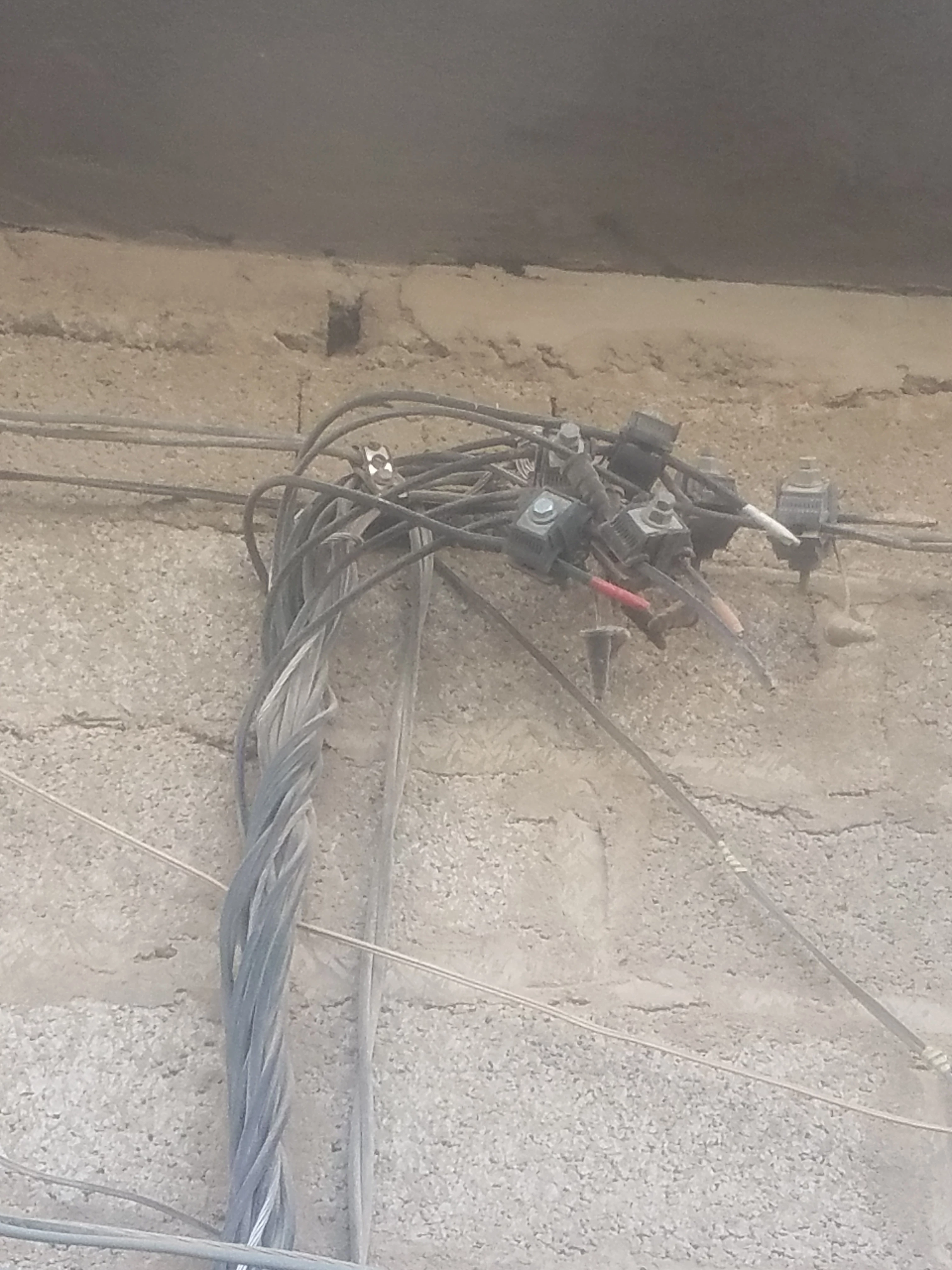
Is this connection for several falts correct or wrong?
Is this connection for several falts correct or wrong?
Ok, FINALLY managed to figure out the cable spaghetti… Man this was complicated…
Just trying to translate the Ministry of Electricity resources into English was a headache not least because Iraq uses Right-To-Left text, unlike the Left-To-Right text here in the UK.
Anyway… I did manage to figure it out enough to get you an answer. But I will admit that it’s pushing my understanding pretty hard as we’re not used to foreign setups like this one.
To give you a straight answer: No, this setup is not safe. In fact, by UK safety standards (which is what we specialise in on this forum), this would be considered a "Category A" immediate hazard.
To answer your question about what you are looking at:
The "Bird's Nest": This is a chaotic junction of "Live" and "Neutral" feeds. It appears to be a mix of official state power and potentially private generator lines all spliced together using IPCs (Insulation Piercing Connectors). The state supply from the Ministry of Electricity (MoE) is cheap, but also known to be unstable and only run for limited hours - the private generators are expensive but cover the remaining hours (and they literally are on street corners run by private individuals). Some of the wires are from the state supply, others from the private generators - but they all converge at the same point, hence the bird’s nest.
The Hazard: Because these wires are bunched together without "cleating" (proper supports), the weight of the cables is pulling on the connections. This leads to arcing—where electricity jumps through the air—creating temperatures hotter than the sun. This is a massive fire risk to the building.
Exposed Live Parts: In your close-up photos, there are exposed metal bolts that are likely carrying 230V. Touching these, or even getting a metal ladder/tool near them, could result in a fatal electric shock or an "Arc Flash" explosion. Even touching the wall they’re on could shock you if it’s damp/wet for any reason.
The Meters: You have a mix of standard "Post-Paid" (Red label) and "Pre-Paid" (Yellow label) electronic meters. Because they are all tied into that same messy "bird's nest," a fault in one neighbour's wire could potentially travel through the cluster and blow the electronics in your meter or cause a fire in your flat.
I also wanted to highlight a specific technical concern regarding how those meters are physically connected. In a standard UK installation, each meter has its own dedicated, isolated feed. Looking at your photos, that is not the case here:
Shared/Common Neutral: It appears that all these meters are sharing a "Common Neutral" line within that cluster. In electrical terms, if that one main neutral wire becomes loose or fails (due to the weight of the "bird's nest"), it can cause a "floating neutral." This can suddenly send 400V through a standard 230V appliance, frying every electronic device in your home instantly.
Daisy-Chaining (Serial Routing): It looks like the "Mains" power enters the first meter and is then "jumped" or daisy-chained to the next one. This means the first set of terminals is carrying the electrical load for multiple households. Those terminals aren't designed for that much current; they will eventually overheat, melt the plastic casing, and potentially start a fire on the external wall.
Zero Isolation: Because the "routing" is so tangled, there is no way to isolated one meter without potentially disturbing the live wires of another. This is why you must never attempt a DIY repair—moving one wire could cause a short-circuit in the wire next to it.
The Blastoise186 Verdict: As this is a UK-based forum, we deal with a very different grid (SMETS2 meters and strict DNO regulations). We cannot advise you on how to fix this because the logic of that "nest" doesn't follow standard engineering rules.
Please do not touch any part of this setup. You need a local professional who has a full Arc Flash Suit and insulated tools. In the UK, we would call the emergency line (105) immediately for this; please find the equivalent emergency contact for the Ministry of Electricity in your area.
Stay safe
No account yet? Create an account
Enter your E-mail address. We'll send you an e-mail with instructions to reset your password.
OVO Energy Ltd, Floor 5, Crescent, Temple Back, Redcliffe, BS1 6EZ, (Company no. 06890795) registered in England and Wales.
OVO (S) Gas Limited is registered in England and Wales (Company No. 02716495) at Floor 5, Crescent, Temple Back, Redcliffe, BS1 6EZ.
OVO (S) Gas Limited is part of OVO Group Ltd