over the past few days, as the Cap on energy is Dropping in Apr 26, Octopus have announce their overnight rate, is dropping from 7p to as low as 3.5p for some customers, but also 5p for others.
do OVO have any plans to drop Anytime from 14p, or are they just going to pocket the extra profit ?
Best answer by divinemadness
I’ve seen people in unofficial OVO CA social media groups posting feedback from customer services with the following statement, so I wouldn’t hold your breath on seeing a reduced CA rate.
“I’ve checked, and there are no plans to lower the unit rate for the Charge Anytime add-on. While your main tariff rates will be adjusted in line with the energy market price cap, the Charge Anytime rate is separate and will not be reduced”
Thank you for sharing your feedback so far. It’s interesting, though not surprising, that everyone has different views on charging their vehicles. I’ve shared this thread internally to ensure we keep the feedback loop open between us and you as our customers.
When we consider Charge Anytime as a whole, we see that it's not the cheapest rate available, but it does offer one of the most flexible options in terms of charging periods for your car.
@woodstok2000 has made some valuable observations about the cost of charging on cheaper rates compared to Charge Anytime and full rate costs. If your usage patterns or behaviors change, it could be argued that Charge Anytime offers better value. However, for those who can charge their cars overnight and commit to shorter charging windows, one could make a case for switching to another supplier for a more cost-effective tariff.
I’d also like to highlight @Colingray83’s comments about customers leaving for cheaper nighttime charging options, which leaves us with “the more expensive daytime charging users.” This is a very interesting point. With all the grid balancing efforts that suppliers are implementing, such as our Power Move challenge or Octopus’s “savings sessions,” it will be intriguing to see if this approach is sustainable in the long term.
Considering the population of EV owners in the UK and their charging behaviors, I would assume that the majority charge their vehicles overnight, which creates significant strain on the grid as everyone pulls energy at the same time. There are already discussions about launching new vehicle-to-grid (V2G) pilot schemes, which I will link below that we'll be keeping a close eye on.
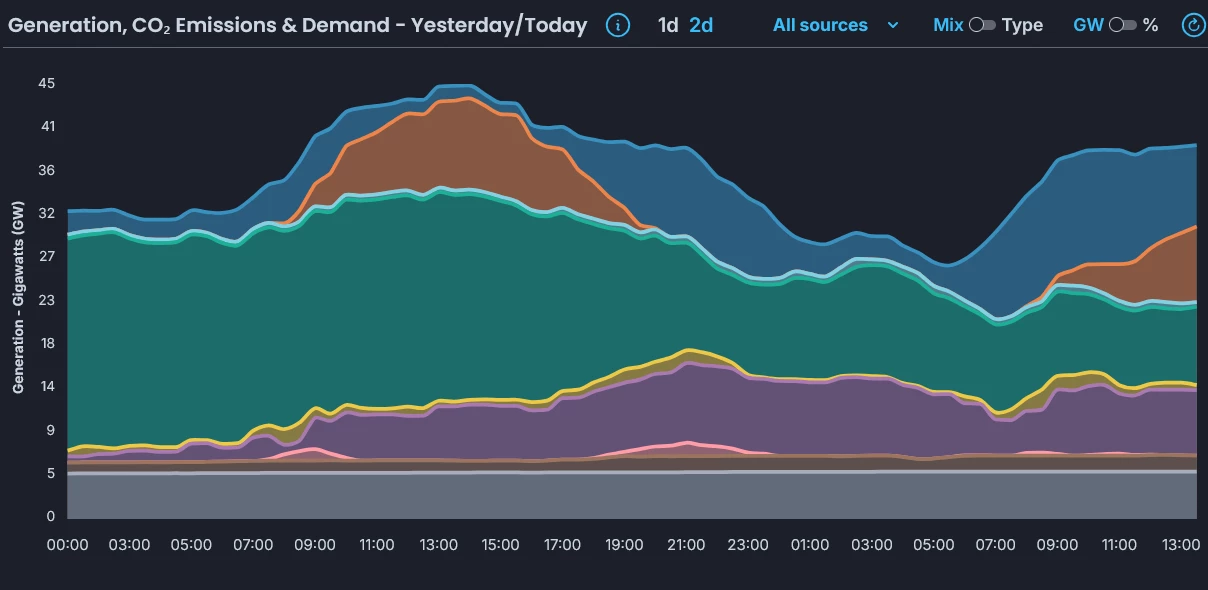
Even with EVs charging the loading on the grid is a lot lower at night. About 15GW less. That means, when there is not a lot of renewables on the grid, that cleaner, cheaper generation plants are used instead of the ‘peaker’ plants brought in at great expense when we need to generate the peak. We are also running the grid a a fraction of what it used to be due to less industrial plant and more efficient energy use. The peak used to be around 60GW if I remember correctly. Yesterday the peak you see below was achieved using only about 1GW of gas powered generation (because of the inertia requirements) resulting in nearly zero wholesale rates.