





A guide to preventing an EVSE (Electric Vehicle Supply Equipment) from discharging a home battery

CONNECT THE EVSE UPSTREAM OF THE SOLAR/BATTERY CT CLAMP – That’s it!
This way the Solar/Battery doesn’t see the power taken by the EVSE unit. Quite often the EVSE is
wired downstream of the Solar/Batter CT clamp from the Consumer Unit so it sees (monitors) the
load from the EVSE, should an EVSE slot be programmed into the period when the battery is set to
discharge into the house load. The example is shown for the Zappi EVSE. Other units may not have
the Solar CT Clamp input/option.
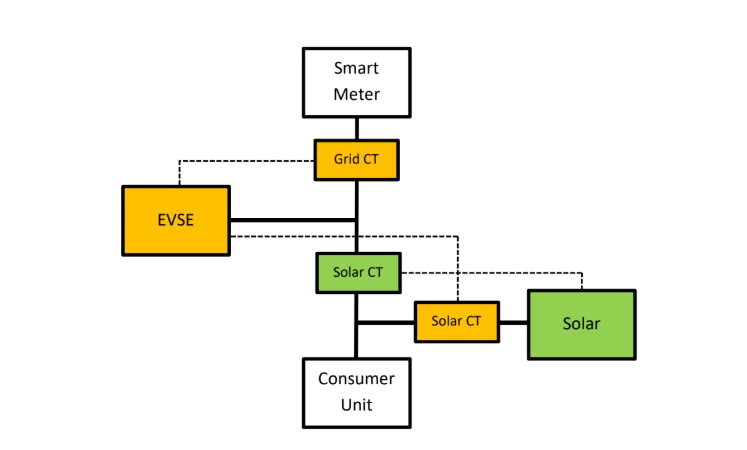
have the Grid CT Clamp.
Downsides
- Export to the grid may now be limited
- The solar/battery system is no longer collecting all your energy usage stats as it can’t see any
load from the EVSE. However, if the EVSE has a Solar/Battery CT Clamp it should be able to
monitor the Solar/Battery energy flow as well.
Other considerations
- Individual EVSEs have different options in their sub-menus to manage battery discharge
without rewiring/moving clamps. As an example the Zappi has a menu to manage battery
discharge because it has a CT Clamp that goes on the power line to the Solar/Battery unit.
- Home Assistant is another way of managing the power flows within the system but needs a
level of technical competence to fit and to set up the sometimes complex options available.
- There is always the possibility that you want the set the system up in a way that is unique in
which case that will be a case of researching possible answers.
Related Links
Zappi (myenergi)
https://support.myenergi.com/hc/en-gb/articles/4716922623633-Hybrid-PV-Battery-Set-up-Avoid-
Draining
Hypervolt
Andersen
https://andersen-ev.com/
No specific advice seems to be available in terms of setting up the EVSE to prevent this but wiring
Indra
https://www.indra.co.uk/support/smart-charging-and-solar/
Very little information available on Solar CT Clamps although the documentation does mention a
Solar mode. The link is next to useless for information.
Searching for information also throws up a lot of videos of various quality so a sample of those might
prove to be useful.