I am a former Shell Energy customer. Under a bit of pressure last year I opted for a fixed energy tariff. The time has come to renew and I am faced with a range of other tariffs variable and fixed, I would appreciate hearing others opinions before I make a decision. For example Did I lose or gain last time by having a fixed tariff? Which of the other tariffs on offer are worth considering if any and why?
@billypop I’m always a bit reluctant to advise on the relative benefits of fixed and variable tariffs. There are just too many variables involved, not least of which is the value placed on knowing just what your costs are likely to be barring major changes in usage.
It’s worth remembering that Standard Variable Tariffs (‘SVT’, the ones subject to Ofgem’s price cap) are calculated on the basis of historical data. The prices to be published in a week’s time reflect changes that have taken place in the last few weeks. On the other hand, fixed rates are worked out according to predictions about costs over the fixed-price term, i.e. the next year or more.
You can see the difference as far as OVO is concerned by looking at the Plans page and comparing the prices of one- and two-year plans and the Extended fixes, which currently run for 15 months. The biggest variation I see is in the standing charge; there are increases in the offing to cover things like the cost of upgrades to the transmission grid and the cost of writing off the bad debt of customers who can’t or won’t pay their bills.
It became obvious a year ago that expanding the scope of the Warm Home Discount would require an increase in everyone’s standing charge to cover the cost. I watched the rates of the Extended Fixed tariff reduce little by little until they turned the corner towards the end of February and began to rise again. I was fortunate enough to latch on to its cheapest version, so that’s what I’m still enjoying even though we’ve seen some of the standing charge increases already. We still don’t know what effect the budget’s much-flaunted “£150 off your energy bill” is going to have. Of course, changes in the standing charge affect customers differently: an increase will hit the low-consumption customer harder than his high-usage neighbour, other things being equal.
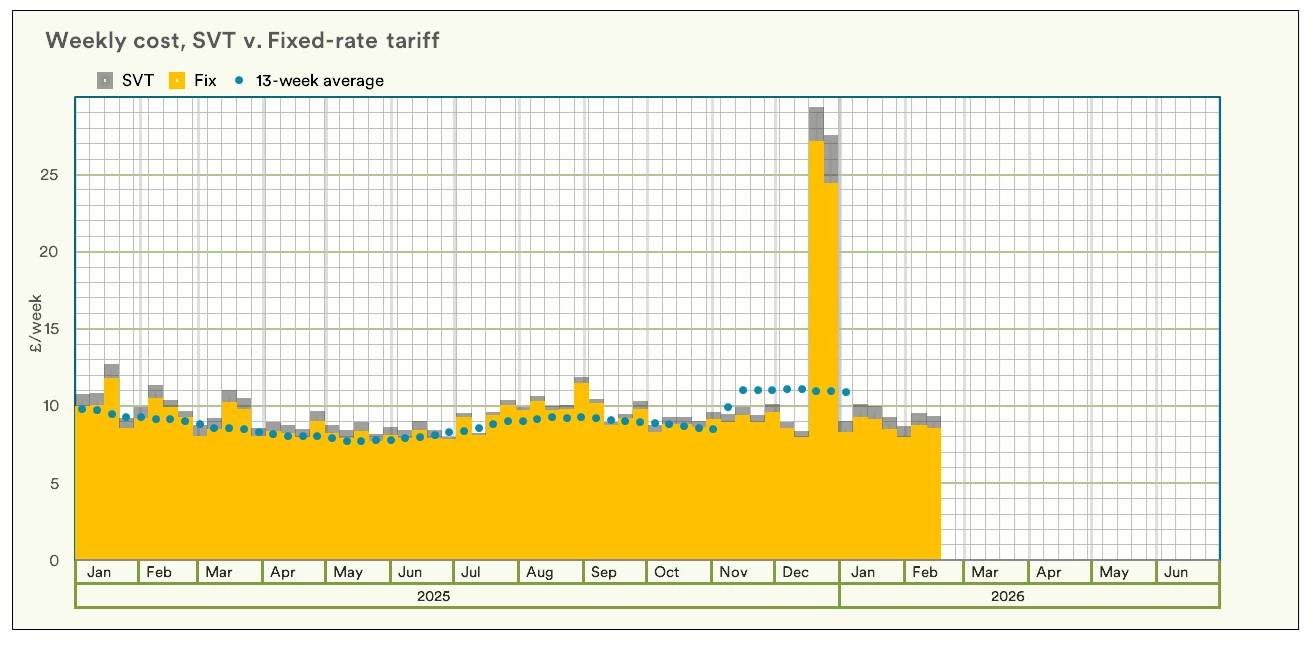
I know @Chris_OVO’s expecting to see one of my pretty graphics, so I won’t disappoint him. I wanted to illustrate the difference between a fixed rate and the SVT as it applied to me, so here goes (click on the image for a bigger picture):
The ‘Fix’ is the plan called Extended Fixed - 27/02/2025 East Midlands region.
A couple of oddities in the chart: the obvious one is towards the end of December, where a surfeit of Christmas spirit persuaded me to turn the electric heating on 25-31 December - lesson learnt, I think. The other is the unseasonal increase from July to September. This is all attributable to OVO fun and games with both the Power Move Flex and the ‘Two Hours of Free Electricity’ schemes. The costs shown in the chart are only unit rate x consumption + standing charge + VAT, so any rebate earned from the schemes doesn’t show.
The ‘saving’ attributable to the fix is the grey bit at the top of each week’s column, Seen like this, it’s not going to be world-shattering, although it does of course add up over time. I saved almost £30 in 2025, £3.60 of that in Christmas week alone.
The grey saving didn’t change much with last March’s fix, and it almost disappeared in the July quarter - but it picked up with October’s price-cap increase and rose even more in the new year. There’s no guessing what will happen in the next two quarters.
Last, I’d point out that other suppliers may have tariffs - fixed or variable - that suit your own usage pattern better than OVO’s offerings. There’s sadly no easy way to find out which, although comparison sites may help. It’s a question of dusting off the slide rule and applying the reluctant grey cells, I’m afraid.
I’m sorry if you’re even less certain now than before …
The following topics may also be of interest here:
Noel | I have no official status; I'm just a volunteer who comes here to help other customers. My gear: Aclara SGM 1416-B Electricity-only E7 meter; Chameleon IHD3-PPMID-AAA | It may look as if I know what I’m talking about, but don’t let that fool you. |
Welcome to the OVO Forum by the way! The name’s Blastoise186 and I’m one of the Forum Volunteers around here - pleased to meet ya! :)
Just so you’re aware, I don’t work for OVO myself but I do get to help out here on the Forum so everything I say is purely as myself.
TBH it’s a bit… Complicated… In general, when it comes to OVO’s Fixed Rate Tariffs the longer deals seem to work out cheaper in the long run as I’ve found with my two year deals. Personally, I can’t recommend Variable unless you want to take a serious gamble every three months - but that’s just me.
Securing energy by zapping security bugs... For that is The Blastoise Way! Remember, I'm just like you - AI Powered Evil Geniuses aren't Staff!
During the pandemic I saw the benefit from choosing a fixed tariff. We had the energy crisis and it saved me some money. But about last three years when the prices are more or less stable, I see that the variable tariff is the cheapest option for me. Probably, it also depends on how long you are the customer of OVO.
Welcome to the community! What a fantastic question to start with! It’s great to see that you’ve already sparked some helpful conversations here. You’ll find that there are many active members who track their energy costs and are eager to share their tips and experiences with you.
Personally, I really like going with a fixed-rate plan. It gives me peace of mind knowing exactly what my unit price will be, and I can lock it in before any price hikes. This way, I can just focus on how much energy I’m using and think about ways to cut back if I need to save a bit. I’ll share a few helpful articles below that might be just what you need to figure out what works best for you!
I’ll tag @Firedog as i’ve seen them give some amazing advice on similar topics before and ask if they’ve got some 2026 reflections to share!
Obviously having no insight as to how energy prices will change in these unstable times, it is a gamble either way, so only wanting to sign up for a year at a time, I am thinking of staying with a fixed tariff. That is after a discussion with an OVO representative of course.
Just out of interest, for years I was originally with SSE, who sold out to Shell Energy who sold out to OVO. Life used to be so simple.
As an EV owner for nearly five years the biggest mistake you can make is spend a lot of time chasing every last penny. If your usage varies, and everyone's does to some extent, then a small change in you total usage and usage pattern will mean you are no longer on the best tariff.
Go to the market, put in accurate data and then look at the recommendations. You can even ask something like ChatGPT where you can put in your last year's data and it can make recommendations but not guaranteed to be the cheapest. I'm with Agile and it suits me for 10k miles a year but you need to be flexible with your usage. If you are a single car the those offering 6 hours 6-7p cheap / 28-32p peak may work for you. For multiple cars then even a fixed rate or SVT may be best. You need to do the calculations or ask the market. Solar and batteries increase the complication beyond calculation. The stark reality is that you might never know if you are on the cheapest tariff especially if you don't spend a lot of time monitoring and comparing.
Peter
Reducing my yearly fossil fuel usage with an EV (-900 litres petrol saving about £950/year), A2AHP (-8,700 kWh gas, cost neutral) and Timed Immersion heater (-1,500 kWh gas, £20/year more expensive but reducing as the gas price goes up)
@billypop I’m always a bit reluctant to advise on the relative benefits of fixed and variable tariffs. There are just too many variables involved, not least of which is the value placed on knowing just what your costs are likely to be barring major changes in usage.
It’s worth remembering that Standard Variable Tariffs (‘SVT’, the ones subject to Ofgem’s price cap) are calculated on the basis of historical data. The prices to be published in a week’s time reflect changes that have taken place in the last few weeks. On the other hand, fixed rates are worked out according to predictions about costs over the fixed-price term, i.e. the next year or more.
You can see the difference as far as OVO is concerned by looking at the Plans page and comparing the prices of one- and two-year plans and the Extended fixes, which currently run for 15 months. The biggest variation I see is in the standing charge; there are increases in the offing to cover things like the cost of upgrades to the transmission grid and the cost of writing off the bad debt of customers who can’t or won’t pay their bills.
It became obvious a year ago that expanding the scope of the Warm Home Discount would require an increase in everyone’s standing charge to cover the cost. I watched the rates of the Extended Fixed tariff reduce little by little until they turned the corner towards the end of February and began to rise again. I was fortunate enough to latch on to its cheapest version, so that’s what I’m still enjoying even though we’ve seen some of the standing charge increases already. We still don’t know what effect the budget’s much-flaunted “£150 off your energy bill” is going to have. Of course, changes in the standing charge affect customers differently: an increase will hit the low-consumption customer harder than his high-usage neighbour, other things being equal.
I know @Chris_OVO’s expecting to see one of my pretty graphics, so I won’t disappoint him. I wanted to illustrate the difference between a fixed rate and the SVT as it applied to me, so here goes (click on the image for a bigger picture):
The ‘Fix’ is the plan called Extended Fixed - 27/02/2025 East Midlands region.
A couple of oddities in the chart: the obvious one is towards the end of December, where a surfeit of Christmas spirit persuaded me to turn the electric heating on 25-31 December - lesson learnt, I think. The other is the unseasonal increase from July to September. This is all attributable to OVO fun and games with both the Power Move Flex and the ‘Two Hours of Free Electricity’ schemes. The costs shown in the chart are only unit rate x consumption + standing charge + VAT, so any rebate earned from the schemes doesn’t show.
The ‘saving’ attributable to the fix is the grey bit at the top of each week’s column, Seen like this, it’s not going to be world-shattering, although it does of course add up over time. I saved almost £30 in 2025, £3.60 of that in Christmas week alone.
The grey saving didn’t change much with last March’s fix, and it almost disappeared in the July quarter - but it picked up with October’s price-cap increase and rose even more in the new year. There’s no guessing what will happen in the next two quarters.
Last, I’d point out that other suppliers may have tariffs - fixed or variable - that suit your own usage pattern better than OVO’s offerings. There’s sadly no easy way to find out which, although comparison sites may help. It’s a question of dusting off the slide rule and applying the reluctant grey cells, I’m afraid.
I’m sorry if you’re even less certain now than before …
The following topics may also be of interest here:
Noel | I have no official status; I'm just a volunteer who comes here to help other customers. My gear: Aclara SGM 1416-B Electricity-only E7 meter; Chameleon IHD3-PPMID-AAA | It may look as if I know what I’m talking about, but don’t let that fool you. |
I think there is one moment that nobody mentioned here. Standing charges could be different to different customers. And they are lower when you are a long time customer (some kind of loyalty?). Again, I can speak only about my own experience. But I have realised that my standing charges went a bit down when nationally they went up. I think I even asked that somewhere on this forum how that could be possible. Also, I always check the fixed tariffs to my current one (it calls Simpler Energy) – difference is usually very small, often not in my favour.
UPD. Just checked my current Simpler Energy tariff with the 2 Year Fixed. Simpler offers lower charges/rates.
Standing Charges vary according to the electricity region you are in. It could go down in your region but go up nationally when the various components of the SC are re-evaluated every quarter. Ofgem often quote the national average Cap and SC to simplify matters. By region it can vary as much as 45p (Southern) to 71p (North Wales and Mersey) per day as an example. It also varies according to the tariff you select as well.
Reducing my yearly fossil fuel usage with an EV (-900 litres petrol saving about £950/year), A2AHP (-8,700 kWh gas, cost neutral) and Timed Immersion heater (-1,500 kWh gas, £20/year more expensive but reducing as the gas price goes up)